← All women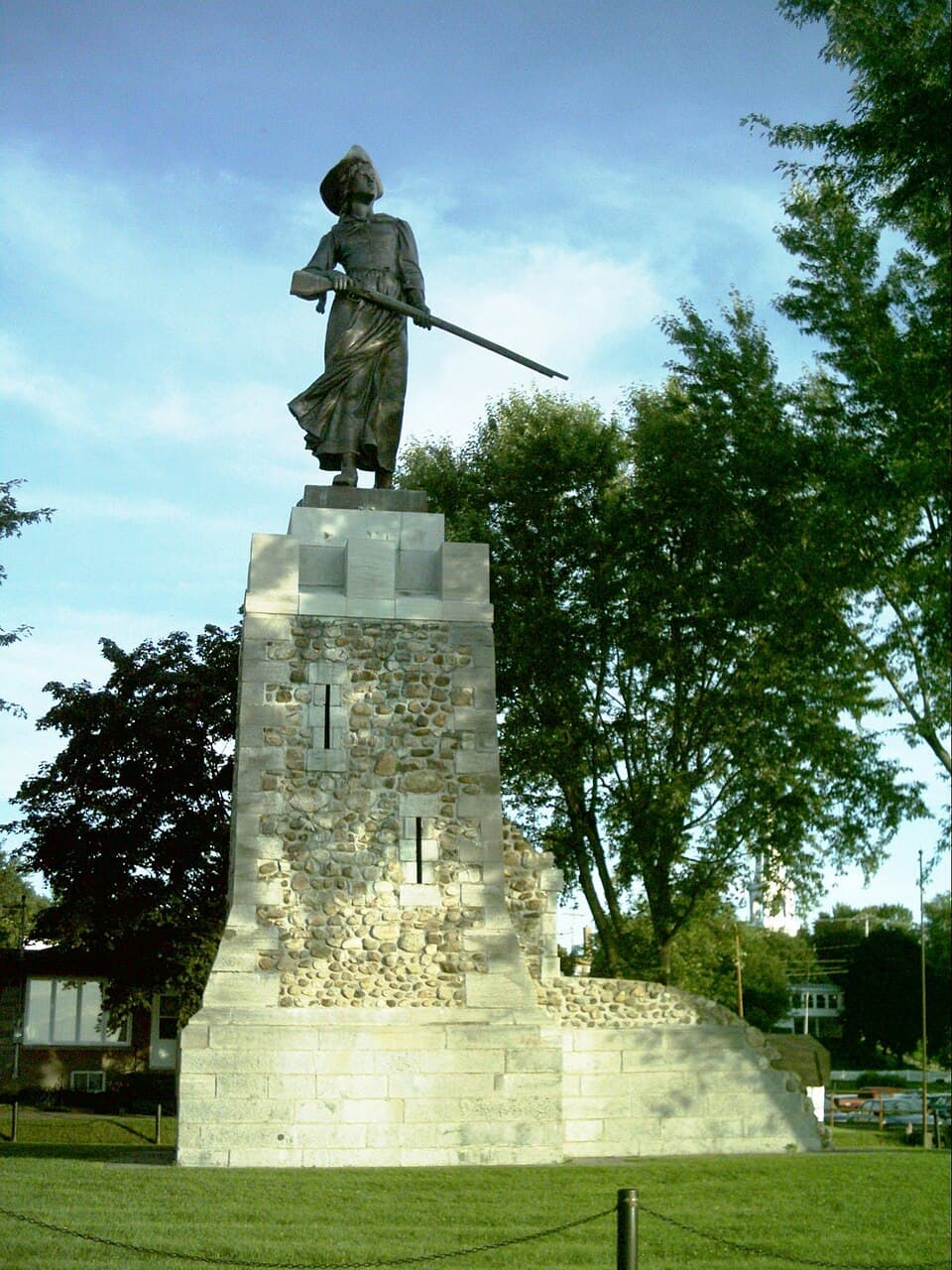
New France (French colonial Canada) · Exploration · Activism
Madeleine Jarret de Verchères
March 29, 1678 – August 8, 1747
Early Life and Family Background
Marie-Madeleine Jarret de Verchères was born on March 29, 1678, at the fortified seigneury of Verchères, on the south shore of the St. Lawrence River, roughly 40 kilometers downstream from Montreal in the colony of New France. She was the fourth of twelve children born to François Jarret de Verchères, a former officer in the famed Carignan-Salières Regiment who had been granted the seigneury of Verchères for his military service, and his wife Marie Perrot.
The Verchères seigneury, like many frontier settlements along the St. Lawrence in the late seventeenth century, existed in a state of near-constant tension with Indigenous nations, particularly the Iroquois Confederacy (Haudenosaunee), whose territories and interests frequently clashed with French colonial expansion and the fur trade. Raids and reprisals between French settlers, their Indigenous allies, and Iroquois warriors were common during this period, part of the broader conflict historians term the Beaver Wars and the later Anglo-French colonial rivalries of the era.
Growing up in this environment, Madeleine and her siblings were raised with an acute awareness of the dangers of frontier life. With her father frequently away on military duties and the fort's garrison often thin, the family — including the women and children — were expected to be capable of defending the settlement if necessary. This upbringing gave Madeleine practical experience with firearms and fortification, knowledge that would prove indispensable in the pivotal event of her life.
The Siege of Fort Verchères, 1692
On October 22, 1692, when Madeleine was fourteen years old, Fort Verchères came under sudden attack by a raiding party of Iroquois warriors. According to her own later written accounts — the primary, though not entirely unbiased, sources for the event — Madeleine was outside the fort's walls near the riverbank when the attack began. She managed to escape capture by narrowly outrunning her pursuers and reaching the safety of the fort.
At the time, most of the adult male defenders, including her father, were away — her father on military business and her mother visiting Montreal. This left the fort defended by only a skeleton crew: an elderly soldier, a handful of frightened settlers, and Madeleine's younger brothers. Rather than surrender to panic, Madeleine reportedly took charge of the situation. She rallied the remaining occupants, distributed weapons, and — in a now-famous detail from her retellings — donned a soldier's cap and grabbed a musket to give the appearance from a distance that the fort had a larger, more capable garrison than it truly did.
She organized watches through the night, kept spirits up among the frightened inhabitants, and fired a cannon to alert nearby settlements and warn off the attackers. The siege, according to her accounts, lasted approximately a week before reinforcements arrived from Montreal, at which point the immediate threat subsided without loss of the fort or, by her account, significant casualties among the defenders.
This episode transformed Madeleine into a celebrated figure of resilience and resourcefulness on the New France frontier. It also placed her name alongside other legendary defenders of Canadian forts, contributing to an enduring narrative tradition of female heroism in colonial settings.
Later Life, Marriage, and Continued Advocacy
In 1706, Madeleine married Thomas-Pierre Tarieu de La Naudière (often recorded as Thomas Tarieu de La Pérade), a military officer who held the seigneury of La Pérade. The couple settled at this seigneury, where Madeleine took an active role in managing estate affairs, a common but demanding responsibility for seigneurial wives in New France, which involved overseeing tenants (censitaires), agricultural production, and local administration.
Madeleine's penchant for decisive action in crisis did not end with her youth. In 1722, she was involved in another notable incident: a flood caused by an ice jam on a nearby river threatened tenants and property at La Pérade, and Madeleine again reportedly organized a rescue effort, demonstrating the same practical courage that had defined her adolescence.
Throughout her adult life, Madeleine repeatedly sought official recognition — and more importantly, financial compensation in the form of pensions — for her actions in 1692. She corresponded with and petitioned French colonial officials and even the royal court, submitting multiple written memoirs recounting the siege of Fort Verchères. Notably, the details of her account evolved and grew more dramatic across these successive retellings, a pattern that has led some modern historians to question the precision of certain details, even while accepting the broad outline of a courageous defense as historically credible.
Historical Scrutiny and the "Myth" of Madeleine de Verchères
Because the primary evidence for the 1692 siege comes largely from Madeleine's own later accounts — written and rewritten over subsequent decades, often with an eye toward securing a pension — historians and biographers, including contributors to the Dictionary of Canadian Biography, have approached her story with a mixture of admiration and critical caution. Contemporary corroborating records are sparse, and some scholars have suggested that the scale of the threat and her role may have been exaggerated in her later narratives.
Nevertheless, even skeptical historians generally accept that some genuine attack occurred and that Madeleine, as a teenage girl, played a meaningful leadership role in the fort's defense during a moment of real danger — an extraordinary circumstance for a person of her age and gender in that era. The debate over the exact truth of her story has itself become part of her historical significance, illustrating how heroic narratives are constructed, embellished, and preserved across generations, particularly regarding women's roles in colonial military history, which were otherwise scarcely documented.
Legacy and Commemoration
Madeleine de Verchères has endured as one of the most iconic female figures of New France's colonial period. Her story has been retold in French-Canadian textbooks, popular histories, and children's literature for generations, often held up as an emblem of youthful courage, resourcefulness, and patriotic duty.
In 1913, a bronze statue of Madeleine — depicted in a dramatic defensive pose, musket in hand — was erected in the town of Verchères, Quebec, which continues to bear her family name. The statue remains a local landmark and a point of civic pride, and the town continues to commemorate her legacy through local heritage initiatives, historical plaques, and educational programming, including material maintained by the municipal government of Verchères.
Her tale has also entered broader Quebecois and Canadian cultural memory as a foundational story of frontier resilience, frequently invoked in discussions of women's contributions to Canadian history, even as modern historiography treats her legend with appropriate nuance regarding self-authored heroic narratives.
Death
Marie-Madeleine Jarret de Verchères died on August 8, 1747, at Chateauguay, near Montreal, at the age of sixty-nine. She left behind a legacy that, more than two centuries later, continues to be studied, retold, and reassessed — a testament to both her remarkable act of youthful bravery and the enduring power of self-crafted historical memory.
Dated achievements
3 indexed.
- Mar291678Science
Birth of Marie-Madeleine Jarret de Verchères
Born at Fort Verchères, New France, into a military family that would shape her later heroism.
View details Dictionary of Canadian Biography - Oct221692Exploration
Defends Fort Verchères against Iroquois attack
At age 14, Madeleine de Verchères organized the defense of her family's fort during a surprise Iroquois raid, becoming a celebrated heroine of New France.