← All women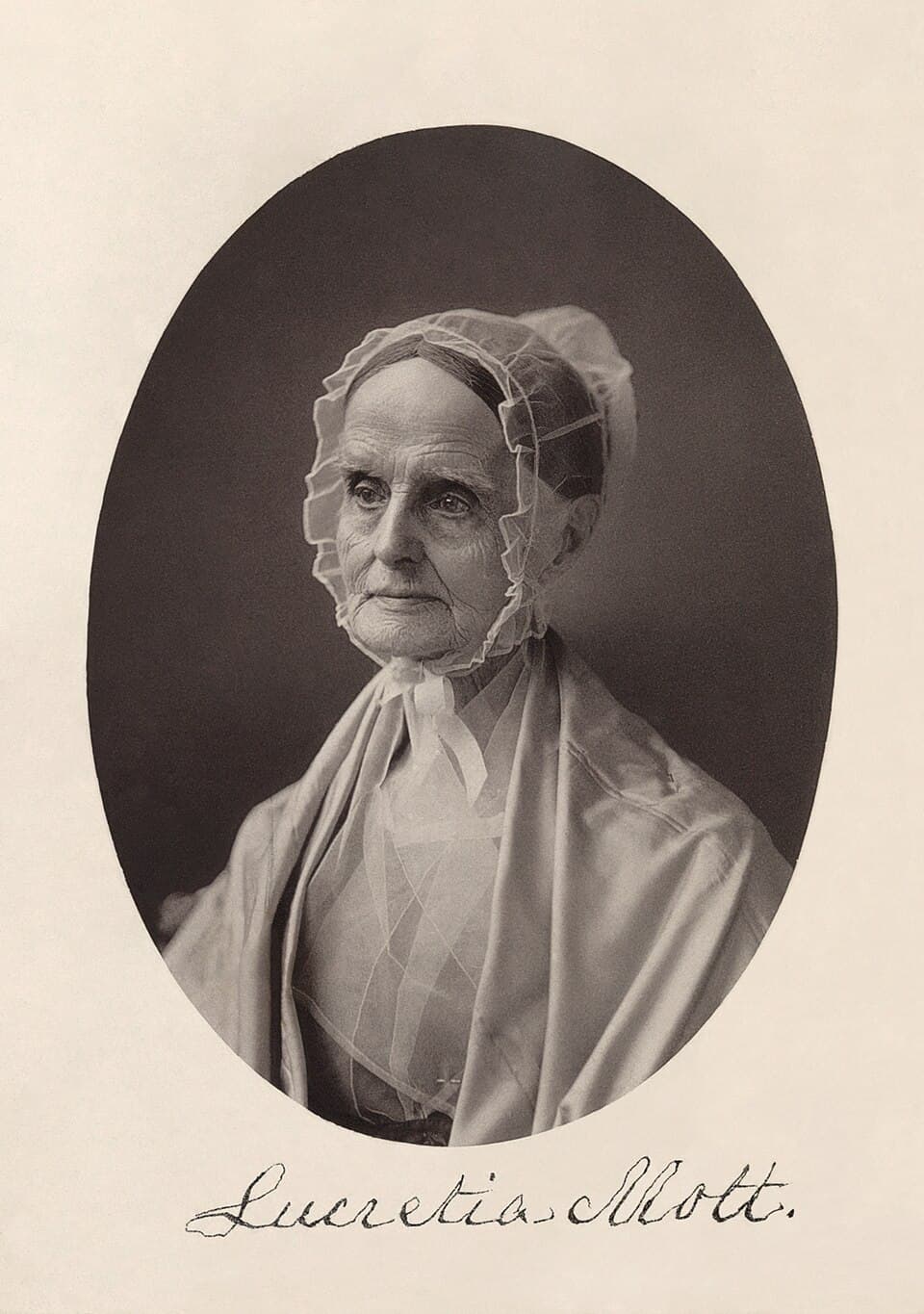
American · Politics · Activism
Lucretia Mott
January 3, 1793 – November 11, 1880
Early Life and Background
Lucretia Coffin Mott was born on January 3, 1793, on Nantucket Island, Massachusetts, into a prominent Quaker family whose values of spiritual equality profoundly shaped her worldview.[1][2][3] Her father, Thomas Coffin Jr., was a ship captain and merchant, and her mother, Anna Folger Coffin, came from a well-established Nantucket family.[1][4] Nantucket’s whaling economy meant that men were often at sea for extended periods, so women managed households and sometimes business affairs, giving Lucretia early models of female responsibility and competence that were unusual in the early republic.[1]
Mott was raised in the Religious Society of Friends (Quakers), a denomination that emphasized the “inner light” in every person and taught a spiritual equality that, at least in theory, extended across gender and race.[1][2][3] This religious environment encouraged girls to speak in meeting and to cultivate moral discernment, forming a stark contrast with broader American norms that confined women to domestic roles.
As a teenager, Mott was sent to Nine Partners Boarding School, a Quaker institution in Dutchess County, New York.[1][4] There she excelled academically and later became an assistant teacher.[1][4] It was at Nine Partners that she met James Mott, another young teacher and fellow Quaker, who would become her lifelong partner in reform.[4][6] The school exposed her to anti-slavery ideas, including the ministry of Elias Hicks and other Friends who condemned slavery as inconsistent with Christian faith.[4]
An early formative experience came when Mott discovered that male teachers at Nine Partners were paid more than female teachers for the same work.[1][2] This realization of wage inequality provoked lasting resentment and helped spark her lifelong concern for women’s economic and legal status.[1] It connected personal experience with a broader critique of gender hierarchy and would later surface in her speeches and writings on women’s rights.
Marriage, Ministry, and Early Career
In 1811, Lucretia Coffin married James Mott, cementing a partnership that combined shared Quaker faith with joint commitment to reform.[1][4][6] The couple eventually settled in Philadelphia, a major center of Quaker life and abolitionist activity.[2][4] They would have six children who survived to adulthood, and their home quickly became a gathering place for reformers and a base for activism.[2][4]
Mott initially worked as a teacher at a Quaker school in New York before her marriage.[1][2] Her experience of unequal pay, combined with exposure to abolitionist thought, deepened her conviction that social structures, not divine will, underpinned both slavery and women’s subordination.[1] After moving to Philadelphia, she increasingly devoted herself to religious service and public speaking.
In 1818, Mott was formally recorded as a minister in the Society of Friends, recognizing her gifts as a speaker and spiritual leader.[1][2][4] Quaker women could be ministers, but it was still unusual for them to take on such extensive public roles. As a minister, Mott preached widely, blending religious exhortation with criticism of slavery and appeals for women’s moral agency.[4] Her sermons were known for their calm reasoning and moral clarity rather than fiery rhetoric.
During the 1820s, she and James aligned with the followers of Elias Hicks in a schism within American Quakerism, forming the Hicksite branch.[4] The Hicksites emphasized inner spiritual guidance and took a stronger antislavery stance than many Orthodox Friends.[4] Mott’s support of Hicks and her outspoken opposition to slavery caused some Friends to view her as radical, but also positioned her at the forefront of a growing network of reform-minded Quakers.
From Abolitionist to Public Reformer
Mott’s public antislavery work intensified in the early 1830s. She endorsed the “immediatist” position that slavery was a sin requiring prompt abolition rather than gradual reform.[2][4] In 1833, she attended the founding convention of the American Anti-Slavery Society (AASS) in Philadelphia and was reportedly the only woman to address the meeting.[4] Her presence and speech challenged gender norms even in radical circles, where many male abolitionists still doubted women’s participation in political life.
On December 4, 1833, she helped establish the Philadelphia Female Anti-Slavery Society (PFASS), one of the earliest and most enduring interracial women’s abolitionist organizations in the United States.[4] PFASS brought together Black and white women, including figures such as Sarah Mapps Douglass and other African American leaders, to organize lectures, fundraisers, and petition campaigns.[4] Mott served as a leading member, leveraging her oratorical skills and social connections to promote abolition.
Two days later, the Motts’ Philadelphia home hosted the organizing meeting of the AASS on December 6, 1833, reinforcing their household’s role as a hub for national antislavery strategy.[4] Mott’s participation in both the male-led AASS and the women-led PFASS positioned her as a critical bridge between gender-segregated wings of the movement.
Throughout the 1830s, she traveled extensively as an antislavery lecturer, speaking in cities across the Northeast and Mid-Atlantic.[2][4] She addressed mixed-gender audiences, often facing hostility, heckling, and threats of violence. Despite this, observers remarked on her poise and ability to maintain composure amid opposition.[1][4] She also supported the free-produce movement, urging boycotts of goods made by enslaved labor, such as sugar and cotton.[4]
In 1837, Mott was involved in the First Anti-Slavery Convention of American Women in New York City, which brought together women abolitionists from multiple states.[5] The convention linked anti-slavery with women’s emerging awareness of their own political exclusion and foreshadowed the later formal women’s rights movement. Mott’s leadership helped sustain such interracial women’s organizing despite mob violence and social backlash.
The 1840 World Anti-Slavery Convention and the Turn to Women’s Rights
A pivotal episode in Mott’s life occurred at the World Anti-Slavery Convention held in London in June 1840. She traveled as an American delegate alongside other women, including Elizabeth Cady Stanton’s husband, Henry Brewster Stanton, and leading male abolitionists.[2][6] Despite being duly appointed as delegates, Mott and the other women were refused seats and voting rights and were made to sit behind a curtain.[2]
On June 12, 1840, the convention’s decision to exclude women from full participation crystallized for Mott the extent of sexism within supposedly progressive circles.[2] Although she maintained her composure and continued to engage in conversation with attendees, the experience sharpened her awareness that women needed to organize on their own behalf, not just as auxiliaries to male reformers.
In London, Mott met Elizabeth Cady Stanton, and the two formed a lasting friendship.[2][6] They discussed the legal and social disabilities women faced in the United States, including coverture, lack of property rights, and political disenfranchisement.[2] Stanton later recalled that she and Mott pledged to hold a women’s rights convention when they returned to America, though it would take eight years for this plan to materialize.[2][6]
Following the convention, Mott continued to lecture on both abolition and the condition of women, often combining the two subjects. Her religiously grounded arguments emphasized that the same spiritual equality that condemned slavery also invalidated women’s subordination. These ideas would later inform the language of the Declaration of Sentiments at Seneca Falls.
National Prominence: Addressing Congress and Broadening Reform
By the early 1840s, Mott had achieved national prominence as an orator. On January 21, 1843, former president and then-congressman John Quincy Adams, an outspoken opponent of the pro-slavery “gag rule” in Congress, invited Mott to address Southern slaveholders at the U.S. Capitol.[2] Her appearance before members of Congress was remarkable for a woman in that era and highlighted her stature within the abolitionist movement.
Mott also extended her reform concerns beyond abolition and women’s rights. She advocated temperance, peace, and Native American rights, insisting that all forms of oppression were interconnected.[2][3] Her theology emphasized the inner light in every person and rejected violence, which aligned her with emerging peace societies.
In the 1840s, she supported efforts to establish institutions that would embody her egalitarian principles. She helped raise funds for the Philadelphia School of Design for Women (later Moore College of Art & Design), which offered women training to support themselves as professional artists and designers.[2] She was also involved in the founding of the Female Medical College of Pennsylvania, one of the first medical schools for women.[2] These efforts reflected her belief that structural change required not only laws and speeches but also educational institutions that opened new professions to women.
Seneca Falls and the Birth of the Organized Women’s Rights Movement
In 1848, while visiting her sister in Auburn, New York, Mott reconnected with Elizabeth Cady Stanton and other reform-minded women, including Jane Hunt and Mary Ann McClintock.[2][6] At a gathering in Hunt’s home, they decided to call a convention to discuss the rights of women.[6] This led to the Seneca Falls Convention, held on July 19–20, 1848, at the Wesleyan Chapel in Seneca Falls, New York.
On July 19, Mott delivered the opening address, setting the moral and religious frame for the proceedings and lending the event credibility among Quakers and other reformers.[6] The convention presented and debated the Declaration of Sentiments, modeled on the U.S. Declaration of Independence, which enumerated grievances against men’s legal domination and called for equal civil and political rights for women, including the vote.[2][6]
On July 20, Mott gave the closing address, helping to steer the final adoption of the Declaration and its resolutions.[6] Although she was initially cautious about the suffrage plank, which some considered too radical, she ultimately supported its inclusion.[6] Her leadership at Seneca Falls, alongside Stanton’s, marked her as a co-founder of the organized women’s rights movement in the United States.[3][6]
The Seneca Falls Convention inspired subsequent women’s rights gatherings, including the Rochester convention later in 1848, and helped establish a recurring pattern of women’s conventions through the 1850s.[2] Mott continued to speak at many of these meetings, reinforcing the linkage between gender equality and abolitionist principles.
Civil Disobedience and the Fugitive Slave Law
The passage of the Fugitive Slave Law as part of the Compromise of 1850 dramatically raised the stakes for abolitionist activism. The law, enacted on September 18, 1850, required citizens and officials in free states to assist in the capture of people who had escaped slavery and imposed penalties on those who aided fugitives.[8]
Mott and her husband James responded by publicly condemning the law and making their Philadelphia home a station on the Underground Railroad.[8][4] They offered shelter and support to people escaping enslavement, with Mott’s role particularly noted in cases such as her aid to Henry “Box” Brown and others.[4] Her willingness to openly defy federal law reflected a deep conviction that moral law superseded unjust statutes.
This commitment placed the Motts at personal risk of prosecution, fines, or mob violence. Yet they persisted, and their home became one of several well-known sites of refuge in the region.[4] Mott’s actions helped normalize civil disobedience among Northern religious communities and furthered the moral delegitimization of slavery in public opinion.
Institution Building: Education and Equal Rights
Beyond direct abolitionist and women’s rights advocacy, Mott invested considerable energy in institution-building that reflected her egalitarian ideals. In 1864, she was among the founders of Swarthmore College in Pennsylvania, established by Hicksite Friends as a coeducational institution from the outset.[2][10][15] Mott and other Quakers ensured that women would have access to the same collegiate education as men, embodying in practice the equality she had long preached.
Mott also played a role in sustaining the Female Medical College of Pennsylvania (founded in 1850), which provided medical education to women at a time when they were barred from most medical schools.[2] She helped raise funds and offered moral support to women entering the medical profession.[2] Similarly, by aiding the Philadelphia School of Design for Women, she supported vocational training for women in the arts and applied design.[2]
After the Civil War, the focus of reform shifted toward the terms of Reconstruction and the redefinition of citizenship. In 1866, Mott joined leading abolitionists and women’s rights advocates to form the American Equal Rights Association (AERA), dedicated to securing universal suffrage regardless of race or sex.[2][10] On May 31, 1866, she was elected its first president, reflecting her reputation as a unifying figure.[2]
The AERA’s work was complicated by growing disagreement over whether to support the Fourteenth and Fifteenth Amendments, which extended constitutional protections and voting rights to Black men but not to women.[2] Mott tried to mediate between activists who backed the amendments as a step forward for African Americans and those who opposed them because they entrenched male-only suffrage.[2] Her consistent position favored universal rights but also sought to avoid irrevocable splits within the movement.
"Discourse on Woman" and Intellectual Contributions
Mott’s intellectual contributions are most clearly captured in her work Discourse on Woman. She first delivered the speech in the late 1840s, and it became one of her best-known addresses.[9] It was later published as a pamphlet in Philadelphia, with a publication date often given as 1869.[2] On December 31, 1869, the text appeared in print in a form that allowed her arguments to circulate widely.[2]
In Discourse on Woman, Mott critiqued legal systems that subordinated married women’s property and earnings to their husbands, challenged religious interpretations that taught female inferiority, and called for expanded educational and professional opportunities.[2][9] She grounded her arguments in scripture but read the Bible through the lens of Quaker emphasis on the inner light, emphasizing spiritual equality as the basis for social equality.
The pamphlet was part of a broader corpus of early feminist texts that included works by Sarah and Angelina Grimké, Elizabeth Cady Stanton, and others. Mott’s contribution stood out for its blend of theological reflection, historical examples, and appeals to common sense. It became a resource for reformers and helped legitimize feminist theology within Quaker and broader Protestant circles.
Personal Life and Character
Lucretia and James Mott’s marriage was widely regarded as a partnership of equals, consistent with their shared beliefs. James supported Lucretia’s public speaking and business travel, managing the family’s wool and cotton business in ways that aligned with their antislavery commitment by avoiding products made by enslaved labor as much as possible.[4][6] Their cooperation modeled the egalitarian domestic relations that Lucretia advocated publicly.
The couple raised several children, including Maria Mott Davis, who became an activist in her own right.[2] Their extended family remained involved in reform work and Quaker service. The Motts’ home in the Philadelphia area served not only as a station on the Underground Railroad but also as a meeting place for reformers from across the Atlantic world.[4]
Contemporaries described Mott as modest in dress and manner, with quiet dignity and a calm but firm speaking style.[1][4] She rejected ostentation and adhered to plain Quaker attire, which lent additional moral authority to her critique of worldly power and privilege. Yet she was also known for her wit and ability to defuse tension with humor, qualities that served her well when addressing hostile audiences.
Later Life, Ongoing Activism, and Death
In her later years, Mott continued to advocate for Black civil rights, women’s suffrage, and broader social reforms. She remained engaged with the controversies surrounding the fractured women’s rights movement after the split between the National Woman Suffrage Association and the American Woman Suffrage Association in 1869, striving to maintain cordial relations across factions.[2]
Although her health gradually declined, she stayed active in Quaker meetings and reform gatherings into the 1870s.[4] She maintained a steady correspondence with younger activists, offering guidance and perspective drawn from decades of experience.
Lucretia Mott died on November 11, 1880, at her home in La Mott, in Cheltenham Township near Abington, Pennsylvania.[2][3] She was eighty-seven years old. Her death was widely mourned within Quaker communities and among abolitionists and suffragists who regarded her as a moral pioneer. Obituaries and memorials emphasized her consistency of principle, personal humility, and the breadth of her influence.
Legacy and Historical Impact
Lucretia Mott’s legacy spans multiple intersecting movements: abolition, women’s rights, peace, and education. Alongside Elizabeth Cady Stanton, she is widely credited with founding the organized women’s rights movement in the United States.[3][6] Her role in the Seneca Falls Convention, her early articulation of women’s rights from the 1820s onward, and her continued leadership through the post–Civil War years position her as a central figure in 19th-century feminism.
In the abolitionist movement, Mott was notable for her consistent advocacy of immediate emancipation, her willingness to collaborate in interracial organizations such as the Philadelphia Female Anti-Slavery Society, and her practice of civil disobedience through the Underground Railroad.[4] She brought a distinctive Quaker theological perspective that emphasized the incompatibility of slavery with Christian faith and pressed both Northern and Southern audiences to confront this contradiction.
Her institutional legacies include her role in helping to found Swarthmore College and in supporting the Female Medical College of Pennsylvania and the Philadelphia School of Design for Women, which expanded educational opportunities for women and helped professionalize women’s work in medicine and the arts.[2] These institutions carried her egalitarian principles into future generations.
Recognition of Mott’s contributions has continued into the modern era. She has been inducted into the National Women’s Hall of Fame, which highlights her as a pioneering advocate for antislavery and women’s rights.[6] The community of La Mott, Pennsylvania, where she lived in later life, bears her name, reflecting local remembrance of her presence.[2] Historical societies, including the National Abolition Hall of Fame and Museum, also honor her as a key abolitionist leader.[4]
Historians underscore Mott’s importance not only for what she achieved but for how she achieved it: through a combination of religious conviction, nonviolent protest, and interracial and intergender collaboration.[3][4] She stands as an example of how 19th-century religious women translated spiritual beliefs into sustained political activism. Her insistence that the struggles for racial and gender equality were inseparable anticipated later conceptions of intersecting oppressions.
Although she did not live to see women gain the vote with the ratification of the Nineteenth Amendment in 1920, her work laid much of the groundwork for that victory. The organizational forms she helped create, the arguments she advanced, and the generations she mentored all contributed to the eventual success of both abolition and women’s suffrage. In the broader narrative of women’s history, Lucretia Mott remains a foundational figure whose life illuminates the evolution of American democracy toward greater inclusivity.
Dated achievements
12 indexed.
- Jan031793Science
Birth of Lucretia Coffin Mott
Lucretia Coffin was born on Nantucket Island, Massachusetts, into a Quaker whaling family, beginning a life that would shape American abolitionism and women's rights.
View details Lucretia Mott | Britannica - Apr081821Science
Delivers 'Discourse on the Subject of Women' sermon
Mott delivered an early public sermon in Philadelphia articulating women's spiritual and social equality within a Quaker religious framework.