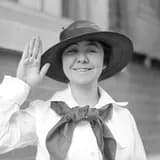
Begins service as Yeoman (F) in the Philadelphia Naval Shipyard recruiting office, initiating women’s enlisted clerical service in the Navy.
Following her swearing‑in on 21 March 1917, Loretta Perfectus Walsh immediately began serving as a Yeoman (F) at the Philadelphia Naval Shipyard recruiting office.[1][7][9] In this clerical position, she handled administrative duties such as typing, record‑keeping, and processing enlistment paperwork, work that was essential to the Navy’s rapid wartime expansion.
Walsh’s assignment drew on the office and secretarial skills she had developed at Scranton & Lackawanna Business College and in her earlier civilian work with the Navy League in Philadelphia.[1][5][7] By stepping into a uniformed role at a major naval installation, she helped demonstrate that women’s clerical labor could be formally recognized as military service, not merely voluntary or auxiliary assistance.
This event marked the beginning of women’s enlisted clerical service in the U.S. Navy during World War I. Walsh’s visible presence in the recruiting office showed potential female applicants that there was now a pathway into official naval roles. As thousands of "Yeomanettes" followed her example, they took over much of the Navy’s paperwork and correspondence, freeing male sailors for deployment to ships and combat zones.[2][7][9] Their work, initiated in part by Walsh’s pioneering assignment, contributed significantly to the logistical efficiency of the wartime Navy.
In an era when women were largely excluded from formal military structures, Walsh’s daily uniformed service in a key administrative hub normalized the idea of women as "citizen‑sailors" performing vital support functions. Her clerical career at the shipyard illustrates how incremental, routine tasks can underpin large institutional transformations.[1][7][9]