← All women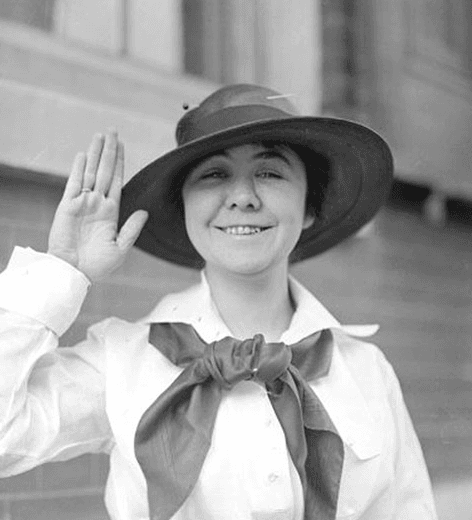
American · Activism
Loretta Perfectus Walsh
April 22, 1896 – August 6, 1925
Early Life and Background
Loretta Perfectus Walsh (22 April 1896 – 6 August 1925) was an American sailor whose enlistment reshaped the role of women in the United States armed forces. She is best known as the first woman to enlist in the U.S. Navy and the first woman to serve in any branch of the U.S. military in a non‑nursing capacity, as well as the Navy’s first woman petty officer and first female Chief Petty Officer.[2][3][4]
Walsh was born on 22 April 1896 in Olyphant, Lackawanna County, Pennsylvania, to Irish immigrant parents James J. Walsh and Catherine (Cummings) Walsh
Walsh was educated at St. Patrick’s Parochial and High Schools in Olyphant and nearby Scranton.[1][5] Seeking practical skills that could secure employment, she went on to attend Scranton & Lackawanna Business College in Scranton, Pennsylvania, where she studied typing and business subjects.[1][5] This training prepared her for clerical and secretarial work at a time when such jobs were among the few professional opportunities open to women. After completing business college, Walsh moved to Philadelphia, a major industrial and naval hub, and worked as a clerk for the Navy League, a civilian organization that advocated for naval preparedness.[1][5][7] She also volunteered with the Women’s Division of the Philadelphia Navy League, gaining experience in recruiting and administrative work related to the Navy.[7] These activities brought her into close contact with naval officers and recruitment operations and exposed her to broader debates about national defense as the United States edged toward participation in World War I. Walsh’s transition from civilian clerical work to naval service occurred in the context of mounting global conflict. By 1916–1917, the U.S. Navy faced a significant administrative burden as it prepared for possible entry into World War I. The Naval Reserve Act of 1916 authorized a reserve force but did not explicitly restrict enlistment by sex, creating a legal loophole that Navy Secretary Josephus Daniels and his advisers recognized as a potential avenue to enlist women.[2][9] Historically, women’s official roles in the U.S. military had been confined largely to nursing. During earlier conflicts, women served unofficially or in disguise, but they were not generally recognized as enlisted personnel with equal pay and benefits. As the Navy’s administrative workload increased, some leaders concluded that women with clerical skills could perform shore‑based duties, thereby freeing more men for sea duty.[2][4][9] Walsh’s prior experience with the Navy League and her business training made her an ideal candidate for this emerging experiment. She was described in contemporary accounts as competent, disciplined, and physically fit, qualities that helped persuade recruiters to consider her for the newly conceived Yeoman (F) category.[1][9] A 1917 New York Times article noted that she underwent "the same rigid examination that is given to male applicants" and was deemed "a fine specimen of womanhood," underscoring that the Navy evaluated her by existing male standards rather than creating separate criteria for women.[9] On 17 March 1917, Loretta Perfectus Walsh enlisted for a four‑year term in the United States Naval Reserve at a recruiting office in Philadelphia.[2][3][4] At age twenty, she became the first woman to enlist in the U.S. Navy and, more broadly, the first woman to serve in any branch of the U.S. armed forces in a non‑nursing role.[2][3][4][11] This enlistment took place just weeks before the United States formally entered World War I, as the Navy moved urgently to expand its personnel. Two days later, on 19 March 1917, the Navy Department issued a formal authorization for the enrollment of women in the Naval Reserve, specifying ratings such as Yeoman (F) and radio electrician.[2][4] This order made the U.S. Navy the first American armed service to officially allow women’s enlistment in non‑nursing capacities, institutionalizing the experiment that Walsh’s enlistment had begun.[2][4][9] The policy exploited the absence of gender‑specific language in the Naval Reserve Act and opened the way for thousands of women to serve in uniform. On 21 March 1917, Walsh’s pioneering status was further solidified when she was sworn in at the Philadelphia Naval Shipyard by Lt. Cmdr. Frederick R. Payne as a Chief Yeoman (F).[1][2][12] This made her the Navy’s first woman petty officer and its first female Chief Petty Officer.[1][2][12] She not only enlisted but did so directly into a non‑commissioned officer rank that carried supervisory responsibilities, demonstrating that women could hold positions of authority within enlisted structures. Contemporary reports emphasized that Walsh was subjected to the same examinations as men and that the Navy was initially unprepared to outfit her, requiring that her first uniform be specially made.[1][9] Her appointment was widely noted in the press and by later historians as a turning point in the recognition of women as full members of the military, entitled to equal basic pay and status for comparable roles.[2][3][10] Immediately after being sworn in on 21 March 1917, Walsh began her duties as a Yeoman (F) at the Philadelphia Naval Shipyard recruiting office.[1][7][9] Drawing on her business college training and Navy League experience, she performed clerical and administrative tasks such as typing correspondence, maintaining personnel records, and processing enlistment forms. Walsh served at what some sources describe as the U.S. Navy Home at the Philadelphia Naval Shipyard, a central facility that handled recruiting and administrative functions for the region.[12] Her work helped ensure that the rapidly growing number of naval recruits were properly documented and assigned, tasks critical to the efficient mobilization of forces. Her role was part of a broader mobilization of women into the newly created Yeoman (F) category. Between 1917 and 1919, more than 11,000 women—and in some accounts over 12,000—served as Yeoman (F) in the U.S. Navy during World War I, following the precedent set by Walsh’s enlistment.[2][9][11] These women, often called "Yeomanettes," took over large portions of paperwork and office duties, allowing male sailors to be reassigned to ships and combat roles. Walsh’s daily presence in a uniformed position demonstrated to other women that naval service was attainable. She embodied the idea of the female "citizen‑sailor" at a time when women did not yet have full voting rights nationwide and faced widespread legal and social restrictions. Her example was particularly important for young women with secretarial skills who sought meaningful ways to support the war effort beyond traditional volunteer and charity work.[7][9] During World War I, Walsh, like many service members, was affected by the 1918 influenza pandemic. She fell ill in the fall of 1918 and later developed tuberculosis, complications that impaired her health for the remainder of her life.[3][7] As her condition worsened, she was eventually released from active duty due to disability and transferred to the inactive reserve, though she remained under enlistment obligations until her term expired.[7][12] Despite her health struggles, Walsh’s service was formally recognized by the Navy. She received the World War I Victory Medal, awarded to military personnel who served honorably during the conflict.[7] Her status as a veteran and her continuing association with the Naval Reserve underscored that her pioneering role was not symbolic but part of a sustained four‑year commitment to the armed forces. Walsh’s four‑year enlistment formally ended on 7 August 1919, marking the conclusion of her Naval Reserve service.[3][12] By that time, most Yeoman (F) positions had been demobilized as the Navy reduced its wartime force, reflecting a broader trend of limiting women’s official military roles after the immediate emergency had passed.[2][7] Walsh’s completion of the full enlistment term demonstrated that women could meet the same contractual obligations as their male counterparts. Information about Walsh’s personal life is limited, but genealogical and veterans’ research sheds some light on her relationships after the war. Following her discharge from active duty, she sought treatment for tuberculosis at White Haven Sanatorium in White Haven, Pennsylvania.[5] While there, she met Frederick Bowman, a fellow tuberculosis patient and veteran of World War I.[5] According to detailed genealogical research, Walsh and Bowman married on 8 June 1922 at St. Madelyn’s Church in Ridley Park, Pennsylvania.[5] Some accounts therefore refer to her later in life as Loretta Walsh Bowman. Their marriage, however, was short‑lived. Her continuing illness prevented the couple from building a long shared life, and there is no evidence of children.[5] Bowman’s presence in her final years highlights how military service and wartime disease connected the lives of veterans across gender lines. Walsh’s personal story reflects the broader experiences of many women who broke barriers during wartime but faced significant health and social challenges afterward. Her marriage to another veteran underscores the shared sacrifice and vulnerability of those who served in World War I, particularly those impacted by influenza and tuberculosis. In the years following World War I, Walsh’s health continued to decline. She resided at or regularly returned to White Haven Sanatorium for the treatment of tuberculosis, which, at the time, had limited effective medical interventions.[5] Despite these challenges, she remained a figure of quiet significance as the first woman to have enlisted in the U.S. Navy. Walsh died of tuberculosis on 6 August 1925 at White Haven Sanatorium, aged twenty‑nine.[2][4] Although one secondary source lists a different date (17 August 1925), the earlier date is supported by multiple biographical references and is widely accepted as authoritative.[2][4][3][12] Her death illustrates the long‑term health consequences of the influenza pandemic and tuberculosis among early twentieth‑century veterans. She was buried in St. Patrick’s Cemetery in Olyphant, Pennsylvania, returning to the community where her life had begun.[2][12] Her grave would later be marked in a way that explicitly acknowledged her unique role in naval history, ensuring that her name remained associated with the pioneering integration of women into the military. During her lifetime, Walsh’s most direct recognition was her World War I Victory Medal, awarded for her service in the Naval Reserve.[7] However, formal institutional honors expanded after her death. By 19 March 1928, the U.S. Navy had erected and was maintaining a prominent grave marker for her in St. Patrick’s Cemetery. The marker describes her as "Woman and Patriot" and, crucially, as the "First of those enrolled in the United States Naval Service" during World War I.[1][4] This inscription publicly affirms that the Navy recognized her as the first woman "citizen‑sailor" in its ranks. The grave marker has been documented by the Naval History and Heritage Command and cited by historians as an early example of institutional commemoration of a woman service member.[1][4] It serves as both a memorial and a historical document, offering a concise summary of her contribution to visitors and researchers. In the decades since, Walsh has been honored in various ways by military museums, veterans’ organizations, and educational initiatives. The Naval History and Heritage Command has published a pamphlet detailing her life and service, and the Foundation for Women Warriors, the American Freedom Foundation’s AFH Museum, and other organizations have featured her in articles and exhibits about women’s military history.[1][6][14] Contemporary Navy initiatives have also commemorated Walsh. In one instance, a gun aboard the USS Constitution was named in her honor, highlighting her status as the first female Chief Petty Officer.[10] Social‑media posts and videos produced by the U.S. Navy Reserve and related institutions likewise recount her story for modern audiences, emphasizing her pioneering role in opening enlisted service to women.[10][11] Loretta Perfectus Walsh’s legacy rests on several intertwined "firsts." She was the first woman to enlist in the U.S. Navy, the first woman to serve in any U.S. armed force in a non‑nursing capacity, and the first female Chief Petty Officer in Navy history.[2][3][4] These achievements positioned her at the center of a transformative moment in military and social history. Her enlistment and appointment demonstrated that women could be integrated into the Navy’s enlisted ranks with equal pay and responsibilities for equivalent roles. This broke with prior practice, under which women’s contributions were largely informal or restricted to nursing, and challenged wider societal assumptions about women’s capabilities in professional and governmental institutions.[2][4][9] Walsh’s example directly paved the way for the enlistment of more than 11,000 Yeoman (F) during World War I, a cohort whose clerical and administrative work was crucial to the functioning of the Navy’s massive wartime bureaucracy.[2][9][11] The success of these women provided practical evidence for later efforts to expand women’s military roles, including the creation of the WAVES (Women Accepted for Volunteer Emergency Service) in World War II and subsequent integration of women into regular Navy and other service branches. As historians of women’s military history have noted, Walsh’s story helps reframe the narrative of wartime participation. She was not a nurse or auxiliary volunteer but an enlisted sailor with a rank, duties, and obligations similar to those of male petty officers.[2][9] Her case illustrates how legal ambiguity—in this instance, the lack of gender‑specific language in the Naval Reserve Act—combined with individual initiative to produce structural change. Beyond military institutions, Walsh’s life contributes to broader studies of women’s rights and citizenship. Her role as a "citizen‑sailor" predates the nationwide ratification of women’s suffrage in the United States (1920), meaning she served as an enlisted member of the armed forces before women enjoyed full voting rights in federal elections.[2] This juxtaposition underscores the complex, uneven path by which women gained access to different aspects of civic participation. Modern commemorations—such as museum exhibits, articles by veterans’ organizations, and educational resources—continue to highlight Walsh as an emblematic figure in women’s military history.[1][2][4][6][14] Her grave marker in Olyphant, the pamphlet published by the Naval History and Heritage Command, and digital tributes ensure that her name remains associated with the opening of naval service to women. Scholarship on Walsh’s life has had to navigate several minor discrepancies in surviving records. For example, some sources list her birthplace as Philadelphia, while others identify Olyphant, Pennsylvania. The balance of evidence from Navy museum publications and genealogical research supports Olyphant as her birthplace, though the association with Philadelphia likely reflects her later residence and work there.[1][3][5] Similarly, there has been occasional confusion in public narratives about the precise dates of her enlistment and swearing‑in. Some accounts emphasize 17 March 1917 as the date of her enlistment in the Naval Reserve, while others focus on 21 March 1917, when she was formally sworn in and appointed Chief Yeoman.[1][2][3][11][12] Careful reconstruction of the sequence indicates that both dates mark distinct stages in her entry into naval service: the initial enlistment and the subsequent oath and rank appointment. There is also a minor discrepancy regarding her date of death. While the majority of biographical and institutional sources cite 6 August 1925, one detailed research article gives 17 August 1925.[2][4][5][12] The earlier date aligns with most institutional references and is generally accepted as authoritative. Such differences illustrate the challenges of reconstructing early twentieth‑century biographies, particularly for women whose lives were not extensively documented during their lifetimes. Despite these small uncertainties, the core elements of Walsh’s story are well supported by Navy records, contemporary press reports, and later historical analyses. Her pioneering enlistment, her service as Chief Yeoman (F), and her role in catalyzing the broader involvement of women in the U.S. Navy are consistent across sources and form the foundation of her enduring historical significance.[1][2][4][9] Loretta Perfectus Walsh occupies a central place in the history of women in the U.S. military. Her life demonstrates how individual agency, institutional need, and legal opportunity can intersect to produce lasting change. By stepping forward to enlist in 1917, she helped redefine both the Navy’s understanding of its potential workforce and society’s perception of women’s roles in national defense. Her story is also marked by personal sacrifice. The health consequences of wartime disease and her early death at twenty‑nine underscore the risks borne by pioneering women in uniform. Yet the continued maintenance of her grave marker, the recognition of her achievements by naval and veterans’ organizations, and her inclusion in modern educational materials attest to the durable impact of her decisions. Walsh’s career as a Yeoman (F) did not involve combat operations or technological innovation, but the symbolic and structural significance of her service is profound. She stands as a reminder that changing who is allowed to serve—and under what terms—can be as historically consequential as any single battle or invention. Her legacy endures in the thousands of women who have since served as enlisted sailors, petty officers, and chiefs in the United States Navy.Path to Naval Service
Enlistment and Historic Firsts
Service as Yeoman (F)
Health Challenges and Later Service
Personal Life
Later Life and Death
Awards, Honors, and Commemoration
Legacy and Historical Impact
Context and Historical Debates
Assessment
Dated achievements
8 indexed.
- Apr221896Activism
Birth of Loretta Perfectus Walsh
Born 22 April 1896 in Olyphant, Pennsylvania, to Irish immigrant parents James and Catherine Walsh.
View details Chief Yeoman (F) Loretta P. Walsh – Naval History and Heritage Command - Mar171917