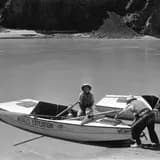
Lois Jotter and Elzada Clover became the first non-native women to boat through the Grand Canyon, and the first botanists to document its plant life.
On August 2, 1938, botanist Lois Jotter, together with her mentor Elzada Clover, completed a harrowing 43-day, 665-mile journey down the Green and Colorado Rivers through the Grand Canyon, becoming the first non-native women ever recorded to travel the entire length of the canyon by boat. The expedition, led by river runner Norman Nevills, traveled in fragile wooden cataract boats through some of the most violent whitewater in North America, including the notorious rapids of Lava Falls and Hance.
Beyond the physical feat of survival — the party lost boats, endured scorching heat, and faced skepticism that women could withstand such an ordeal — Jotter and Clover conducted the first systematic botanical survey of the inner canyon corridor. Jotter, a doctoral student in botany at the University of Michigan, collected and catalogued hundreds of plant specimens along the river, several of which were previously undescribed to science, establishing a scientific baseline against which later ecological changes (especially after the construction of Glen Canyon Dam) could be measured.
Newspapers of the era sensationalized the trip, often focused on the novelty of women undertaking such a dangerous expedition rather than the serious scientific contribution it represented. Nonetheless, the 1938 expedition is now recognized as a landmark moment in both the history of river exploration and field botany, and Jotter and Clover are honored as pioneers who opened both wilderness exploration and scientific fieldwork to women.