← All women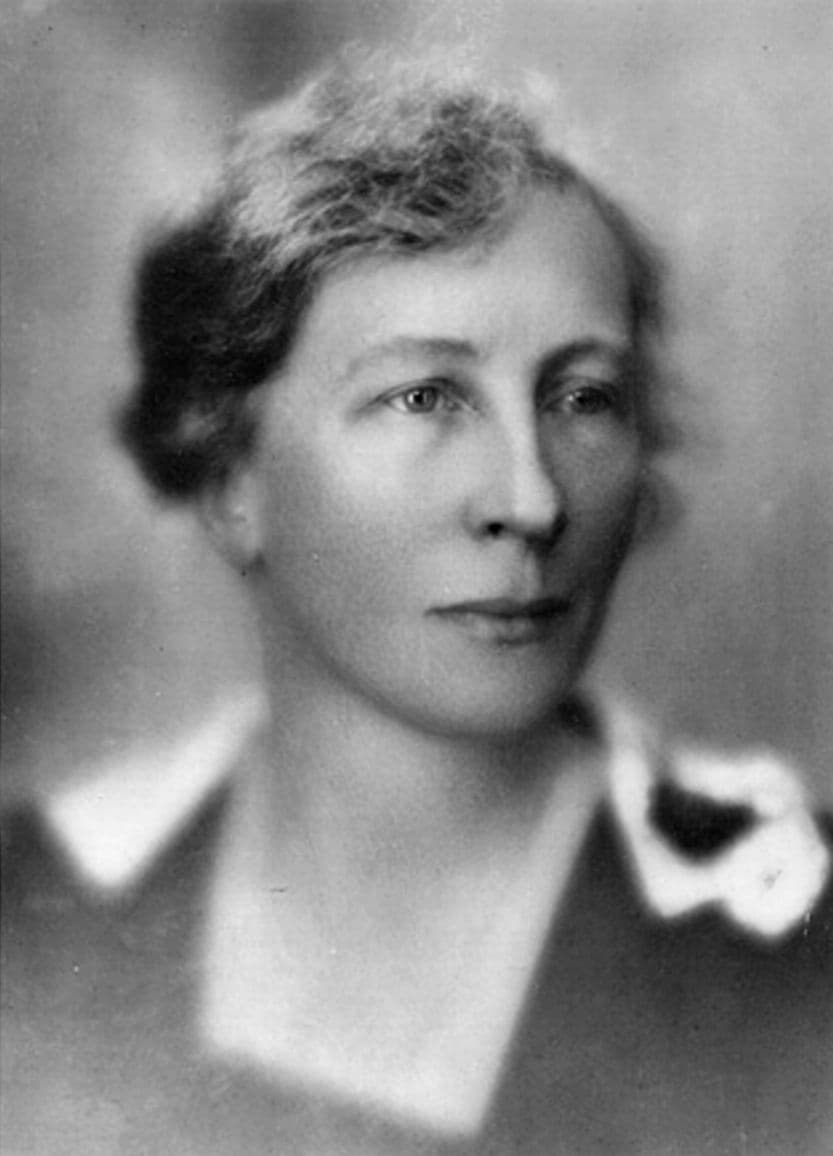
American · Science · Medicine
Lillian Gilbreth
May 24, 1878 – January 2, 1972
Early Life and Background
Lillian Evelyn Moller was born on May 24, 1878, in Oakland, California, the eldest of nine children in a prosperous German‑American family.[1][8] Her father, William Moller, was a builder’s supply merchant, and her mother, Annie Delger Moller, maintained a devout household with strong German cultural influences.[1][8] Growing up in this environment, Lillian was expected to conform to late‑Victorian ideals of femininity while also shouldering responsibilities as the oldest child, experiences that fostered discipline, resilience, and organizational skill.
Educated in Oakland’s public schools, she showed early aptitude in languages and literature. Despite social expectations that middle‑class women should prioritize marriage over advanced study, Lillian aspired to attend university. Her family eventually supported her enrollment at the University of California, Berkeley, at a time when relatively few women pursued higher education.[7][11]
At Berkeley, she studied literature and classics, earning a B.A. and an M.A. in English and related fields.[1][11] In 1900, she delivered a commencement address and is reported as the first woman ever to speak at a UC Berkeley graduation ceremony, a symbolic achievement in a male‑dominated academic culture.[7] Her rhetorical skills and public presence at Berkeley foreshadowed her later role as a lecturer and consultant.
Education and Intellectual Formation
After completing her degrees at Berkeley, Lillian continued her intellectual development through teaching and graduate study. She became interested in the emerging field of psychology, especially its potential applications to everyday problems of work and management. In the early twentieth century, scientific management—associated with figures like Frederick W. Taylor and Henry Gantt—focused primarily on optimizing tasks through time measurement and mechanical reorganization. Lillian believed that this approach neglected crucial human elements such as fatigue, motivation, and morale.
Seeking formal training, she enrolled at Brown University, where she pursued advanced study that combined English with psychology.[1][2] Under the mentorship of psychologist Walter Bingham and others, she developed a dissertation on what she called the psychology of management. On June 16, 1915, Brown awarded her the Ph.D., making her one of the first women to earn a doctorate closely tied to engineering and industrial management.[1][2] Her dissertation was later published as The Psychology of Management (1914–1915) and is today regarded as a foundational text in industrial/organizational psychology.[1][8][12]
Marriage to Frank Bunker Gilbreth and Career Beginnings
On October 19, 1904, in Oakland, Lillian Moller married Frank Bunker Gilbreth, a self‑taught construction contractor and management innovator.[1] Frank had begun experimenting with ways to increase efficiency on building sites, focusing on minimizing unnecessary motions. Lillian’s literary education and growing interest in psychology complemented his practical engineering experience.
The couple combined their talents in a consulting practice that eventually became Gilbreth, Inc., which operated from roughly 1910 to 1920 and beyond.[2][8] Their home functioned as both laboratory and school of scientific management, equipped with cameras and other devices for studying work motions. Together they developed and refined time‑and‑motion study, using motion‑picture film to analyze tasks ranging from bricklaying to clerical work.[1][9]
Lillian played a critical role in interpreting motion‑study data, emphasizing the importance of worker fatigue, skill acquisition, and psychological factors. She argued that management should be conceived as a relationship built on cooperation and respect for human needs, departing from more mechanistic views of Taylorist scientific management.[8][12]
Founding Industrial/Organizational Psychology
Lillian Gilbreth’s most significant intellectual contribution was the integration of psychology into industrial management and engineering. Her book The Psychology of Management explored how motives, attitudes, and satisfaction affected productivity and turnover.[8] She maintained that efficiency could not be measured solely in terms of output and cost, but had to account for the health and wellbeing of workers.
In 1911, at the Dartmouth College Conference on Scientific Management, she publicly introduced the concept of the "psychology of management," helping to found what would later be called industrial/organizational psychology.[8][12] Unlike many contemporaries, she insisted that standardized methods should be adapted to individual differences and that workers should participate in improving processes.
Scholars and professional organizations now regard Gilbreth as the first true industrial/organizational psychologist, as she systematically applied psychological theory and research tools to industrial problems and tied them to management education and practice.[11][12]
Motion Study, Ergonomics, and Human Factors
Working with Frank, Lillian helped develop the detailed analysis of work motions known as motion study. They investigated tasks step‑by‑step to identify "therbligs"—basic units of motion—and sought ways to reduce unnecessary movements, thereby increasing efficiency and reducing fatigue.[1][9] Their research informed improvements in factory workflows, tool design, and training methods.
After Frank’s sudden death from a heart attack on June 14, 1924, while traveling to deliver a lecture,[1][8] Lillian assumed full leadership of the firm. She delivered his scheduled speech and continued their consulting practice, broadening its scope to include office work, retail, and domestic labor.[2] Over time she moved from classic motion study toward what is now called ergonomics or human factors engineering, designing workplaces and tools to fit human capabilities and limitations.[4][5][7]
Her home laboratory extended to household tasks, where she analyzed cooking, cleaning, and child‑care routines. She applied motion‑study principles to kitchen design, advocating efficient work triangles and improved storage, and she contributed to innovations such as foot‑pedal trash cans, refrigerator door shelves, and improved electric mixers.[2][5][10] These designs helped reduce the physical burden of housework and influenced modern domestic architecture and appliance design.
Professional Recognition and Society Memberships
Despite widespread exclusion of women from engineering organizations, Gilbreth gradually gained recognition. In 1921, she was named an honorary member of the Society for Industrial Engineers, often described as its first female member, at a time when women were not admitted as regular members.[2][8] In 1926, she became the second woman member of the American Society of Mechanical Engineers (ASME), further breaking gender barriers in professional engineering societies.[5][8]
During the Great Depression, Gilbreth served on President Herbert Hoover’s Emergency Committee for Unemployment Relief (around 1930), applying her expertise in work organization to national economic problems.[8][11] She later consulted for federal agencies on wartime production and educational strategies during the 1940s, and in 1951 she was appointed to the Civil Defense Advisory Commission, contributing to civil‑defense planning from a human‑factors perspective.[8]
Academic Career at Purdue and Other Universities
In 1935, Gilbreth joined Purdue University as a full professor of management in the School of Mechanical Engineering, becoming Purdue’s first female engineering professor.[3][5] Her appointment on September 9, 1935, is widely cited as the first female professorship in an engineering school in the United States.[3][9] She held this position until 1948. At Purdue she developed curricula that fused psychology, industrial engineering, and home economics, and she helped design model kitchens for research and public demonstration.[3][5]
Gilbreth also held teaching or visiting roles at Bryn Mawr College, Rutgers University, and other institutions.[11] On February 1, 1955, she began a visiting professorship in management at the University of Wisconsin–Madison, further extending her influence in business and engineering education.[8] Her academic work emphasized "human relations" in management, encouraging students to consider workers’ needs and family responsibilities alongside production targets.
Major Honors and Awards
Gilbreth received numerous honors recognizing her contributions to engineering, psychology, and public service. On November 29, 1944, the American Society of Mechanical Engineers and the American Management Association awarded her the Henry Laurence Gantt Medal, honoring her distinguished achievements in management and service to the community.[1][8]
On April 27, 1948, she received the American Women’s Association Award for Eminent Achievement, which celebrated her as an outstanding American woman for her pioneering work in industrial psychology and engineering.[8] Throughout her career she also received multiple honorary degrees from universities, though many of these honors can be dated only by year.
On May 7, 1965, Gilbreth was elected to the National Academy of Engineering (NAE), becoming its first woman member.[5][9][13] This landmark recognized her as a leading engineer whose work in ergonomics, management, and household technology had national significance.
On September 14, 1966, she became the first woman recipient of the Hoover Medal, an award jointly conferred by major U.S. engineering societies for "great, unselfish, nontechnical services by engineers to humanity."[2][5][13] For years she remained the only woman ever to hold the medal, underscoring the barrier‑breaking nature of the honor.
On July 1, 1968, during the Gilbreth Centennial celebrating the hundredth anniversary of Frank B. Gilbreth’s birth, ASME honored Lillian with the Gilbreth Medal, recognizing her long‑standing contributions to management and engineering.[8]
Posthumously, on February 24, 1984, the U.S. Postal Service issued a 40‑cent stamp bearing her portrait in its Great Americans series, making her the first female psychologist depicted on a U.S. stamp.[1] On October 7, 1995, she was inducted into the National Women’s Hall of Fame in Seneca Falls, New York, in recognition of her pioneering work linking engineering and human relations.[2]
Personal Life and "Cheaper by the Dozen"
Lillian and Frank Gilbreth had twelve children, eleven of whom survived to adulthood.[1][9] Their large family became a living laboratory for time‑and‑motion principles, as they experimented with efficient routines for bathing, meals, and homework. The family’s life was immortalized in the 1948 best‑selling memoir Cheaper by the Dozen, written by their children Frank Jr. and Ernestine Gilbreth Carey.[1][9]
Gilbreth managed the dual demands of a high‑profile consulting career and the responsibilities of parenting a large family, often while traveling or teaching. She became, in retrospect, an emblem of "work‑life balance" long before the term entered common usage.[13] Admirers described her in the 1940s as "a genius in the art of living," emphasizing her capacity to integrate professional achievement, public service, and domestic life.[1][7]
Some recent scholarship has also documented her involvement with eugenic ideas, specifically an ideology supporting the racial dominance of white Anglo‑Saxon Protestants in the U.S. population, and her belief that educated white families should reproduce to preserve American "purity."[9] These views, common in certain elite circles of her era, complicate the assessment of her legacy and highlight the need to situate her work within broader social and ideological contexts.
Legacy and Historical Impact
Lillian Moller Gilbreth is widely recognized as a founder of industrial/organizational psychology and a pioneer in industrial engineering, ergonomics, and human factors.[1][4][11][12] By insisting that management must attend to workers’ psychological and physical needs, she helped shift scientific management away from purely mechanical optimization toward more holistic approaches.
Her motion‑study methods influenced factory layout, tool design, and training practices across industries. Her advocacy for worker participation and attention to fatigue anticipated later developments in occupational health and organizational behavior.[8][12] In the domestic sphere, her kitchen and appliance designs contributed to modern concepts of efficient household work and consumer ergonomics.[2][5][10]
Gilbreth’s career also had profound gender significance. She broke multiple barriers—as the first woman full professor in an engineering school at Purdue, the second woman member of ASME, the first woman elected to the National Academy of Engineering, and the first woman recipient of the Hoover Medal.[3][5][9][13] Her achievements demonstrated that women could excel in technical fields and occupy leadership roles in industry and academia.
Her influence extends into contemporary engineering and psychology. The National Academy of Engineering established the Gilbreth Lectures in 2001 to honor outstanding young American engineers.[5] Professional organizations, women‑in‑engineering programs, and popular histories continue to cite her as a role model and to celebrate her innovations in work design and household technology.
At the same time, critical assessments of her engagement with eugenics remind scholars to examine how even progressive figures could be shaped by problematic ideologies.[9] This complexity enriches our understanding of the early twentieth‑century intersection of science, gender, class, and race.
Later Life and Death
In her later years, Gilbreth remained active in consulting, teaching, and public lecturing. She continued to advise on industrial efficiency and household design, and she participated in professional societies and government committees well into the mid‑twentieth century.[8][12] She also continued to receive honors and honorary degrees, reflecting enduring respect for her contributions.
On January 2, 1972, Lillian Gilbreth died of a stroke in Phoenix, Arizona, at the age of ninety‑three.[1][6][8] Obituaries and memorials emphasized her pioneering role in both engineering and psychology and her distinctive ability to apply scientific principles to everyday life.
Her death marked the end of a career that had spanned the rise of scientific management, two world wars, the Great Depression, and the early years of modern ergonomics and organizational psychology. Subsequent decades have only deepened appreciation for her work, as scholars and practitioners recognize the prescience of her emphasis on human factors, worker wellbeing, and the integration of professional and domestic spheres.
From her birth in 1878 to her posthumous honors in the late twentieth century, Gilbreth’s life story exemplifies how one woman could shape multiple disciplines while challenging, though sometimes also reflecting, the constraints of her era. Her legacy endures in the workplaces we inhabit, the kitchens we use, and the ongoing efforts to make both more humane and efficient.
Dated achievements
14 indexed.
- May241878Science
Birth of Lillian Moller Gilbreth
Born in Oakland, California, future industrial psychologist and engineer.
View details Lillian Moller Gilbreth - Wikipedia - Oct191904Science
Marriage to Frank Bunker Gilbreth
Married Frank Gilbreth, beginning influential partnership in motion study.
View details