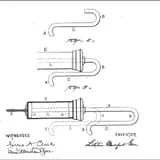
Letitia Mumford Geer filed a U.S. patent application for a one-handed medical syringe with a glass barrel, rubber plunger, and U-shaped handle.
On February 12, 1896, Letitia Mumford Geer, a working nurse in New York City, formally filed a patent application with the United States Patent Office for a revolutionary medical syringe design. Her invention featured a glass barrel, a rubber plunger, and a distinctive U-shaped handle that allowed a healthcare worker to operate the device using only one hand.
Prior to this innovation, standard medical syringes typically required two hands to operate — one to steady the barrel and another to depress the plunger — making it difficult for a single nurse or physician to simultaneously hold a patient still (particularly children or those in distress) while administering an injection. Geer's design solved this practical clinical problem directly from her firsthand nursing experience.
This filing represents a genuine barrier-breaking moment: as a woman working in the male-dominated field of medical technology and patent law in the 1890s, Geer navigated the formal U.S. patent system to protect an invention that would go on to influence medical device design for generations. Her practical, nurse-driven perspective on usability set her apart from many contemporary inventors who approached medical tools from a purely mechanical or physician-centric standpoint.
The three-year gap between filing and grant reflects the rigorous examination process of the era, but the eventual approval confirmed the novelty and utility of her design.