← All women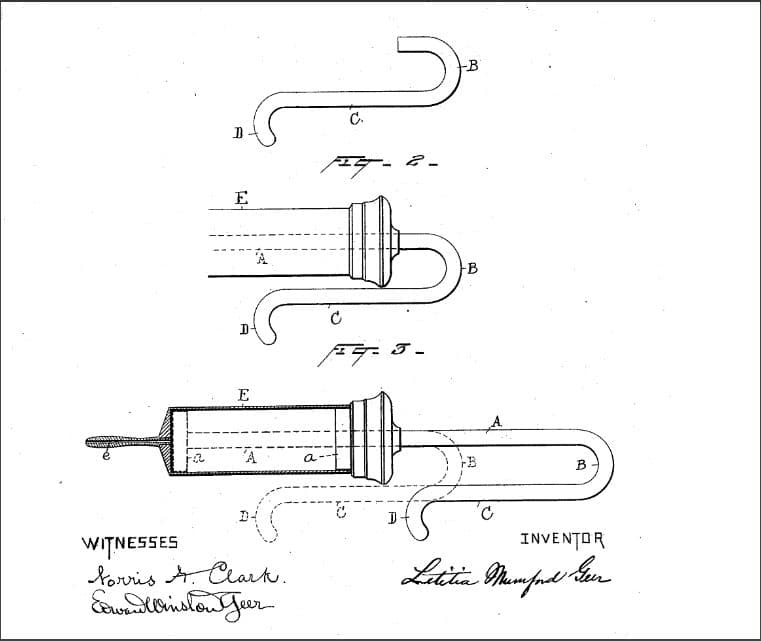
American · Medicine
Letitia Geer
1852 – July 18, 1935
Early Life and Background
Letitia Mumford Geer was an American nurse and inventor best known for creating one of the first practical one‑handed medical syringes, a device that would profoundly influence modern clinical practice.[1][3][4] She was born in New York, United States, in 1852, though surviving records do not agree on the exact day or month of her birth.[1][4][9][13] Several biographical notes compiled from census data indicate that she was the daughter of George Warren Geer and Cornelia Matilda Geer and grew up with multiple siblings in a New York family of modest means.[4][9][16]
Details of Geer’s childhood and formal education are sparse, a common situation for women of her era whose lives were often recorded only intermittently in official documents. Later reconstructions by educators and historians of women in STEM suggest that she spent most of her life in or near New York City and that she trained as a nurse, likely through hospital‑based programs that were emerging in the late 19th century.[1][4][9][10] These programs typically combined ward work with classroom instruction, exposing nurses to both the practical realities of patient care and the newest medical technologies.
Biographical essays emphasize that Geer’s formative experiences were shaped by the rapid evolution of medicine: the hypodermic needle capable of piercing skin and facilitating intravenous treatment had been introduced only a year after her birth, and hospital practices were gradually being standardized.[3][19] In this environment, nurses like Geer occupied frontline roles, administering medications, monitoring patients, and witnessing the limitations of existing instruments. Those daily frustrations would later play a crucial role in inspiring her most significant invention.
Career Beginnings and Development
By the final decades of the 19th century, Geer was working as a nurse in New York, walking hospital corridors at a time when syringes were relatively crude tools.[1][3][4][11] Descriptions in later accounts portray her as a young nurse in the 1890s, observing how injections often required awkward two‑handed use or the help of an assistant.[11][17] Syringes of the era typically consisted of a glass or metal barrel and a plunger, but their design made it difficult for the operator to maintain steady control while also managing the patient or other instruments.
Women’s historical contributions to medicine were often overlooked, and nurses were rarely seen as inventors. Nevertheless, Geer’s experience at the bedside gave her unique insight into how devices might be improved. She recognized that many procedures—especially in emergency medicine, anesthesia, and the withdrawal of bodily fluids for testing—would benefit from a syringe that could be controlled entirely with one hand.[3][4][12][17] This would free the other hand for stabilizing the injection site, restraining a distressed patient, or handling other equipment.
Geer’s decision to pursue an invention and seek patent protection placed her at the intersection of nursing practice, medical technology, and the legal structures of intellectual property. Around the mid‑1890s, she began to refine a new syringe design that incorporated a glass barrel, a rubber plunger, and a handle shaped so that the operator could hold and actuate the instrument with the same hand.[4][13][20] Her work reflected not only technical ingenuity but also a willingness to navigate the U.S. patent system at a time when women accounted for only a tiny fraction of patent applicants.[14][16]
Invention of the One‑Handed Medical Syringe
Geer’s most important achievement was the invention of a one‑handed medical syringe, which she put forward for patent protection in the United States. On February 12, 1896, she filed a U.S. patent application describing a syringe that could be operated entirely with one hand.[4][13][20] The design featured a cylindrical glass barrel, a rubber plunger, and a distinctive U‑shaped or hook‑shaped handle attached to the plunger, so that the same fingers gripping the barrel could also pull or push the plunger.[4][11][13]
The application articulated a clear goal: to produce a device that was “simple” and “cheap” yet capable of improving medical techniques in her own profession.[14][19] The detachable needle made cleaning and replacement easier, while the plunger mechanism enabled more precise control of fluid movement, both into and out of the syringe.[4][13][20] These features addressed multiple problems observed at the bedside, including inefficient dosing, contamination risks from excessive hand movement, and the difficulty of maintaining a steady injection for agitated or fragile patients.
On April 11, 1899, Geer’s efforts culminated when the United States Patent Office granted her patent, recorded in official documentation as US622,848A.[11][14][20] The patent text, later reproduced and discussed by historians, begins by identifying "Letitia Mumford Geer, citizen of the United States" and resident of East 114th Street in New York City, underscoring her status as a local professional woman rather than a university‑affiliated researcher.[16][20] The document explains how the syringe’s structure allowed single‑handed operation and describes variations in form that could be made without altering the spirit of the invention.[14][20]
Medical historians and science writers have since credited Geer’s syringe as the first practical one‑handed syringe in widespread medical use, distinguishing it from earlier, less ergonomic instruments.[1][3][17][19] Mental Floss and other popular science outlets note that when she secured the patent in 1899—coinciding with the publication of the first Merck Manual—she fundamentally changed healthcare by making injections faster, cleaner, and more controllable.[3] Educational resources on women in STEM describe her design as the basis for most modern medical syringes, which retain the core principle of one‑handed operation even as materials and disposability have evolved.[1][10][19]
Other Medical Instruments and Entrepreneurial Activity
Although the one‑handed syringe is Geer’s best‑documented invention, several sources note that she developed additional medical instruments. A profile in Women’s Activism NYC, drawing on secondary research, states that Geer invented a nasal speculum and a surgical retractor, contributing to the broader field of medical instrumentation.[4][13] These devices would have been used to open and stabilize bodily structures during examinations and surgeries, improving visibility and access for physicians.
Some contemporary narratives and professional posts suggest that Geer later expanded her work into manufacturing. A 21st‑century summary of her career mentions that by 1904 she had launched a Geer Manufacturing Company to produce improved syringes and other instruments, indicating that she may have operated not only as an inventor but also as an entrepreneur overseeing production and distribution.[7] While original corporate records are not widely cited, this portrayal aligns with the broader pattern of late‑19th‑ and early‑20th‑century inventors who established small firms to commercialize their patents.
Exact dates for these additional inventions and business activities are not consistently documented in accessible sources, and some accounts may conflate later interpretations or local oral histories. Nonetheless, the recurring attribution of a nasal speculum, retractor, and manufacturing enterprise to Geer suggests that her engagement with medical technology extended beyond a single device.[4][7][13] In the context of her time, such a portfolio would have been unusual for a woman without formal academic appointments, underscoring the breadth of her technical and organizational skills.
Recognition, Awards, and Contemporary Reception
There is little evidence that Geer received major formal awards or public honors during her lifetime, a reflection of the limited visibility accorded to women inventors in the early 20th century.[1][4][16] Patent records verify her legal rights to the syringe design, but mainstream medical journals and institutional histories from her era rarely mention her name. The relative anonymity of her contribution may be partly due to the fact that syringes are everyday tools rather than dramatic headline‑grabbing technologies; their incremental refinement often escapes broad public attention.
Modern recognition of Geer’s work has grown substantially. Educational projects, women‑in‑STEM initiatives, and digital exhibitions now highlight her as a "game changer" in medicine. The Wellspring "Game Changers" series presents her as an inventor who redesigned one of medicine’s most basic tools and whose 1899 patent underlies the modern syringe.[5] Women’s Activism NYC includes her story in its archive to illustrate how a nurse’s practical expertise can lead to transformative innovation.[4] Schools and outreach programs, such as those documented by St Mary’s in Australia, use her biography to inspire students and demonstrate the historical role of women in science and technology.[10]
Popular science and history outlets such as Mental Floss and various online documentaries further disseminate her story, framing her invention as having "saved millions of lives" by improving emergency medicine and routine care.[3][12][18] Social media campaigns around International Women’s Day and women’s history months increasingly reference Geer as an example of a previously unsung female innovator.[6][17] This renewed attention represents a form of posthumous recognition, even in the absence of formal awards from her own time.
Personal Life
Information about Geer’s personal life is fragmentary. Available biographical sketches, drawing from census records and later summaries, consistently identify her parents as George Warren Geer and Cornelia Matilda Geer and mention that she had multiple siblings.[4][9][16] One Spanish‑language profile notes that she had three or four brothers and spent most of her life in New York, suggesting a family network rooted in the region.[9][16]
There is no clear documentation in readily accessible sources regarding marriage, children, or close personal relationships, and no evidence of a widely recognized spouse or descendants appears in standard reference entries.[1][4][9][13][15] This absence may reflect gaps in the historical record rather than the reality of her life, but it also underscores how women’s private lives were often not systematically recorded unless connected to prominent male figures.
Some reconstructions of her biography also note her resting place in Green‑Wood Cemetery in Kings County, New York, based on cemetery records, though detailed information about funeral proceedings or family memorials is limited.[15] Overall, Geer’s personal narrative remains overshadowed by her professional identity as a nurse and inventor, with historians focusing principally on the documented impact of her syringe design.
Legacy and Historical Impact
Geer’s legacy lies primarily in her transformation of the syringe from a two‑handed, often awkward instrument into a ergonomic one‑handed tool that has become standard in medicine. Later accounts emphasize that her design improved the sanitation, accuracy, and efficiency of drug administration, influencing how vaccines, anesthetics, and other treatments are delivered.[1][3][4][10] The one‑handed mechanism facilitates more controlled injection, reduces the likelihood of needle movement or dosing errors, and enables practitioners to manage other aspects of patient care simultaneously.
Historians and educators highlight several aspects of her impact:
- Clinical practice: By allowing single‑handed operation, Geer’s syringe made emergency medicine and anesthesia more manageable, particularly in situations where staff or time were limited.[3][11][17]
- Technological evolution: Her design became a conceptual foundation for later syringes, including the development of disposable models in the mid‑20th century, which combined her ergonomic insights with new materials and infection‑control strategies.[3][6][10]
- Women in innovation: Geer’s success in obtaining a patent during a period when women held only about one percent of U.S. patents has been used to illustrate both the barriers faced by women and their capacity to overcome them.[14][16][19]
- Educational symbolism: Modern STEM education initiatives present her as a role model showing how frontline healthcare workers can drive technological change, reinforcing the idea that innovation emerges from close engagement with practical problems.[4][10][19]
While the exact lineages of influence between Geer’s patent and later commercial syringe designs are complex, narrative histories often link her work to subsequent breakthroughs. For example, some discussions connect her ergonomic innovations to the disposable syringes invented by Colin Murdoch in the 1950s, noting that the basic one‑handed structure she introduced remained central even as materials and production methods shifted.[6][10][12][14]
Geer’s story also contributes to broader efforts to recover the contributions of women in medicine. Projects like Women’s Activism NYC, Ecofeminita, and various Genially presentations explicitly frame her as a figure whose work was undervalued and whose name is only now being restored to the historical record.[4][14][16][19] In this sense, her legacy encompasses not only a specific device but also a narrative about recognition, equity, and the importance of documenting women’s technical achievements.
Later Life and Death
After securing her patent in 1899, Geer appears to have remained connected to medical work and, possibly, instrument manufacturing. Some modern summaries report the establishment of a Geer Manufacturing Company by 1904 to produce syringes and related devices, though detailed documentation of the firm’s operations and longevity is limited in easily accessible sources.[7] It is likely that her later career involved a mixture of nursing practice, oversight of instrument production, and perhaps continued tinkering with medical devices, consistent with the pattern of small‑scale inventors of the period.
Geer spent the remainder of her life in New York. Spanish‑language and Catalan‑language entries state that she died in Bronx or Kings County, reflecting minor discrepancies in the record, but English‑language reference sources, including the main English Wikipedia article, agree that she died in Brooklyn, New York, on July 18, 1935, at the age of 83.[1][2][4][13][15] She was later recorded as being interred at Green‑Wood Cemetery in Kings County.[15] No major obituary or contemporaneous press coverage has been widely cited, which is consistent with the broader pattern of limited recognition of women inventors at the time.
By the time of her death, the principle embodied in her syringe—single‑handed operation, precise control, and detachable components—had already become integral to routine medical practice. Although her name was not prominently celebrated, the design she patented continued to influence how injections and fluid withdrawals were performed across hospitals and clinics.[1][3][10] Subsequent generations of syringes, with refinements in materials, standardization of sizes, and the advent of disposable devices, can still be traced back conceptually to the key ergonomic idea that Geer introduced.
In the early 21st century, renewed interest in women’s history and in the origins of medical technology has brought Geer back into view. Her life and work are now documented in multiple languages and across various platforms, from encyclopedic entries to educational videos and social media campaigns.[1][2][4][9][10][14][18][19] As these efforts continue, Letitia Mumford Geer’s story serves as a reminder that critical advances in everyday medical tools often originate from the insights of practitioners whose names, for many years, went largely unrecorded.
Dated achievements
3 indexed.
- Feb121896Medicine
Files U.S. Patent Application for One-Handed Medical Syringe
Letitia Mumford Geer filed a U.S. patent application for a one-handed medical syringe with a glass barrel, rubber plunger, and U-shaped handle.
View details Letitia Mumford Geer - Women's Activism NYC - Apr111899Medicine
Granted U.S. Patent No. 622,848 for One-Handed Medical Syringe
The U.S. Patent Office granted Geer Patent No. 622,848A for her one-handed syringe, a design that became a lasting standard in medical device ergonomics.