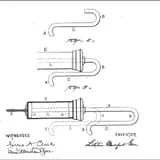
The U.S. Patent Office granted Geer Patent No. 622,848A for her one-handed syringe, a design that became a lasting standard in medical device ergonomics.
On April 11, 1899, the United States Patent Office officially granted Letitia Mumford Geer U.S. Patent No. 622,848A for her one-handed medical syringe. This landmark grant came roughly three years after her initial application, following examination of the device's novel mechanism combining a glass barrel, rubber plunger, and ergonomic U-shaped handle.
The significance of this patent extends far beyond a single device. Geer's design directly addressed a fundamental problem in clinical practice: the need for medical personnel, especially nurses, to administer injections single-handedly while simultaneously managing a patient — whether comforting a frightened child, restraining a struggling patient, or performing other simultaneous tasks. Her invention is widely credited as the first practical one-handed medical syringe, and no earlier design with documented prior art achieving the same functionality has been identified.
As a woman inventor in the late 19th century, Geer faced significant structural barriers — women were a small minority of patent holders during this period, and the medical device industry was overwhelmingly dominated by male physicians and engineers. Her success in securing this patent demonstrated that practical, user-centered innovation from nursing practice could compete and succeed within formal channels of intellectual property protection.
The core one-handed mechanism she pioneered influenced subsequent generations of syringe design, including later 20th-century innovations such as Colin Murdoch's 1956 disposable syringe, which built upon principles of single-handed operability that Geer had established nearly six decades earlier.