← All women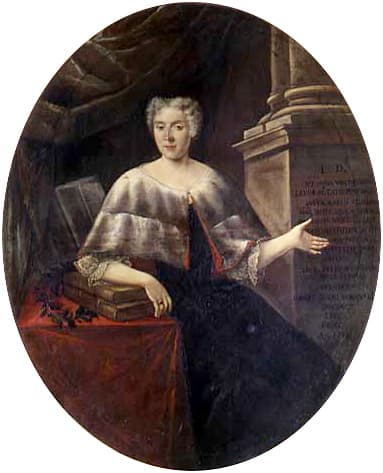
Italian · Science
Laura Bassi
October 31, 1711 – February 20, 1778
Early Life and Background
Laura Maria Caterina Bassi was born in Bologna, in the Papal States (now Italy), on 31 October 1711 to lawyer Giuseppe Bassi and Rosa Maria Cesari.[1][9] She was their only surviving child and grew up in a lower‑middle‑class but cultured household, rather than in the aristocracy that produced many early learned women.[2][8] This social position influenced both the opportunities and constraints she faced: her family had enough means to support a serious education, but not the powerful patronage networks that came with noble birth.
Bassi did not attend a formal girls’ school. Instead, she was privately educated under the supervision of a distant relative, the priest Lorenzo Stegani, who recognized her talent and introduced her to Latin, logic, Aristotelian philosophy, and later to mathematics and natural philosophy.[2][8][9] As she progressed, Stegani began inviting local scholars to witness her disputations in his home, effectively creating an informal salon around her abilities.
Bologna in the early eighteenth century was an important intellectual centre, home to the University of Bologna, one of Europe’s oldest universities, and the Istituto delle Scienze, a major scientific institute. The city also had a tradition—though limited—of women’s learning, most famously through the seventeenth‑century anatomist and lecturer Anna Morandi Manzolini and earlier scholars. This environment helped make Bassi’s extraordinary trajectory marginally conceivable, even though formal university study for women remained rare.
A key figure in her early life was Prospero Lambertini, then Archbishop of Bologna and later Pope Benedict XIV. Lambertini attended her private disputations, was impressed by her erudition, and became a crucial patron, arguing for her admission to academic honours otherwise reserved for men.[9][11] Through a combination of intellectual brilliance and strategic patronage, Bassi moved from domestic education into the public academic sphere.
Career Beginnings and Academic Breakthroughs
Bassi’s formal academic career began with a series of landmark events in 1732. On 20 March 1732, after deliberation by sixteen members, she was unanimously elected to the Academy of Sciences of the Institute of Bologna, becoming its first female member.[1][9][10] Admission to a scientific academy was a powerful credential, signalling that her scholarship merited recognition alongside leading male savants.
Shortly afterwards, she prepared for the formal degree examinations of the University of Bologna. On 17 April 1732, in a major public event, she defended forty‑nine theses in philosophy and natural philosophy before a large audience of academic and ecclesiastical dignitaries.[3][9] The theses showed her mastery of both traditional scholastic topics and newer scientific ideas. Some of her arguments reflected the influence of Isaac Newton, particularly on optics and light, indicating her engagement with cutting‑edge experimental philosophy.[1]
Following this disputation, on 12 May 1732 the university awarded Bassi the doctor of philosophy (laurea), formally recognizing her as a graduate.[1][3][9] She thus became only the second documented woman to earn a university degree, after Elena Cornaro Piscopia’s 1678 doctorate at Padua.[3][9][10] Many later accounts describe her as the first woman to hold a doctorate in science, given the strong natural philosophy component of her work.[1][3]
Her degree prompted further honours. In 1732 she was named an honorary member of the College of Philosophers and the Academy of the Institute for Sciences, and she obtained an additional teaching qualification after defending further theses.[9] That same year, the university began paying her a salary, making her the first salaried female university teacher, and at certain points she became one of its highest‑paid employees.[3][6]
Professorship and Teaching Work
In October 1732, the University of Bologna granted Bassi an honorary professorship in natural philosophy (physics).[1][2][9] Although initially framed as honorary and subject to limitations, this appointment effectively made her the first woman to hold a university professorship in Europe and the first female physics professor at a European university.[1][9] The university statutes and social conventions still restricted women’s presence in regular lecture halls, so her teaching was at first confined to special occasions and to courses held in her own home.
In December 1732, she delivered her first public lecture at the Archiginnasio, Bologna’s historic university building, appearing in the role of professor before a mixed audience.[2][8] Over time, she built a substantial teaching practice. Because university authorities were reluctant to allow a woman to teach large mixed‑gender classes, Bassi organized many of her courses privately, inviting select students and colleagues to attend lectures and demonstrations in her house. This domestic space effectively functioned as an independent laboratory and seminar room, prefiguring modern research groups.
Bassi became an important populariser of Newtonian mechanics in Italy.[1][3][6] At a time when continental physics still often favoured Cartesian or Leibnizian frameworks, she used her courses to introduce and defend Newton’s ideas of force, motion, and universal gravitation, drawing on texts such as the Principia and commentaries. Her emphasis on experiment and mathematical reasoning aligned her with Enlightenment science and helped shift local intellectual culture toward Newtonianism.
Major Works, Research, and Scientific Contributions
Although Bassi did not publish extensively by modern standards, she produced a number of scientific papers and maintained a strong experimental program. Surviving works include treatises on hydraulics, hydrodynamics, and other areas of mechanics, as well as contributions to physics and natural philosophy more broadly.[1][9] Two of her known papers address mathematical topics, indicating competence in analytical methods as well as in qualitative philosophy.[9]
Her importance lies as much in her teaching and experimental practice as in printed output. Bassi acquired scientific instruments and built a laboratory in her home, where she conducted experiments and demonstrations. In the 1760s, she began investigating the possible medicinal uses of electricity, reflecting contemporary interest in electrotherapy and the biological effects of electric currents.[1] These studies put her in conversation with other European experimenters exploring electricity’s practical applications.
Bassi corresponded and interacted with major figures of her day, including Francesco Algarotti, who dedicated his Newtonian popularization Il Newtonianismo per le dame in part to the idea of women participating in science, and with members of multiple academies. She became a member of numerous learned societies—sources mention up to fourteen academies—as her reputation spread beyond Bologna.[10][11]
Her work also influenced and was supported by her husband, the physician and scientist Giuseppe Veratti. Together they carried out experiments, especially in electricity and physiology, and their papers sometimes appeared under his name or shared credit, reflecting both collaboration and the gendered authorship norms of the period.[1][9] Bassi’s laboratory became a focal point for local and visiting scholars interested in empirical natural philosophy.
Awards, Honours, and Institutional Recognition
Bassi’s career was marked by an unusual accumulation of honours. Her 1732 election to the Academy of Sciences of Bologna made her not only the first woman in that body but, according to many accounts, the first woman admitted to any scientific establishment of its kind.[1][3][10] The same year, she received her doctorate and professorial appointment, a cluster of distinctions rarely, if ever, granted to women.
In 1745, Pope Benedict XIV—formerly Prospero Lambertini, her early patron—appointed her to an expanded role within the Bologna academy, often described as membership in the elite Benedettini, a group of twenty‑five leading scientists and scholars.[1][3] She was the only woman admitted to this circle, underscoring her exceptional status in papal and academic eyes.
Her salary and institutional rank rose over time. She became, at one point, the highest‑paid employee at the University of Bologna, an extraordinary situation for a woman in the eighteenth century.[3][6] In 1776, the Senate of Bologna and the university formally appointed her to the Chair of Experimental Physics at the Istituto delle Scienze, making her the first woman in the world to hold a university chair in physics and specifically a chair in experimental physics.[1][2][8][9]
Long after her death, astronomical bodies were named to honour her. A crater on the planet Venus was designated Bassi, and the main‑belt asteroid 15742 Laurabassi, discovered in 1991, also carries her name, recognizing her contribution to women’s place in science.[4]
Personal Life and Collaborations
In 1738, Bassi married Giuseppe Veratti, a physician and fellow scientist associated with the University of Bologna.[1][3][9] The marriage was both personal and intellectual. Veratti supported her experimental work, and together they conducted research, especially on electricity and its physiological effects. Their collaboration illustrates a model in which a husband’s social position and professional status could help legitimize a woman’s scientific career, while she in turn strengthened his scholarly profile.
The couple reportedly had eight children
Bassi’s home functioned as a hybrid domestic and academic space—part household, part laboratory and lecture room. Students, colleagues, and visiting dignitaries attended her courses and demonstrations there. This arrangement allowed her to circumvent institutional reluctance to have a woman teach in formal lecture halls, while still exercising real pedagogical and scientific authority. Bassi’s legacy operates on several levels. She was a trailblazer for women in science and higher education, demonstrating that a woman could earn a doctoral degree, hold a professorship, and lead experimental research in the eighteenth century.[10] Her career offered a concrete precedent that later reformers could cite when arguing for women’s admission to universities and scientific societies. Intellectually, she played a key role in the dissemination of Newtonian physics in Italy. Through her courses and demonstrations, she helped shift local scientific culture from older frameworks toward empirical, mathematically grounded mechanics.[1][3][6] Her work contributed to the broader integration of Newton’s ideas into continental science. Institutionally, Bassi’s positions—first as honorary professor, later as salaried teacher, and finally as chair of experimental physics—show the gradual, contested path by which a woman could enter and rise within academic structures that were not designed to accommodate her. Her reliance on private teaching spaces, on papal and civic patronage, and on exceptional status underscores both her achievements and the systemic barriers that continued to block most women. Modern historians of science and gender have recovered Bassi from relative obscurity, emphasizing her significance as one of the earliest professional women scientists.[9][11] Digitization of the Bassi–Veratti archives has made her manuscripts and correspondence more widely accessible, enabling detailed study of her scientific practice and social networks.[3] Her story is now regularly cited in biographies, scholarly articles, and educational initiatives highlighting women’s contributions to STEM. She appears in institutional histories of the University of Bologna and in projects such as directories of women philosophers and mathematicians.[2][9][12] These reinterpretations present her not merely as a curiosity but as a central figure in the long history of women’s engagement with science. In her later years, Bassi continued to teach and experiment, particularly in collaboration with Veratti. The 1776 appointment to the chair of experimental physics came relatively late in her career and has often been described as a belated recognition of work she had effectively been doing for years.[1][2][8][9] Even after gaining this formal title, she still faced the gendered expectations of her society, balancing her academic duties with family life and navigating institutional structures that remained male‑dominated. Bassi died in Bologna on 20 February 1778, aged sixty‑six.[1][3][5][9] Contemporary records list her cause of death as attacco di petto, an “attack in the chest,” likely a heart attack.[3] After her death, her husband Veratti succeeded her in some teaching roles, and her chair returned to male occupancy, illustrating the fragility of individual breakthroughs in the absence of broader structural reform. For a time, Bassi’s achievements were remembered locally but did not fundamentally alter university policies toward women. It would take more than a century before significant numbers of women gained regular access to higher education and academic posts in Europe. Nonetheless, the rediscovery and celebration of her life in the twentieth and twenty‑first centuries have repositioned her as a key figure in the narrative of women’s scientific history. Today, Laura Bassi is widely recognized as the first woman to become a physics professor at a European university, the first woman appointed to a chair of physics, and an early pioneer of women’s academic science.[1][9] Her biography illustrates both the possibilities opened by exceptional talent and patronage, and the enduring obstacles that continued to limit women’s full participation in scientific institutions.Legacy and Historical Impact
Later Life and Death
Dated achievements
8 indexed.
- Oct311711Science
Birth of Laura Bassi
Laura Maria Caterina Bassi was born in Bologna, in the Papal States (now Italy).
View details Laura Bassi - Britannica - Mar201732Science
First woman admitted to the Academy of Sciences of Bologna
Bassi became the first female member of the Bologna Academy of Sciences, admitted unanimously by sixteen members.