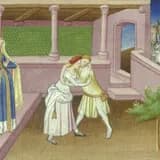
Khutulun became famous for wagering suitors horses on wrestling matches she never lost, reportedly amassing a herd of over ten thousand horses.
Khutulun's most celebrated legacy is her career as an undefeated champion wrestler, a story preserved by Marco Polo and later immortalized in the ballet Esclarmonde and believed by some scholars to have influenced the character of Atalanta-like folklore transmitted to Europe (and possibly an inspiration for the Puccini opera Turandot).
As recounted by Polo and corroborated in Central Asian chronicles, Khutulun declared that she would only marry a suitor who could defeat her in wrestling; any man who lost the match would forfeit a wager of horses to her. Suitors came from great distances to try their luck, wagering as many as one hundred horses on a single match. Khutulun never lost, and by some accounts she accumulated a herd of more than ten thousand horses through her winnings, an almost unimaginable sign of wealth and status on the steppe.
This practice cannot be tied to a single date, as it spanned much of her adult life from roughly her late teens into her thirties, but it represents one of the most extraordinary documented instances of a woman openly and repeatedly besting men in athletic combat in a public, high-stakes setting during the medieval period. Her wrestling prowess allowed her a degree of personal agency over her own marriage highly unusual for the era, since she used her physical dominance to control whether and whom she would wed, rather than being married off through purely political arrangement.