← All women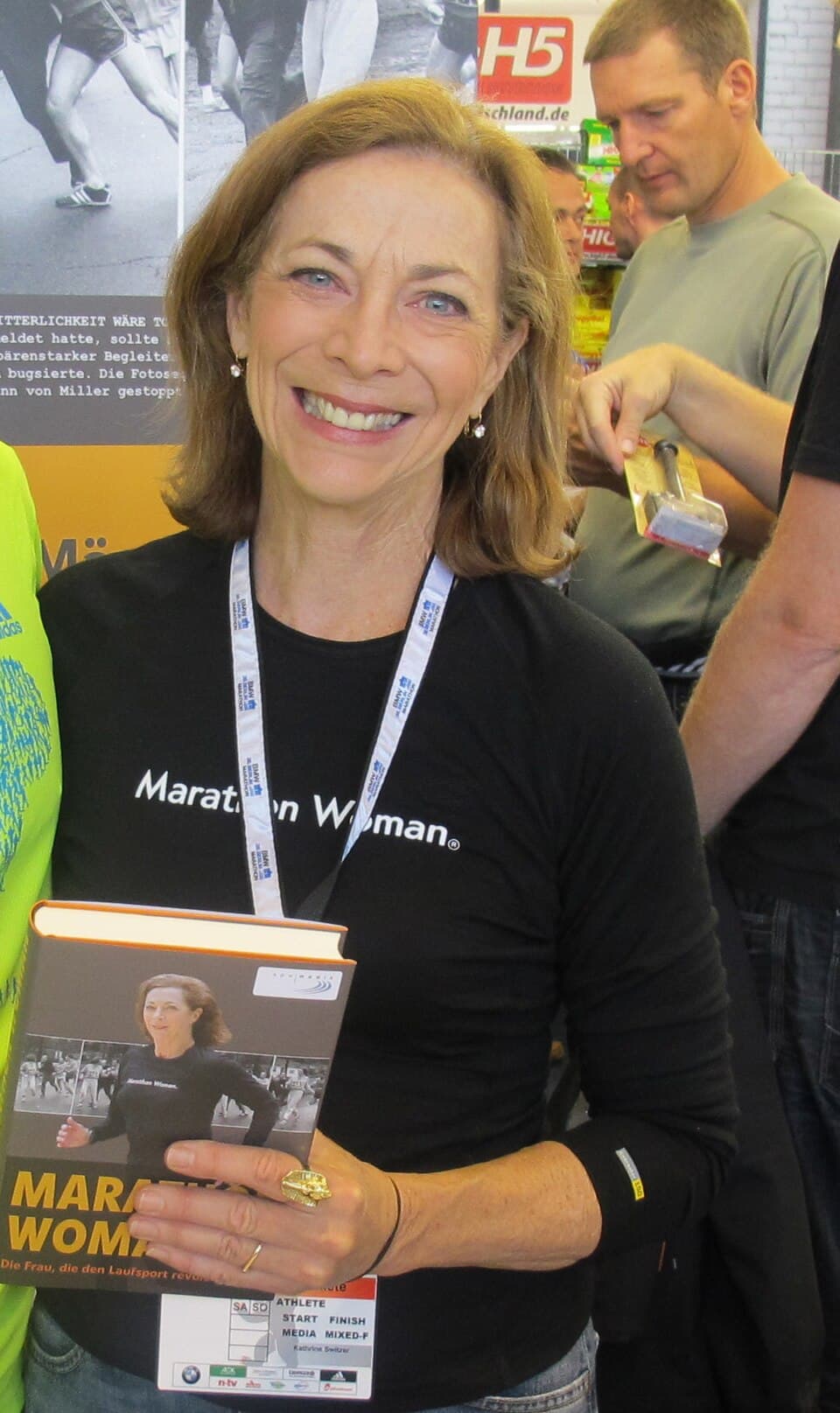
American, German · Sports · Activism
Kathrine Switzer
January 5, 1947 – present
Early Life and Background
Kathrine Virginia Switzer was born on January 5, 1947, in Amberg, in the American‑occupied zone of Germany, where her father was serving as a major in the United States Army.[1][3][11] Born into a military family, she spent her early childhood amid the dislocations and discipline of post‑Second World War service life. When she was two, the family returned to the United States, settling eventually in Northern Virginia, where Switzer attended high school and discovered a love of both running and writing.[6]
Switzer has described herself as a determined and energetic child who was encouraged by her father to run a mile a day from the age of twelve as preparation for making her high school field hockey team.[1][4] This daily running routine fostered her enjoyment of distance and instilled the idea that consistent training could open doors in sport and life. At the same time, she was an avid reader and writer, interests that later led her into journalism.
After high school, Switzer enrolled at Syracuse University in New York State, where she studied journalism at the S. I. Newhouse School of Public Communications.[4][9] She earned a B.A. in journalism in 1968 and later completed a master’s degree in public communications at Syracuse.[4][6] During her university years she continued to run, joining the men’s cross‑country team as a training partner under coach Arnie Briggs, who became a key mentor and eventually encouraged her to attempt the Boston Marathon.
Career Beginnings and the Road to Boston
In the mid‑1960s, long‑distance running was widely considered inappropriate for women. Medical myths suggested that women were physically incapable of running 26.2 miles and that doing so might harm their reproductive health.[4] Few races allowed women entries; the Boston Marathon, then governed by the Amateur Athletic Union (AAU), was effectively a men‑only event, though the rulebook did not explicitly state a sex restriction.[1]
At Syracuse, Switzer trained with the men’s team, gradually extending her mileage. Coach Briggs, who had run the Boston Marathon many times, initially doubted her ability to cover the full distance, but agreed to support her attempt if she first completed the marathon distance in training.[1][13] Switzer met this challenge, finishing a 26‑mile training run, which convinced Briggs and strengthened her resolve to enter Boston officially rather than participate as a bandit runner.
To comply with formal entry procedures, Switzer registered for the 1967 Boston Marathon using her initials, "K. V. Switzer," a standard practice for her at the time and not intended as a disguise.[1][4] The race organizers processed her form and issued bib number 261, unaware she was a woman. At that time, another woman, Roberta "Bobbi" Gibb, had already made history by running and finishing the 1966 Boston Marathon without official entry or a bib, hiding in the bushes near the start and joining the race unofficially.[1] Switzer knew of Gibb’s feat, but sought to demonstrate that women could participate through official channels and thus challenge institutional rules more directly.
1967 Boston Marathon: Breaking the Gender Barrier
On April 19, 1967, Switzer lined up for the Boston Marathon alongside her coach Arnie Briggs and boyfriend Tom Miller, wearing bib 261.[13] The start proceeded without incident, but a few miles into the race an official, later identified as race director Jock Semple, spotted her and became enraged that a woman, and one with a bib, was in "his" race.[1][9]
Semple ran onto the course, attempted to grab Switzer’s bib, and shouted at her to "get the hell out of my race."[1][4] A sequence of photographs captured the struggle: Switzer’s expression of shock and determination, Semple reaching for her bib, and Miller body‑blocking and shoving Semple away, allowing Switzer to continue running.[13] These images, later dubbed the "Boston Incident," appeared in newspapers and magazines around the world, dramatically illustrating the resistance women faced when they challenged gender boundaries in sport.
Despite the confrontation, Switzer continued and finished the marathon in approximately 4 hours and 20 minutes, becoming the first woman to officially enter and run the Boston Marathon as a registered, numbered competitor.[1][10][11] In the same race, Bobbi Gibb again ran unofficially and finished ahead of Switzer in terms of time, but without formal entry. The distinct roles of the two women—Gibb as the first woman finisher and Switzer as the first officially registered woman—are now recognized as complementary milestones in the history of women’s distance running.[1]
The incident had immediate consequences. The AAU subsequently moved to clarify its regulations and banned women from competing in races longer than 1.5 miles under its jurisdiction.[4] Far from deterring Switzer, this decision galvanized her activism. She began writing, speaking, and organizing to challenge such rules, arguing that women’s exclusion from marathons was based on outdated beliefs rather than scientific evidence.
Advocacy and the Opening of Road Races to Women
In the years following 1967, Switzer became a prominent advocate for women’s participation in road races. She worked with other runners, organizers, and officials to pressure governing bodies into changing their rules.[4][9] Her efforts, combined with those of Gibb and other early female runners, contributed to the AAU’s decision in 1971 to officially allow women into road races in the United States.[4]
By 1972, women were finally officially accepted to run the Boston Marathon in a sanctioned women’s division.[1][4] On April 17, 1972, Switzer entered this inaugural official women’s race and finished third among women, receiving a trophy from race director Jock Semple.[1][4] The scene of Semple now awarding her a prize highlighted the change in institutional attitudes over just five years and has become a symbolic moment in the narrative of women’s sports progress.
During this period, Switzer also pursued her journalism career, working in communications and broadcasting while continuing to compete. She ran numerous marathons, improving her times and competing at a high level, which reinforced her argument that women could both endure and excel in long‑distance events.[10][8]
Athletic Achievements
Beyond her barrier‑breaking run in Boston, Switzer achieved notable competitive success. On September 29, 1974, she won the women’s title at the New York City Marathon, which at the time was run as multiple loops in Central Park.[1][10][11] She recorded a time of 3:07:29, securing the women’s championship and demonstrating her ability to win major races, not merely participate as a symbolic figure.
In 1975, Switzer achieved her personal best marathon time of 2:51:37 at the Boston Marathon, finishing second among women.[8][10] This performance placed her among the leading women marathoners of the era, at a time when the depth of female competition was still developing. Throughout her career, she reportedly completed over thirty‑seven marathons.[4][8]
Recognizing her influence both on and off the road, Runner’s World magazine named Switzer "Runner of the Decade" for 1966–1976, "Visionary of the Century" in 2000, and a "Hero of Running" in 2012.[2][9] These honors reflected her dual role as athlete and architect of change in the running community.
Organizer, Promoter, and Global Advocate
In 1977, Switzer founded the Avon International Running Circuit, working with Avon Products to create a series of women’s road races around the world.[4][9] Over the following years, she directed more than 300 races in 20–27 countries, involving over one million women participants.[4][9] The circuit offered distances from 5K to marathons and provided opportunities for women who had never before had access to organized running events.
These races were strategically designed not only as athletic competitions but also as advocacy platforms. Switzer and her colleagues used them to gather performance data, build a visible community of female distance runners, and demonstrate to sports governing bodies that women’s marathons were viable and popular.[4] The success of the Avon circuit was instrumental in convincing the International Olympic Committee (IOC) to include the women’s marathon in the Olympic Games, which first occurred at the 1984 Los Angeles Olympics.[4][9]
Switzer’s work with Avon coincided with her broader career in sports promotion. She formed her own company, AtAlanta Sports Promotions, and became an Emmy Award‑winning television commentator, providing coverage for major networks such as ABC, CBS, NBC, and ESPN.[4][2] As a broadcaster, she brought expert analysis and historical context to distance races, continuing to highlight women’s achievements and the sport’s evolution.
Authorship and Media Work
Switzer has written extensively about running and women’s sports. Her memoir, Marathon Woman, first published in 2007, recounts her journey from young runner to global advocate and explores the intersection of gender, sport, and social change.[2][15] The book has been cited as influential in inspiring new generations of women to take up running and challenge limitations in their own lives.
She also authored Running and Walking for Women Over 40, the Road to Sanity and Vanity, which provides advice on fitness, health, and self‑image for midlife women, emphasizing the mental benefits of regular exercise alongside physical outcomes.[2][4] In addition, she co‑authored 26.2 Marathon Stories, a collection highlighting the drama and diversity of marathon experiences.[2]
Switzer’s media work extends beyond books and commentary. She is a sought‑after public speaker, delivering keynote addresses and lectures on topics such as women’s empowerment, overcoming adversity, and the history of running.[2][4] Her ability to blend personal narrative with broader social analysis has made her a prominent voice in discussions about gender and sport.
261 Fearless and Later Activism
In the 2010s, Switzer launched 261 Fearless, a global nonprofit initiative named after her 1967 Boston Marathon bib number.[2][4] The organization aims to empower women through running, using local clubs, training programs, and community events to build confidence, reduce social isolation, and challenge cultural restrictions.
261 Fearless clubs provide safe, non‑competitive environments for women to begin or continue running, often in regions where women’s public participation in sport is limited.[2] The organization also trains "coaches" and "club leaders," emphasizing female leadership development. Switzer’s story and the symbolism of 261 are central to the program’s messaging: the number that once marked a controversial presence at Boston has become a global emblem of fearlessness.
On April 18, 2017, following Switzer’s fiftieth‑anniversary run at Boston, media coverage and organizational communications placed significant attention on 261 Fearless, boosting its visibility and underscoring its role as the contemporary continuation of the running revolution she helped start.[2] The initiative remains a key part of her later‑life activism.
Awards, Honors, and Recognition
Switzer’s contributions have been widely recognized. Beyond Runner’s World’s accolades, she has received honors from organizations such as the National Association of Girls and Women in Sports and the New York State Regents, including the Regents Medal of Honor for her role in advancing women’s sports and educational opportunities.[9][4]
On September 30, 2011, Switzer was inducted into the National Women’s Hall of Fame in Seneca Falls, New York.[4] The Hall’s biography emphasizes that "photos of this ‘Boston Incident’ ignited the women’s running revolution" and credits her with founding the Avon International Running Circuit and helping secure the women’s marathon in the Olympic Games.[4] Her induction placed her among key figures in the history of women’s rights and equality.
Switzer has also been part of the National Distance Running Hall of Fame’s first class of inductees, further cementing her athletic and historical stature.[2] International encyclopedias and national media in multiple languages—English, German, Spanish, French, Czech, Portuguese, and others—feature entries on her, underscoring her global recognition.[3][5][7][10][11]
2017 Boston Marathon: Commemoration and Symbolism
The fiftieth anniversary of Switzer’s 1967 Boston Marathon run in 2017 marked a major moment in her later life and in public memory. On April 17, 2017, she returned to run the Boston Marathon at age 70, again wearing bib 261.[1][6][8] She finished the race, demonstrating continued endurance and drawing widespread media attention.
That same day, she served as grand marshal of the Boston Marathon, leading the event and embodying the transformation from contested participant to celebrated figurehead.[1] The Boston Athletic Association also retired bib number 261, a rare honor that permanently removed the number from circulation in recognition of its historical significance.[1][6] This act symbolized institutional acceptance of the change Switzer had once fought to achieve.
Major outlets such as The New York Times published profiles and retrospectives on her story, recounting the 1967 incident and detailing the progress in women’s participation since then.[1] The National Women’s Hall of Fame and other organizations highlighted her achievements, framing the anniversary as a celebration of five decades of advancement in women’s sports.[4]
Personal Life
Switzer’s personal life has often intertwined with her athletic journey. Her first marriage was to Tom Miller, the fellow runner who famously blocked Jock Semple during the 1967 Boston Marathon, helping her continue in the race.[6] The couple later divorced, but Miller’s action remains a vivid part of the Boston story.
Switzer later married Roger Robinson, a writer, literary scholar, and accomplished masters runner originally from New Zealand.[6][12] Robinson has written extensively on running history and culture, and the two have sometimes appeared together at running events and literary engagements. Their partnership reflects a shared commitment to both athletics and writing.
Switzer has lived in various locations, including the United States and New Zealand, while maintaining a global travel schedule for races, speaking engagements, and advocacy work.[2][12] She has not publicly emphasized motherhood as part of her biography; most profiles focus instead on her professional and athletic achievements.
Legacy and Historical Impact
Kathrine Switzer’s legacy rests on her role as a pioneer of women’s marathon running and as a architect of structural change in sports. Her 1967 Boston Marathon run is widely regarded as a watershed moment that exposed discriminatory rules and cultural attitudes.[1][4] The dramatic imagery of Jock Semple’s attempted removal and her determination to continue became a powerful symbol of resistance to gender barriers.
Historically, Switzer’s impact can be seen in several dimensions:
- Policy change: Her advocacy contributed to the AAU opening road races to women and helped pave the way for official women’s divisions in events like the Boston Marathon from 1972 onward.[4]
- Global competition: Through the Avon International Running Circuit, she helped create mass‑participation events for women worldwide and provided evidence that supported the IOC’s decision to include the women’s marathon in the 1984 Olympic Games.[4][9]
- Cultural narratives: Her writings and media work reframed distance running as a tool for women’s empowerment and personal transformation, influencing how countless women understand and engage with sport.[2][15]
- Ongoing activism: 261 Fearless extends her legacy into the present, using her story and bib number as a foundation for community‑based efforts that challenge social isolation and gender norms.[2]
Switzer’s story is frequently taught and cited in histories of women’s sports, gender equality, and social movements. International encyclopedia entries and educational materials recognize her as a central figure in the "women’s running revolution" that emerged in the late twentieth century.[3][5][7][10][11]
Later Life and Continuing Influence
In her later life, Switzer has remained active as a runner, commentator, and advocate. Her return to Boston in 2017 and her role in 261 Fearless demonstrate her ongoing commitment to using sport as a platform for social change.[1][2] She continues to speak at conferences, races, and educational institutions, emphasizing the importance of persistence, courage, and community.
Switzer has also engaged with digital platforms, using social media and online content to reach new audiences of runners and activists.[2] She remains a visible figure at major marathon events, sometimes participating, sometimes commentating, and often appearing in ceremonial roles that acknowledge her historical significance.
As of the mid‑2020s, Switzer is alive and continues to contribute to conversations about women’s rights, health, and sport. Her life and work exemplify how individual actions—such as insisting on one’s right to run a race—can have lasting structural and cultural consequences.
Dated achievements
10 indexed.
- Jan051947Science
Birth of Kathrine Switzer
Kathrine Virginia Switzer was born in Amberg, Germany, later becoming an American marathon runner and women's sports advocate.
View details Kathrine Switzer - Wikipedia - Apr191967Sports
First woman to officially enter and run the Boston Marathon
Switzer ran Boston Marathon as registered bib #261 'K.V. Switzer,' becoming the first official female entrant, despite race director Jock Semple's attempt to forcibly remove her.