← All women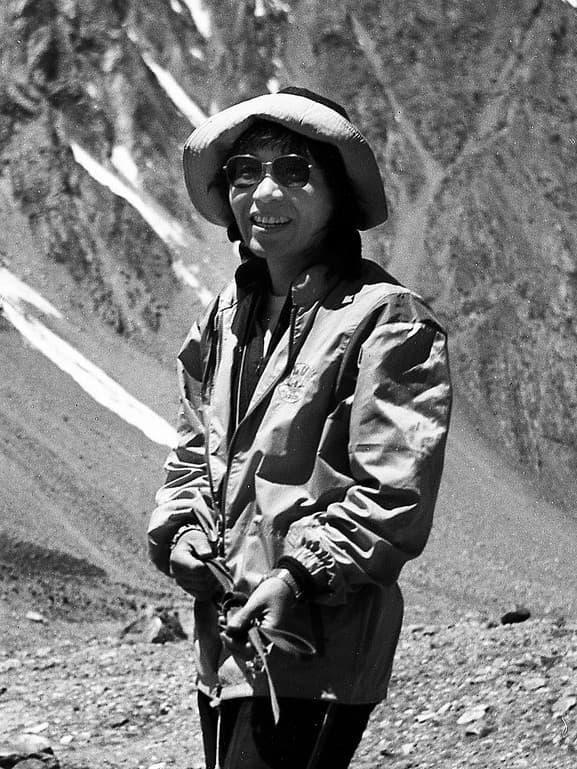
Japanese · Exploration · Activism
Junko Tabei
September 22, 1939 – October 20, 2016
Early Life and Background
Junko Tabei (née Junko Ishibashi) was born on 22 September 1939 in the town of Miharu, in Fukushima Prefecture, northern Japan.[2][5] She was the youngest of seven children in a family living in a rural, mountainous region where agriculture was a mainstay of local life.[4][13] Growing up in the aftermath of the Second World War, she experienced a Japan marked by scarcity and reconstruction, in which leisure activities were often seen as luxuries.
Tabei’s fascination with mountains began in childhood. Biographical accounts commonly report that a formative moment occurred on a primary-school trip to Mount Nasu when she was around ten or eleven years old.[5][16] The outing introduced her to the exhilaration of mountain landscapes, and despite a lack of money and limited access to equipment, she resolved to keep climbing. As a girl in conservative postwar Japan, she encountered prevailing attitudes that considered mountaineering a male pursuit and discouraged women from physically demanding sports. Some sources recount that she was occasionally labeled a "weak" or "delicate" child, further deepening the contrast between expectations and her ambitions.[2][11]
Education became a crucial pathway for Tabei. She showed academic ability at school and eventually left Fukushima for Tokyo to attend Shōwa Women’s University (also rendered Shōwa Women’s College), where she studied English literature and graduated in 1962.[2][5][6] Moving to the capital exposed her to a wider world of ideas and, critically, to organized mountaineering clubs.
Career Beginnings and Development
While at university and shortly afterward, Tabei joined several existing climbing clubs in Tokyo.[2][16] In these predominantly male spaces she often faced skepticism and condescension. Some male climbers questioned her motives, assumed she was seeking a husband rather than serious climbing, or refused to rope up with a woman.[6][11] Equipment was expensive, and as a young woman she had limited financial means; some accounts describe her making or mending her own gear and saving carefully for trips.[11][16]
Despite such barriers, Tabei’s technical skills advanced quickly. She began climbing in Japan’s rugged ranges, including the Japan Alps, and participated in increasingly challenging routes. A significant early milestone came in 1965, when she took part in what sources describe as the first all-female ascent of the Central Buttress of Tanigawa-dake, one of Japan’s most notorious peaks for climbing accidents.[6] This ascent showcased both her competence on serious alpine terrain and her interest in women-only teams, foreshadowing her later leadership of all-women expeditions.
Frustrated by the marginalization of women in mixed clubs, Tabei founded the Ladies Climbing Club: Japan (Joshi-Tohan Club) in 1969.[2][6][16] The club adopted the motto "Let’s go on an overseas expedition by ourselves" and provided a space in which women could plan and lead their own climbs, develop technical skills, and support one another. At a time when even recreational travel abroad was still relatively uncommon for Japanese women, the idea of organizing female-led international expeditions was radical.
In the early 1970s, Tabei began to realize this vision. In 1970, she took part in an all-female Japanese expedition to Annapurna III in Nepal, a 7,555‑metre Himalayan peak.[1] Although detailed day-by-day records are scarce in popular sources, this expedition marked her first major Himalayan success and helped establish her reputation as a serious high-altitude climber.
Everest Expedition and Historic Summit (1975)
Tabei’s most famous achievement came with the Japanese Women’s Everest Expedition of 1975, which she helped to organize and lead. Comprising 15 Japanese women climbers and a support team of Sherpa, the expedition represented a bold challenge: no woman had yet reached the summit of Mount Everest, and many in Japan questioned the propriety and safety of sending women to such extremes.[2][6][11]
Funding posed a major challenge. The climbers faced skepticism from sponsors and limited financial support compared with male-led teams. To raise money, they engaged in creative efforts such as securing corporate donations and even collecting used car tyres for resale.[11][16] Many members, including Tabei, balanced expedition preparation with jobs and family responsibilities. Tabei, by then married and a mother, trained intensively while also caring for her young daughter.[4]
The team approached Everest via the South Col route in Nepal. In early May 1975, while they were camped at around 6,300 metres in the Khumbu Icefall or lower Western Cwm, a powerful avalanche struck their camp.[2][11][15] Several climbers, including Tabei, were buried in snow. She lost consciousness and had to be dug out by Sherpa Ang Tsering and others, suffering bruises and injuries that initially left her unable to walk. For several days she recuperated at camp, and it was uncertain whether she would be able to continue.
Nonetheless, Tabei decided to proceed with the climb. Moving slowly and carefully, she advanced up the mountain with a reduced summit party. On 16 May 1975, at approximately 12:30 p.m. local time, Tabei reached the summit of Mount Everest, accompanied by Ang Tsering.[2][10][11] She thus became the first woman in the world to stand on Everest’s summit. Contemporary accounts vary on her overall position among summiteers—some cite her as the 36th person, others as the 40th—but all agree on the historic nature of her ascent.[9][10][15]
The news travelled quickly. Media in Japan and abroad celebrated her success, often emphasizing her small physical stature—she was about 1.5 metres tall—and contrasting it with the enormity of the mountain.[11] While such coverage sometimes relied on gendered stereotypes, it also cast Tabei as a symbol of determination and a pioneer of women’s achievements in extreme environments. In Japan, she received honors and invitations, and her name became widely known.
Seven Summits and Continued Mountaineering
Rather than treating Everest as the culmination of her career, Tabei continued climbing extensively. Over the following decades she would summit hundreds of peaks around the world, including many outside the better-known list of high-altitude objectives.[2][9] Among her most notable pursuits was the quest to complete the Seven Summits, the highest peak on each of the world’s continents.
Sources differ in completeness, but reconstructed chronologies typically include:
- Kilimanjaro (5,895 m, Africa): ascent in 1980, as part of her early Seven Summits efforts.[1][2][4]
- Aconcagua (6,961 m, South America): ascent in 1987.[1][2]
- Denali (Mount McKinley, 6,190 m, North America): ascent in 1988.[2]
- Mount Elbrus (5,642 m, Europe): ascent in 1989.[2]
- Mount Vinson (4,892 m, Antarctica): ascent in 1991.[2][16]
- Puncak Jaya (Carstensz Pyramid, 4,884 m, Australasia/Oceania): summit reached on 28 June 1992, completing the Seven Summits.[9][16]
With her successful ascent of Puncak Jaya, Tabei became the first woman to complete the Seven Summits.[1][2][9][16] This accomplishment required navigating not only technical and environmental challenges but also the difficulties of arranging travel and permits to remote and politically sensitive regions, especially in the pre‑internet era. She pursued these climbs while continuing her work and family life in Japan, reflecting her long-term commitment to mountaineering rather than a single, concentrated campaign.
Beyond the Seven Summits, Tabei is reported to have climbed at least 70 of the highest mountains worldwide and to have continued expeditionary climbing well into later adulthood.[2][9][16] Her itineraries included peaks in Asia, Europe, Africa, the Americas, and smaller ranges that attracted less publicity but further refined her skills and experience.
Writing, Teaching, and Environmental Activism
In addition to her climbing achievements, Tabei built a parallel career as an author, lecturer, and educator. She wrote or co‑wrote at least seven books about mountaineering, her expeditions, and the mountains of the world, published between the mid‑1990s and 2000s.[2][9] These works combined personal narrative with practical information and reflections on the environment and on women’s experiences in climbing.
Tabei also worked as a teacher and later as director of the Himalayan Adventure Trust of Japan, an organization involved in mountain-related education and activities.[2] She frequently gave talks at schools, universities, and public events, using her story to encourage young people—especially girls—to pursue their interests even when they ran counter to social expectations. Her lectures often emphasized preparation, teamwork, and respect for the natural world rather than the pursuit of records for their own sake.
Environmental advocacy became an increasingly central part of her work. After witnessing the growing accumulation of trash and human waste on Everest and other popular peaks, Tabei helped organize clean‑up expeditions to remove debris from high-altitude camps.[2][11][16] She pointed out that even remote mountain environments were not immune to human impact and argued that climbers bore special responsibility as stewards of these places.
Following the Great East Japan Earthquake and tsunami of 2011, Tabei became involved in initiatives to support affected communities. She led or supported annual climbs of Mount Fuji for children from the disaster-hit Tōhoku region, combining physical challenge with psychological healing and environmental education.[2] These projects linked her lifelong love of mountains to broader social and humanitarian concerns.
Awards, Honors, and Recognition
Tabei received numerous honors in Japan and abroad, though detailed records of each award’s date are not always readily accessible in popular sources. She was widely celebrated as a national hero after her 1975 Everest ascent, appearing in Japanese media and being recognized by mountaineering organizations.[2][4] Her status as the first woman on Everest and first woman to complete the Seven Summits brought her lasting international recognition, including features by organizations such as National Geographic and entries in biographical encyclopedias and women’s history reference works.[2][1][6]
In the 21st century, she began to be commemorated more explicitly as a pioneer of women’s achievements in exploration. She appears in timelines of women explorers, in children’s books and educational resources, and in exhibitions and online projects highlighting historic women in adventure and science.[1][11][20] Some astronomical tributes have even been noted in secondary sources, such as a mountain on Pluto informally nicknamed in her honor, reflecting her symbolic association with pushing boundaries beyond Earth.[10]
Although precise dates for individual awards are not always reported, the pattern of recognition underscores how Tabei’s image gradually shifted from that of a singular record‑setter to an enduring icon of perseverance, modesty, and environmental stewardship.
Personal Life
Tabei’s personal life intertwined closely with her climbing career. She married Masanobu Tabei, a mountaineer and system engineer, after meeting him through climbing circles.[2][14] The couple shared a passion for mountains, and their partnership facilitated Junko’s continued involvement in demanding expeditions at a time when married women in Japan often faced strong expectations to focus primarily on domestic roles.
They had at least one child, a daughter, and accounts often emphasize that Junko balanced motherhood with her training and expedition commitments. For the 1975 Everest expedition, she left her young daughter in the care of family, a decision that attracted public scrutiny in Japan and highlighted the double standards applied to mothers versus fathers who left home for long periods.[11] Tabei herself later reflected that she did not see her pursuits as incompatible with being a good parent, challenging contemporary norms about women’s responsibilities.
Despite her international fame, Tabei was widely described as modest, soft‑spoken, and averse to self‑promotion.[2][7][8] She repeatedly stated in interviews that she did not set out to be the first woman on Everest or the first to complete the Seven Summits; rather, she simply loved climbing and wanted to continue going to the mountains. She sometimes expressed discomfort with being singled out for attention when many others contributed to her expeditions’ success.
Legacy and Historical Impact
Junko Tabei’s legacy operates on several interconnected levels: as a pioneering woman in mountaineering, as an environmental advocate, and as a symbol of everyday perseverance against social constraints.
Her 1975 Everest summit fundamentally altered perceptions of women’s capabilities in high-altitude climbing. Before her ascent, some commentators openly questioned whether women could withstand the physiological and psychological stresses of extreme altitude. After 16 May 1975, such arguments became harder to sustain. Within a few decades, many more women would climb Everest and other 8,000‑metre peaks, often citing Tabei as an inspiration.[2][11][15]
The completion of the Seven Summits in 1992 reinforced this impact by demonstrating that a woman could achieve one of the era’s most coveted aggregate mountaineering goals.[1][2] At a time when adventure sports media still tended to focus heavily on male achievements, Tabei’s record provided a counter-narrative and encouraged sponsors and institutions to take women’s expeditions more seriously.
Tabei’s work in environmentalism added another dimension to her influence. By drawing attention to the problem of waste on Everest and supporting clean‑up efforts, she helped shift attitudes among climbers from a purely conquest-oriented mindset toward one emphasizing responsibility and stewardship.[2][11][16] Her post‑2011 activities with children from disaster-affected regions further demonstrated how mountaineering could serve social and educational purposes beyond sport.
In women’s history and feminist scholarship, Tabei is often cited as an example of how individuals can challenge gender norms not primarily through overt political activism but through persistent pursuit of their vocation. She navigated and quietly subverted expectations in mid‑ and late‑20th‑century Japan, showing that a woman could be both a mother and a world-class athlete, both modest in demeanor and uncompromising in ambition.
Despite these achievements, commentators have noted that her name remains less widely known internationally than those of male counterparts such as Sir Edmund Hillary or Reinhold Messner.[7][11][15] Recent scholarly and popular articles have sought to address this imbalance, arguing that Tabei’s story deserves a more prominent place in global narratives of exploration and sport.
Later Life, Illness, and Death
In her later years, Tabei continued to climb, lecture, and engage in environmental projects. She remained active in the Himalayan Adventure Trust of Japan and other organizations, and she maintained a demanding schedule of public appearances and educational activities.[2][16] Even as age and cumulative injuries made high-altitude expeditions more challenging, she sought out new mountains and projects, including climbs in less-heralded regions such as Niger and Oman.[16]
Around 2012, Tabei was diagnosed with peritoneal cancer.[2][16] The illness gradually limited her physical activities, but she persisted in climbing smaller peaks and continued to participate in environmental and educational initiatives as her health allowed. Her approach to illness echoed her approach to mountaineering: she acknowledged the risks and difficulties but focused on what remained possible.
Junko Tabei died on 20 October 2016, at the age of 77.[2][16] Obituaries and tributes from around the world emphasized her role as the first woman to summit Everest and the first woman to complete the Seven Summits, but also highlighted her humility, kindness, and commitment to the environment and to young people. In Japan and internationally, she is remembered not only as a record‑breaking climber but as a person who used her achievements to open paths for others.
In the years since her death, Tabei has increasingly been recognized in books, articles, documentaries, and educational materials aimed at both adults and children. Her story serves as a reminder that historic "firsts" are not isolated feats but the culmination of years of effort, community support, and quiet resistance to limiting expectations—and that their impact can endure long after the climber has left the mountain.
Dated achievements
6 indexed.
- Sep221939Science
Birth of Junko Tabei
Junko Tabei (née Ishibashi) was born in Miharu, Fukushima Prefecture, Japan.
View details Junko Tabei - Wikipedia - May161975Exploration
First Woman to Summit Mount Everest
Junko Tabei became the first woman in history to reach the summit of Mount Everest, on May 16, 1975.
View details