← All women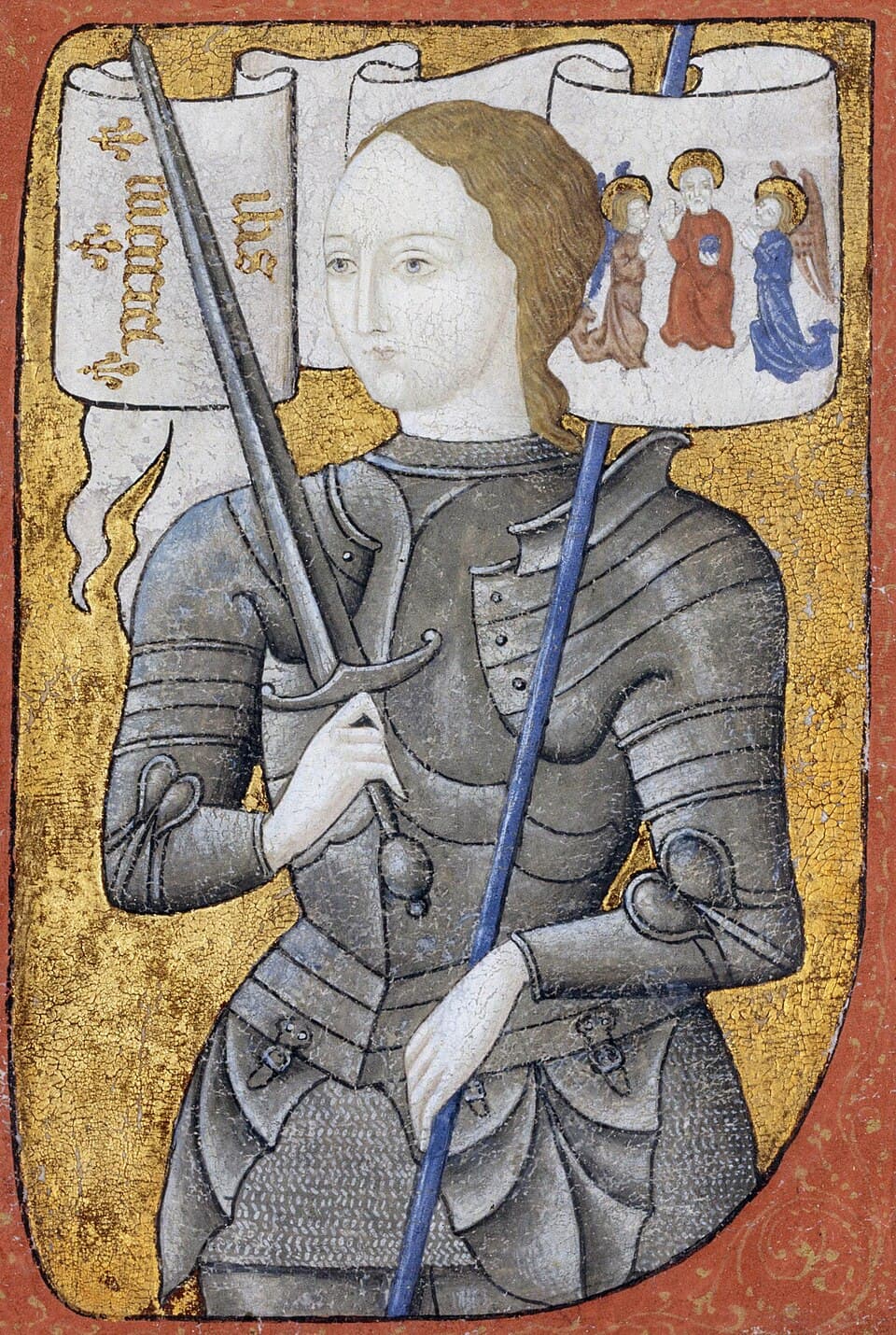
French · Politics · Activism
Joan of Arc
1412 – May 30, 1431
Early Life and Background
Joan of Arc (French: Jeanne d’Arc; c.1412–1431) was born in the small village of Domrémy in the duchy of Bar, in northeastern France, to peasant parents Jacques d’Arc and Isabelle Romée. Only the year of her birth, 1412, is regarded as reasonably secure by historians; specific dates such as 6 January are traditional rather than firmly documented. She grew up in a rural community marked by poverty, piety, and intermittent violence associated with the long-running Hundred Years’ War between France and England.[1][6]
Domrémy lay near a political and military frontier where loyalties were contested between Armagnac supporters of the Valois dauphin and Burgundian allies of the English. As a child, Joan witnessed raids and heard of towns sacked by hostile forces. Her family appears to have been respected locally; her father owned some land and worked as a ploughman, and Joan likely learned domestic skills typical of rural girls—spinning, sewing, and tending animals—alongside catechetical instruction at church.[1][6]
Around 1425, when she was about thirteen, Joan later testified that she began to experience visions and voices of saints—especially Michael the Archangel, St Catherine, and St Margaret—who exhorted her to live piously and eventually to support the dauphin Charles in expelling the English from France.[1][6] These experiences formed the core of her sense of divine mission and would be scrutinized intensively at her trial. For Joan, they were not abstract inspirations but concrete directives: she believed God had chosen her to help restore the French kingdom.
Call to Mission and Journey to the Dauphin
By the late 1420s, France was in crisis. Much of northern France and Paris lay under Anglo-Burgundian control, and the English advanced the claim that their king, Henry VI, was rightful ruler of France under the Treaty of Troyes. The Valois heir, Charles, known as the dauphin, held a diminished court at Bourges and had not been crowned at Reims, the traditional coronation site.[1][6]
In 1428, Joan traveled from Domrémy to Vaucouleurs, a nearby stronghold loyal to the dauphin, to petition the local captain Robert de Baudricourt for an escort to the dauphin’s court. Initially dismissed and ridiculed, she persisted, claiming that God would grant the French kingdom victory if Charles accepted her aid.[1][6] Her determination and reputation for piety slowly won support among some local notables.
Early in 1429, on a second approach to Vaucouleurs, Joan secured a small escort and a letter of introduction. She cut her hair and adopted male dress—a practical choice for security on the journey and later a contested issue at her trial—and departed to meet the dauphin at Chinon.[1][6] The journey took her through enemy-held or contested territory, highlighting both her courage and the willingness of some Armagnac officers to take a risk on her claims.
At Chinon, Joan was brought before Charles in a crowded audience. Accounts relate that she recognized him even when he stood disguised among courtiers, reinforcing her aura of divine insight. She told him that God commanded him to claim his crown and that she would help lift the siege of Orléans.[1][6] Because her claims were extraordinary, theologians and clerics subjected her to examination at Poitiers, assessing her orthodoxy and motives. They found no clear fault and, cautious but intrigued, advised that she be allowed to accompany a relief army, while emphasizing that success would be the ultimate test of her mission.[6]
Military Leadership and the Relief of Orléans
In the spring of 1429, Joan joined the French forces preparing to relieve Orléans, a vital city on the Loire that had been besieged by English and Burgundian troops since October 1428. The city’s fall would have opened the heart of the kingdom to further enemy advances.[6] Joan adopted armor and continued wearing male dress, carried a banner depicting religious imagery, and quickly became a focal point for soldiers and citizens.
On 29 April 1429, she entered Orléans, greeted by enthusiastic crowds and defenders who saw in her arrival a sign of divine favor.[1][6] Though she did not hold formal command in the modern sense—decisions were shared among noble captains—her influence on strategy and morale was considerable. She urged offensive operations, criticized hesitation, and promoted public acts of piety, including processions and confession, linking spiritual renewal to battlefield success.[6]
Several days of fighting followed as French forces targeted the English fortifications (bastilles) encircling the city. On 7 May 1429, Joan took part in a major assault on the stronghold of the Tourelles guarding the river crossing. Carrying her banner near the fighting, she was wounded by an arrow, removed briefly from combat, and then returned after receiving treatment, rallying the troops to a final attack that captured the position.[6][1] Her conduct reinforced her image as both inspirational and personally brave.
The English position around Orléans rapidly deteriorated. On 8 May 1429, the siege was lifted as the English withdrew, a dramatic reversal after months of encirclement.[1][6] The relief of Orléans marked a turning point in the later phase of the Hundred Years’ War, disproving the assumption that English arms were invincible and giving credibility to Joan’s assertion of divine mission. Contemporary chroniclers and later interpreters would call her the "Maid of Orléans" (La Pucelle d’Orléans) in recognition of this achievement.[1][4]
Campaign Along the Loire and the March to Reims
Following Orléans, the French undertook a bold offensive along the Loire, seizing the initiative from the English. In June 1429 they won engagements at Jargeau, Meung-sur-Loire, and Beaugency, consolidating control over the region and clearing a corridor for further advances.[1][4] Joan played an active role in these operations, exhorting troops and pressing commanders not to delay.
On 18 June 1429, the French army engaged an English force at the Battle of Patay. French cavalry exploited English deployment errors, attacking before longbowmen could establish defensive positions, and inflicted a decisive defeat.[4] While detailed accounts of Joan’s tactical actions at Patay are limited, her presence and the sense of divine favor surrounding her contributed to the confidence of French commanders. Patay shattered the aura of English battlefield superiority dating from Crécy and Agincourt and further strengthened the momentum behind Joan’s counsel.
With the Loire secured, Joan turned her attention to the political heart of her mission: the coronation of the dauphin as king at Reims. She insisted that God required this act to confirm Charles’s legitimacy and unify the kingdom.[1][6] Despite lingering hazards, Charles accepted her guidance and arranged a royal progress northward, receiving the submission of several towns along the way, often aided by the prestige of recent victories.
On 16 July 1429, Joan and the French forces reached Reims, overcoming local hesitation and clearing the way for the ceremony.[1] The next day, 17 July 1429, Charles was anointed and crowned King Charles VII of France in Reims Cathedral, according to long-standing ritual.[1][6] Joan stood nearby, bearing her banner, and later remarked that her banner had "had the honor" since it had been present in battle and at the coronation. This moment fulfilled the central objective of her mission as she understood it: to see the rightful king consecrated.
Later Campaigns and Capture at Compiègne
After Reims, Joan continued to advocate aggressive action to secure more of the kingdom, including attempts to bring Paris under royal control. In September 1429, an assault on Paris failed, with Joan wounded and the city remaining in Anglo-Burgundian hands.[1][6] Political divisions at court and war-weariness limited the scope of further campaigns. Some royal advisers favored caution and negotiation over the kind of bold offensives Joan urged.
Despite reduced support, Joan persisted in local operations. In early 1430, she helped defend Compiegne and other towns exposed to Burgundian and English pressure.[1] On 23 May 1430, during a sortie from Compiègne against Burgundian forces, she was captured outside the city near the gate of Saint-Honoré as the defenders attempted to retreat. The drawbridge was raised before all could reenter, leaving Joan vulnerable; she was seized and delivered to the Burgundian commander John of Luxembourg.[1][6]
Joan’s capture removed from the field the charismatic figure who had come to embody French resurgence. Over subsequent months, she was effectively sold to the English, transferred between secular and ecclesiastical custody, and finally brought to Rouen, the English administrative center in Normandy, for trial by an inquisitorial court led by Bishop Pierre Cauchon, who was aligned with English interests.[1][6]
Trial for Heresy at Rouen
Joan’s trial for heresy in Rouen in 1431 remains one of the most thoroughly documented legal proceedings of the medieval period. It combined theological inquiry, political objectives, and gendered suspicion of a young woman who had claimed prophetic authority, dressed in male clothing, and influenced royal policy.
The formal public phase of the trial opened on 21 February 1431, following earlier private interrogations.[1] The court questioned Joan on her visions and voices, her use of male attire, her obedience to Church authorities, and her loyalty to Charles VII. She defended the sincerity of her experiences, repeatedly stating that her voices came from God and had guided her in lifting the siege of Orléans and in bringing the king to Reims.[1][6]
The judges sought to frame her as disobedient and possibly diabolically inspired. They pressed her to submit unconditionally to the Church’s judgment. Joan, however, insisted on referring ultimate judgment to God and refused to admit that her revelations were false.[6] Her responses display intelligence, composure, and a nuanced understanding of theological concepts for a layperson, though she was at times confused by procedural complexities and the Latin documents presented.
A crucial moment came on 24 May 1431, in the churchyard of Saint-Ouen, where a sermon was preached and Joan was threatened with immediate execution if she did not recant. Under extreme psychological pressure and in fear of the stake, she signed an abjuration, a brief text she may not have fully understood, renouncing her visions and agreeing to submit to Church authority.[6] The judges commuted her sentence to life imprisonment, stipulating, among other conditions, that she abandon male dress.
Within days, however, Joan was again found wearing male clothing in her cell. She later explained that this provided practical protection and that she had renewed contact with her voices. The court interpreted this as relapse into heresy, which under canon law warranted the death penalty.[6] On this basis, they condemned her as a relapsed heretic, with additional accusations including schism and idolatry.
Execution and Immediate Aftermath
On 30 May 1431, Joan was executed by burning in the marketplace of Rouen. She was brought to the scaffold, asked for a cross, and is reported to have cried out the name of Jesus repeatedly as the flames rose.[1][17] Her body was burned several times, reduced to ashes, and the remains were thrown into the Seine, a measure intended to prevent the collection of relics and spontaneous saintly cults.[6]
For her English and Burgundian enemies, the execution aimed to demonstrate that her visions were false and to undermine the legitimacy she had conferred on Charles VII’s coronation. Yet among many in France, Joan quickly came to be regarded as a martyr, both for the French cause and for her faith. Rumors and stories circulated about heavenly signs and her innocence, and some witnesses expressed remorse.[4][7]
Politically, her death did not reverse the strategic shift she had helped initiate. The war continued; in 1435, the Burgundians abandoned their alliance with England via the Treaty of Arras, and in 1436 Paris returned to French control.[12] By 1453, major hostilities of the Hundred Years’ War ended with French victory. In retrospect, Joan’s brief military career in 1429 became a symbol of the moment when the tide turned toward Valois recovery.[2][7]
Rehabilitation Trial of 1456
After the war, the memory of Joan and the injustice of her trial remained potent. In the 1450s, initiators including Joan’s mother, Isabelle Romée, and brothers, along with supporters of King Charles VII, sought a formal review. Pope Callixtus III authorized a nullification trial to examine the legality of the 1431 proceedings.[6]
The inquiry, conducted between 1450 and 1456, collected testimonies from witnesses in Domrémy, Orléans, and other locations, including soldiers, clergy, and townspeople who had known Joan or observed her actions.[1][6] They described her piety, modesty, courage, and the circumstances of her trial and execution. Canon lawyers reviewed procedural errors, including denial of appeal, bias of judges, and reliance on coerced statements.
On 7 July 1456, the court issued its final verdict in Paris, declaring the 1431 sentence null and void, branding the Rouen trial a miscarriage of justice, and proclaiming Joan innocent of heresy.[1] The rehabilitation re-framed her as a victim of political animosity and recognized the authenticity of her faith. This legal reversal supported Charles VII’s dynastic narrative by validating the coronation at Reims and the spiritual legitimacy he had gained through her support.[6]
Personal Life and Identity
Joan’s personal life, as far as records show, was shaped by her rural upbringing, religious devotion, and single-minded focus on her mission. There is no evidence that she married or had children; she referred to herself as a maiden (pucelle) and maintained a reputation for chastity that both supporters and opponents acknowledged.[1][6]
Her adoption of male clothing had practical, symbolic, and theological dimensions. She wore armor and male garments during campaigns, which allowed easier movement and protection, and she kept similar dress in prison, in part to safeguard herself from potential sexual assault.[6] The trial records reveal her conscious reasoning about dress: she stated that she obeyed God in wearing it, and that she would change if God commanded. For the judges, however, cross-dressing became a central proof of alleged deviance.
Joan’s visionary experiences formed the core of her identity. She differentiated the inner "voices" and apparitions, describing St Michael, St Catherine, and St Margaret as instructing her to assist the dauphin and maintain personal virtue.[1][6] Her interlocutors at trial probed whether she trusted these voices more than the Church; she replied that she would obey the Church but maintained that the voices came from God. Her sense of mission fused personal spirituality with national politics in a way that was unusual for a teenage peasant woman.
Awards, Honors, and Religious Recognition
During her lifetime, Joan’s "honors" took the form of royal favor, symbolic gestures, and the esteem of soldiers and townspeople. She received armor, a banner, and sometimes gifts from cities grateful for deliverance. Charles VII did not immediately initiate formal ecclesiastical recognition, but her reputation grew steadily after the war.[6]
The most significant forms of recognition came centuries later. Her rehabilitation in 1456 restored her honor in Church law and provided a foundation for later veneration. Over the nineteenth century, renewed historical interest, notably through works by French historians such as Jules Michelet, and rising nationalism contributed to a modern revival of her image as a symbol of French identity.[17]
On 18 April 1909, Pope Pius X beatified Joan of Arc in St. Peter’s Basilica, formally recognizing her heroic virtue and permitting public devotion as "Blessed".[6][12] On 16 May 1920, Pope Benedict XV canonized her as a saint of the Catholic Church, a ceremony that drew delegations from France and confirmed universal veneration.[1][6][18] She was subsequently acknowledged as a patron saint of France, and of soldiers, prisoners, and those persecuted for their beliefs.[6][8][19]
On 10 July 1920, the French Republic enacted a law establishing a national feast day in her honor, to be celebrated on the second Sunday in May, blending civic patriotism with religious commemoration.[4][5] These recognitions illustrate how Joan, executed as a heretic in 1431, became one of the most honored women in European religious and national history.
Legacy and Historical Impact
Joan of Arc’s legacy is multifaceted, spanning military history, religious devotion, national identity, and gender studies. Militarily, her role in the relief of Orléans and the Loire campaign helped shift momentum in the Hundred Years’ War toward France. Historians emphasize that she was one factor among many—including diplomacy, economics, and broader strategic changes—but her presence decisively boosted morale and encouraged a more assertive French posture.[2][7][12]
Politically, Joan became a symbol of French nationalism, especially after her rehabilitation and later rediscovery in the nineteenth century. She was invoked as an emblem of unity and resistance against foreign domination and internal discord. During and after the French Revolution, diverse factions claimed her image, from monarchists who saw in her a defender of legitimate kingship to republicans who emphasized her humble origins and popular support.[2][17]
Religiously, Joan stands as a paradigmatic martyr and mystic whose visions intersected with public affairs. The Catholic Church’s eventual canonization endorsed her as an example of obedience to conscience and steadfast faith under persecution. She is widely venerated in France and beyond, with churches, statues, and shrines dedicated to her memory.[6][8][19]
From a women’s-history perspective, Joan’s life challenges traditional narratives that marginalize women’s political and military agency. As a teenage peasant girl, she influenced royal strategy, participated in major battles, and shaped the symbolism of kingship. Her cross-dressing, visionary claims, and willingness to confront elite male authorities at court and in trial have made her a central figure in discussions of gender, power, and spirituality.[5][14]
Joan has inspired countless cultural works—plays, operas, films, novels, and visual art—that reinterpret her story in successive contexts. She has been portrayed as a saint, patriot, feminist icon, and tragic heroine. Across these portrayals, her courage in the face of death and her insistence on the truth of her experiences remain central themes.[7][11]
Later Interpretations and Global Reception
Modern scholarship has examined the historical Joan with increasing rigor, distinguishing between legend and documented fact. Historians have explored the political uses of her image, the socio-religious environment of late medieval France, and the complex nature of her trial records. They emphasize that while some traditional details—such as the exact date of her birth—lack firm evidence, the core outlines of her military actions, trial, and rehabilitation are well supported by primary sources.[1][6][17]
Joan’s global reception reflects her resonance beyond French or Catholic contexts. She is referenced in human-rights discourse, military ethics, and debates about conscience and obedience. Her story is used in education for children and adults to illustrate themes of bravery, faith, and critical thinking about authority, as seen in popularizations by outlets such as National Geographic Kids and educational publishers.[8][14]
Today, Joan of Arc remains one of the most studied women of the medieval period and a central figure in both French collective memory and broader narratives of women’s historical impact. Her brief but intense public career—from the village of Domrémy to the stake at Rouen—continues to provoke reflection on the intersections of gender, religion, and power, and on the possibilities and dangers faced by women who step beyond prescribed roles in times of crisis.[5][7][14]
Death and Ongoing Commemoration
Joan’s death on 30 May 1431 is firmly documented in the records of her trial and execution.[1][17] Subsequent centuries have seen that date regularly commemorated in France, particularly in Orléans, where annual festivals recall her role in lifting the siege. With her canonization and the 1920 law establishing a national feast day on the second Sunday in May, her memory became enshrined in both ecclesiastical and civic calendars.[4][5][6]
In the modern era, Joan’s image appears across the political spectrum in France and internationally. She has been mobilized by various causes, sometimes in conflicting ways, underscoring the malleability of historical symbols. Yet across interpretations, Joan of Arc endures as a figure of extraordinary courage—a young woman who, claiming divine guidance, stepped into the heart of war and politics, and whose life and death have shaped conversations about justice, faith, and national identity for nearly six centuries.[2][7][11]
Dated achievements
15 indexed.
- Jan061412Politics
Traditional birth date in Domrémy
Traditional date given for the birth of Joan of Arc in Domrémy in northeastern France.
View details 1412: Joan of Arc born in France - Jul161429Politics
Arrival at Reims with Charles VII
Joan and French forces arrive at Reims for the coronation.
View details