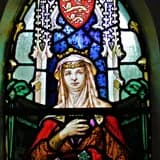
Joan, Lady of Wales, died at the royal court at Aber and was buried at Llanfaes, ending nearly three decades as a key Anglo-Welsh diplomatic intermediary.
Joan, Lady of Wales, died on 2 February 1237 at the royal court of Aber in Gwynedd, bringing to a close a life of roughly three decades spent at the heart of Anglo-Welsh politics. Her death was recorded by contemporary Welsh chroniclers, reflecting her prominent standing within the court of her husband, Llywelyn ap Iorwerth.
In grief, Llywelyn founded a Franciscan friary at Llanfaes on Anglesey in her memory, where Joan was buried — an extraordinary posthumous honour for a woman, reflecting the depth of her husband's devotion and the significance of her contributions to his reign. The friary became an important religious institution, and Joan's tomb there was venerated for centuries; her stone sarcophagus survives today, having been rediscovered after the friary's dissolution and now housed in the parish church at Beaumaris.
Joan's death marked the end of an era of relatively stable Anglo-Welsh relations that she had done much to sustain through personal diplomacy across the reigns of both King John and Henry III. Llywelyn himself would die just two years later, in 1240. Joan's legacy endured not only through the diplomatic precedents she set but through her descendants, including her son Dafydd ap Llywelyn, who succeeded his father as Prince of Gwynedd, continuing the dynastic line she had worked so hard to secure and legitimise.