← All women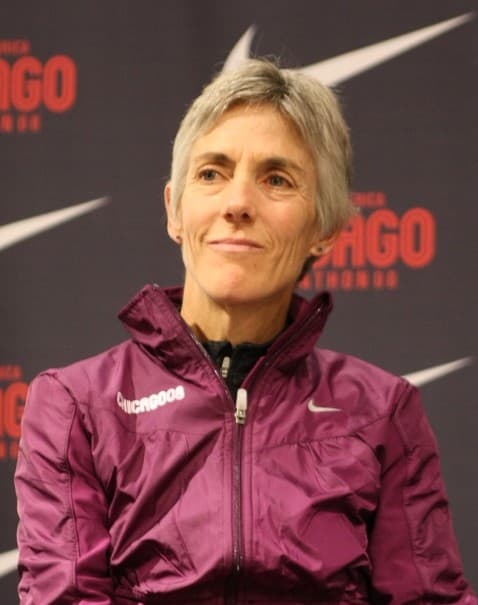
American · Sports
Joan Benoit
May 16, 1957 – present
Early Life and Background
Joan Benoit Samuelson, born Joan Benoit on May 16, 1957, in Cape Elizabeth, Maine, is an American long-distance runner who became one of the most influential figures in women’s marathoning.[1][2][7][12] She is the daughter of Nancy and Andre Benoit, a clothing retailer, and grew up in a New England coastal community whose outdoors culture and seasonal sports shaped her athletic interests.[7][12]
As a child and teenager, Benoit was an avid skier. A broken leg suffered in a skiing accident led her to distance running as part of her physical rehabilitation, a pivotal turn that would launch her career in athletics.[8][12] She attended Cape Elizabeth High School, where she ran track and developed into a standout middle-distance athlete before transitioning fully to longer distances.[12]
Benoit’s formative years coincided with major changes in U.S. women’s sport. The passage of Title IX in 1972, which prohibited sex-based discrimination in federally funded education programs, including athletics, expanded opportunities for girls and women. She came of age at the moment when colleges began investing more seriously in women’s teams, creating the environment in which she could compete as a distance runner at the collegiate level.[13][12]
Education and Collegiate Career
After high school, Benoit enrolled at Bowdoin College in Brunswick, Maine, a small liberal-arts institution where she initially intended to focus on shorter track events and field hockey.[12][13] She would ultimately become one of the most decorated athletes in the college’s history. At Bowdoin, she ran track and cross-country and also played field hockey, exemplifying the multi-sport participation typical of early generations of female college athletes.[8][13]
Benoit began serious long-distance running while at Bowdoin, partly as an extension of the rehabilitation that had introduced her to the sport.[8][12] She quickly showed exceptional talent, becoming a four-time All-American and setting numerous school and regional records, including New England marks in the 1,500- and 3,000-meter races and a U.S. women’s record in the 10,000 meters.[13] Her performances helped raise the profile of Bowdoin’s women’s programs at a time when small colleges were just beginning to make a place for elite women’s athletics.
Academically, Benoit pursued a double major in history and environmental studies and graduated from Bowdoin in 1979.[7][12][13] This combination reflected her interest in the broader social and ecological contexts surrounding sport and community life, themes that would later inform her advocacy for environmental stewardship and healthy living through running.
After Bowdoin, Benoit also spent time at North Carolina State University, racing for its team, though her most significant collegiate achievements and her lasting institutional association remained with Bowdoin.[11][13] The dual experience—at a small New England college and a large NCAA program—gave her exposure to different competitive structures and training environments.
Career Beginnings and Development
Benoit’s transition to elite marathoning occurred during the late 1970s running boom, when road races and city marathons were expanding rapidly in the United States. She entered the Boston Marathon—a race that had only officially allowed women since 1972—and rapidly made her mark.[8][9]
Her breakthrough came with her first Boston Marathon victory in 1979, when she finished in 2:35:15 and broke the women’s course record, an achievement that announced her arrival as a major U.S. marathoner.[7][8][9] This performance, early in her twenties and shortly after her college graduation, demonstrated that a woman from a small New England college could compete with and defeat the best international runners.
Over the next several years, Benoit continued to refine her training and racing. She returned to Boston multiple times, steadily lowering her times, and began competing in other major road races and national championships. Her mileage, speed work, and willingness to race aggressively placed her at the forefront of an emerging generation of women distance runners who were reshaping expectations about women’s endurance.[8][9]
World-Best and Major Marathon Achievements
In 1983, Benoit reached a new pinnacle at Boston. She won the marathon that year in 2:22:43, a time that broke the existing women’s world best for the marathon by more than two minutes.[1][6][9] Her performance was remarkable not only for its speed but for its audacity: she attacked the hilly course with a bold, front-running style, demonstrating that women could race the marathon with the same aggressive tactics that male champions had long employed.
Boston’s 1983 race is widely regarded as one of the defining moments in women’s distance running. By taking such a large chunk off the world best, Benoit reset the global standard for women’s marathoning. Her run was noted by athletics historians and Hall of Fame committees as a world-record-level performance that stood as a benchmark for more than a year.[6][18]
The following year, Benoit’s focus shifted to the 1984 U.S. Olympic Trials and the debut of the women’s marathon at the Olympic Games. In early 1984 she underwent arthroscopic knee surgery, raising questions about whether she could adequately prepare for the Trials and the Olympics.[6][7] Despite this setback, she won the U.S. Olympic Marathon Trials with a time of 2:31:04, securing her place on the American team.[7] The victory, coming weeks after surgery, was itself a testament to her resilience.
On August 5, 1984, at the Los Angeles Olympic Games, Benoit made history by winning the inaugural Olympic women’s marathon in 2:24:52.[1][2][6][8] She broke away from the field early, running alone for much of the race and entering the Coliseum well ahead of her closest competitors. Her time set an Olympic record and earned her the first gold medal ever awarded in the women’s marathon.[2][7] This victory was a landmark for women’s athletics, symbolizing the arrival of women’s marathoning on sport’s biggest stage.
In 1985, Benoit extended her record-breaking influence to the Chicago Marathon, where she won in 2:21:21.[1][7][15] The performance set a U.S. women’s marathon best and, according to later accounts, remained the fastest time by an American woman in Chicago for 32 years.[1][15] Chicago’s flat, fast course showcased her ability to adapt to different marathon environments and further cemented her standing as one of the world’s premier marathoners.
Other Major Marathon Performances
Beyond Boston, Los Angeles, and Chicago, Benoit competed in a range of high-profile events. She raced the New York City Marathon, one of the world’s largest and most visible marathons, posting strong times in the late 1980s and early 1990s. In 1988, she finished New York in 2:32:40, and in 1991 she returned to record a time of 2:33:49, performances that demonstrated her continued relevance on the international stage.[8]
She also returned repeatedly to Boston, adding notable times in 1981 and 1991 and maintaining a long-term presence in the race she had helped transform.[8] These repeated appearances across multiple decades are crucial to understanding her legacy: Benoit was not only a record-setter but a sustained competitor whose career extended well beyond a single Olympic cycle.
Over the course of her career, Benoit held U.S. records in multiple events—including the 10 km, the half-marathon, and the marathon—and at one point held the women’s marathon world record.[2][7][9] The exact durations of these records varied, but together they illustrate her breadth as a distance runner and her influence on the performance standards of her era.
Awards, Honors, and Recognition
Benoit’s achievements brought significant recognition from the sports community. In 1984, the year of her Olympic triumph, she received the Jesse Owens Award, one of U.S. track and field’s highest honors, and was named the Women’s Sports Foundation Amateur Sportswoman of the Year.[7][13] These awards reflected a broader appreciation of her role in advancing women’s athletics.
In 1985, she received the Sullivan Award as the top U.S. amateur athlete, further underscoring her prominence in national sports culture.[13] Later, she was inducted into the Bowdoin Athletic Hall of Honor and the U.S. Olympic & Paralympic Hall of Fame, institutional recognitions that placed her among the most distinguished American athletes of the late twentieth century.[6][13]
Her influence has also been acknowledged in broader historical rankings. In 1999, Sports Illustrated listed her as #20 on its "Top 100 Women Athletes of the Twentieth Century", highlighting both her competitive achievements and her symbolic importance in the trajectory of women’s sport.[13]
In addition to awards, Benoit’s story has been told in media and literature. She co-authored the book "Running Tide", reflecting on her life and career.[1][16] Her experiences—balancing training, family, public expectations, and health—provided material for discussions of women’s athletic identity during a period of rapid social change.
Personal Life
In 1984, the same year she won Olympic gold, Joan Benoit married Scott Samuelson and subsequently adopted the name Joan Benoit Samuelson.[1][7] The couple has two children: a daughter, Abigail, born in 1987, and a son, Anders, born in 1990.[7][11] Balancing motherhood with an elite running career, she became an example of how women athletes navigate family responsibilities alongside training and competition.
Benoit has remained closely connected to Maine throughout her life. Her ties to Cape Elizabeth and Bowdoin College have informed her public persona as a grounded, community-oriented athlete, and she has been involved in local running initiatives and environmental causes.[12][13] Her commitment to community reflects the broader tendency among women pioneers in sport to leverage their visibility in support of health, youth engagement, and social change.
Later Career and Ongoing Contributions
After her peak competitive years in the 1980s and early 1990s, Benoit continued to run marathons and road races, often focusing on age-group excellence and symbolic appearances that linked past and present generations of runners.[1][12] She has participated in major events well into her later adulthood, occasionally drawing attention for performances that approach or surpass age-group records and that demonstrate the possibilities of lifelong athletic participation.
Beyond racing, Benoit has contributed to the sport as a coach, mentor, and advocate. She has shared training philosophies and experiences through clinics, articles, and online platforms, and has engaged with initiatives aimed at encouraging women and girls to take up distance running.[1][15] Her example—transitioning from world-record marathoner to community advocate—mirrors broader patterns in women’s sports leadership, where pioneers often remain active in shaping the next generation.
Her life and career have also become subjects of educational and inspirational materials, including a profile in MasterClass that presents her as a case study in perseverance, training discipline, and the evolution of women’s competitive opportunities.[15] These narratives emphasize not only her major victories but also the setbacks—such as injury and surgery—that she overcame.
Legacy and Historical Impact
Joan Benoit Samuelson’s legacy rests above all on her role as the first Olympic women’s marathon champion and as a pioneer in women’s distance running.[1][2][3][4][10][14] Her 1979 Boston Marathon victory gave American women a visible champion in a race that had only recently opened formally to female competitors. Her 1983 world-best Boston run shattered assumptions about women’s endurance limits. Her 1984 Olympic gold provided an iconic image of a woman commanding the marathon on the world’s most prestigious athletic stage.
Historically, she is part of the first generation of women to benefit fully from Title IX and to travel internationally as professional or semi-professional athletes. At the same time, she faced the lingering effects of earlier prejudices—questions about whether marathons were too demanding for women, doubts about women’s place in the sports marketplace, and uneven institutional support.[2][7][9] Her achievements helped dispel these doubts, demonstrating that when given similar opportunities and resources, women could perform at levels that rivaled or surpassed men’s expectations.
Benoit’s impact also extends to cultural perceptions of aging, motherhood, and athletic identity. As a mother who continued to run and compete, she represented a model of integrated life roles. Her later marathons and age-group performances offered a counter-narrative to the idea that serious athletic achievement must end in early adulthood, particularly for women.[7][12]
In the historiography of women’s sport, Benoit is frequently cited as one of the greatest female marathoners of the twentieth century.[9][13] Her records and titles provide the quantitative basis for this assessment, while her public presence and advocacy supply the qualitative dimension. She showed that a woman from a small-town background and a liberal-arts college could influence global standards in a sport long dominated by major-city clubs and male elites.
Later Life and Status
Joan Benoit Samuelson remains alive and continues to be engaged with the running community. Profiles and interviews in the 2010s and 2020s portray her as an active participant in events, a mentor to younger athletes, and a commentator on the evolution of women’s marathoning.[1][12][15] She is often invited to reflect on the 1984 Olympic race and its legacy, particularly during milestone anniversaries.
While she no longer competes at the very top of the elite field, Benoit’s ongoing presence in running underscores the endurance of her influence. Her career trajectory—from injured skier to collegiate star, from Boston record-setter to Olympic champion, and from professional athlete to community advocate—captures the broader arc of women’s distance running in the late twentieth and early twenty-first centuries.
In historical terms, Joan Benoit Samuelson’s life provides a lens through which to view the transformation of women’s opportunities in sport. Her achievements are central to the story of how women claimed the marathon as their own, and how individual excellence can become a catalyst for structural change in athletics.
Dated achievements
9 indexed.
- May161957Sports
Birth of Joan Benoit
Joan Benoit was born in Cape Elizabeth, Maine, on May 16, 1957.
View details Wikipedia: Joan Benoit - Apr231979Sports
First Boston Marathon Victory
Benoit won her first Boston Marathon in 2:35:15, setting an American course record.
View details