← All women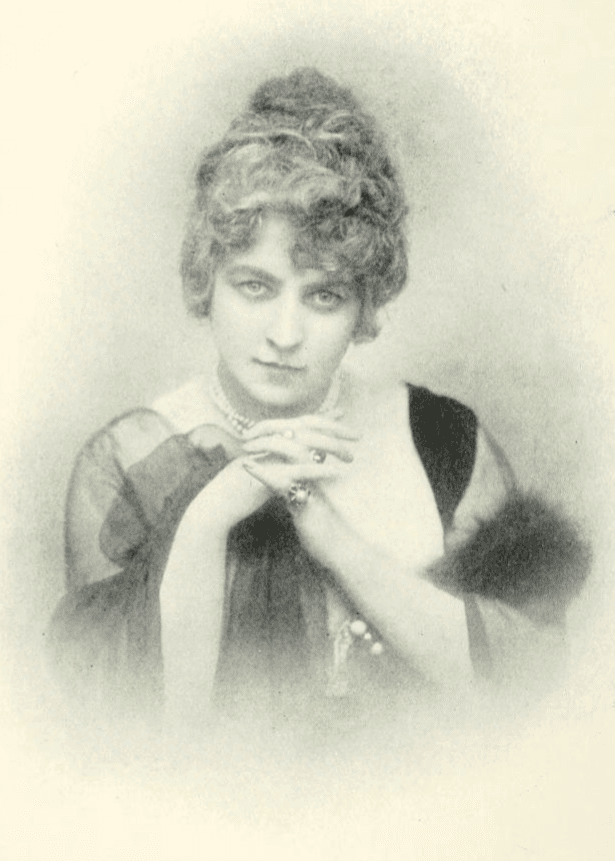
French · Arts
Jeanne Paquin
June 23, 1869 – August 28, 1936
Early Life and Background
Jeanne Paquin, born Jeanne Marie Charlotte Beckers in 1869, came from L’Île-Saint-Denis, a commune in Saint-Denis on the northern outskirts of Paris, France.[2][5][6] Sources describe her as growing up in a modest environment, with at least one account noting that her father was a doctor of medicine, positioning the family within the lower middle class rather than the traditional aristocratic clientele of couture.[8] Raised close to, but not within, the elite circles that frequented Paris fashion houses, she belonged to the burgeoning urban population that supplied both labor and consumers for the city’s expanding luxury trades.
From a young age, Paquin trained as a dressmaker, entering the flourishing couture industry of late nineteenth‑century Paris.[4][12] She apprenticed at Maison Rouff, a high‑fashion house founded in 1884, and quickly rose through its internal hierarchy.[12] Accounts agree that she eventually became the première, or head of the atelier, a position of considerable responsibility that required coordinating teams of seamstresses, interpreting the chief designer’s ideas, and ensuring the quality of garments.[4][12] These formative years immersed her in the technical and organizational aspects of couture work and gave her intimate knowledge of client expectations and workshop management.
Her upbringing in Saint-Denis and apprenticeship in Paris’s couture houses shaped a designer deeply attuned to both the aspirations of bourgeois women and the realities of working‑class labor. Rather than being groomed as a society figure, she arrived in fashion from the shop floor, with skills earned through experience. That perspective would later inform her emphasis on practical movement, modern silhouettes, and nontraditional marketing strategies.
Career Beginnings and the House of Paquin
Paquin’s professional breakthrough coincided with her personal life. Around 1890, she married Isidore René Jacob, a businessman whose family owned a menswear shop.[6][9] Jacob adopted the name Paquin, which would become the label under which Jeanne’s couture house operated.[14][16] Their marriage formed a partnership combining Jeanne’s creative expertise with Isidore’s commercial acumen.
In 1891, shortly before or just after their marriage, Jeanne and Isidore established the Maison de Couture Paquin on the fashionable Rue de la Paix in Paris, next door to the famed house of Worth.[1][4][9][14][16] Jeanne served as the creative director and chief designer, while Isidore ran the business operations.[4][14] The firm was initially known as Paquin & Cie and quickly gained attention for designs that contrasted strongly colored fabrics with the pastel tones then in vogue, as well as for an approach that foregrounded movement and theatrical effects.[11][14]
From the outset, Paquin distinguished herself with innovative marketing tactics. She and her husband were among the first couturiers to send their models to public events—operas, theatre performances, and horse races—wearing Paquin gowns as a form of live advertisement.[14] These appearances transformed social spaces into informal fashion shows and positioned the brand in front of influential audiences without relying solely on traditional salon presentations. Paquin herself consistently wore her own designs in public, further reinforcing the house’s image.[9]
The house expanded rapidly. By the late 1890s, Paquin’s clientele included aristocrats, actresses, and international socialites. The Victoria and Albert Museum holds Paquin garments dated to winter 1897, confirming that by that time the house was producing highly finished couture daywear and eveningwear documented in museum collections.[1] Her designs often featured dynamic drapery, imaginative use of lace, and bold color juxtapositions, all calculated to stand out in crowded public settings.
Design Style and Major Contributions
Paquin became known for her modern and innovative designs, a reputation repeated across fashion histories.[1][2][5][7][12] She helped transform the female silhouette at the turn of the twentieth century, moving away from the heavily ornamented, rigid forms of the 1880s toward more fluid lines suited to the lifestyles of modern urban women.[7] Her clothes emphasized mobility and theatrical effect, aligning with the culture of spectacle that characterized the Belle Époque.
Color was central to Paquin’s aesthetic. Commentators note that she favored rich jewel tones in the 1890s, lighter pastels in the early 1900s, and often daring combinations and clashing hues in the 1910s.[11] Rather than obeying strictly conventional palettes, she orchestrated color contrasts that were striking but harmonious, using fabrics such as silk, velvet, and chiffon to create depth.
She also showed an ability to incorporate and reinterpret foreign influences. Around 1907, Paquin launched an “Impero” range that included a kimono‑style cape, reflecting the period’s fascination with Japanese forms and art nouveau lines.[1] By translating these inspirations into wearable couture rather than costume, she helped domesticate exotic elements for Western clients.
Beyond individual garments, Paquin’s business model was groundbreaking. She was one of the earliest couturières to organize multi‑branch couture operations, with shops in London, Buenos Aires, and Madrid, and later representation in New York.[2][9][14] At the height of her success, her company reportedly employed more than 2,000 people worldwide, servicing a clientele that included royalty and theatrical performers.[6][13] This scale was unprecedented for a woman designer and rare even among male couturiers of the period.
International Expansion
Maison Paquin’s first major step beyond France came in 1896, when the firm entered into partnership with English investors and opened a London branch.[2][9] This establishment made Paquin among the first Paris couturiers to maintain a permanent presence in a foreign capital. It catered to British aristocrats and wealthy clients who wanted direct access to Paris fashion without extensive travel.
In 1912, the house opened a branch in Buenos Aires, extending Paquin’s reach to South America.[2][9][14] Buenos Aires, with its affluent elites and strong ties to Europe, offered fertile ground for couture imports. The branch allowed the house to serve clients locally while reinforcing Paris’s status as the origin point for high style.
By 1914, Paquin had established a branch in Madrid, adding the Spanish capital to her network.[2][9] Together, the London, Buenos Aires, and Madrid operations positioned Paquin as a pioneer of international couture branding. Her network prefigured the global retail structures later adopted by fashion houses in the second half of the twentieth century.
These expansions were not merely commercial; they also symbolized the reach of French culture. Paquin’s garments circulated as tangible expressions of Parisian modernity, and her entrepreneurial success helped consolidate the notion of Paris as the undisputed fashion capital.
World’s Fairs and Institutional Leadership
Paquin played a major role in institutional representations of fashion. During the Exposition Universelle of 1900 in Paris, she was elected by her peers as President of the Fashion Section, overseeing the first collective showcase of couture at a world’s fair.[4][9][11][14][16] This appointment highlighted her standing among couturiers and her ability to coordinate competitors in a unified presentation.
The fashion section presented couture as an important French industry, linking artistic creativity with economic vitality. Paquin’s leadership contributed to framing fashion displays as organized spectacles, a concept that carried over into later industry exhibitions and influenced the evolution of fashion shows.[4] The fair attracted tens of millions of visitors, giving her house enormous visibility.[11]
Her institutional leadership continued into the 1910s. From 1917 to 1919, she served as president of the Chambre Syndicale de la Haute Couture (or Chambre syndicale de la couture), the governing body of Parisian couture houses.[4][9][11][16] She is widely noted as the first woman to hold this role.[4][9] During her presidency, which coincided with the final years of World War I, she helped guide the industry through shortages and evolving social needs while maintaining its international relevance.
Awards, Honors, and Recognition
Jeanne Paquin became one of the most decorated figures in early twentieth‑century fashion. In 1910, she was awarded the Order of Leopold II of Belgium, a national honor recognizing her achievements as a leading couturière and business innovator.[2][9] The decoration signaled foreign courts’ esteem for her work and acknowledged the economic and cultural value of couture beyond France.
Her most significant recognition came in 1913, when she was awarded the Légion d’honneur in the field of commerce.[2][4][9][11][14][16] Multiple sources emphasize that she was the first woman designer and the first woman dressmaker to receive this distinction.[2][4][11][14] The award underscored her role in supporting the French economy through a successful export‑oriented couture business.
Paquin’s honors extended beyond medals. Contemporary press coverage and later scholarship describe her as the first woman to gain international celebrity in the fashion business, a status that reflects her widespread renown among clients and industry professionals.[2] Some accounts call her the first major female fashion designer in Europe and a pioneer of the modern fashion business.[1][5][12][14] Although earlier female couturiers existed, Paquin’s combination of size, visibility, and institutional roles made her uniquely prominent.
Personal Life
Jeanne Paquin’s personal relationships shaped, but did not overshadow, her professional identity. Her marriage to Isidore René Jacob dit Paquin around 1890 provided business support and a surname that became synonymous with her brand.[6][9][14] The couple’s complementary roles secured the early success of Maison Paquin, with Jeanne overseeing design and Isidore managing finances and expansion.[4][14]
In 1907, Isidore Paquin died, leaving Jeanne a widow and the sole figure at the helm of the house.[11] Rather than retreating, she intensified her involvement in business decisions and continued to grow the company. Sources emphasize that she became a successful businesswoman in her own right after her husband’s death, strengthening her public image as an independent entrepreneur.[11]
After retiring from active design work, Paquin remarried. In 1931, she wed Jean-Baptiste Noulens, a French diplomat.[9] This late marriage took place after she had already secured her place in fashion history. There is limited documentation of children or extended family life; most accounts focus on her professional achievements and institutional roles.
Later Career, Retirement, and House Continuity
Paquin’s active design career spanned roughly three decades, from the opening of her house in 1891 to her retirement in 1920.[2][9][11] During World War I, she continued to produce designs that balanced elegance with practicality, adjusting hemlines and volumes to accommodate changing social roles for women, many of whom entered wartime work.
In 1920, she retired from direct involvement in the house, choosing designer Madeleine Wallis as her successor.[11][16] Wallis and other subsequent designers maintained the Paquin label, which remained active under varying leadership until 1956, when the house finally closed.[11] This continuity underscores the structural solidity of the brand Paquin had built; even without her daily presence, the house persisted for decades.
After retirement, Paquin appears less frequently in contemporary press, but her reputation remained strong. She continued to be cited as a leading figure in the history of couture, and her earlier institutional honors maintained her symbolic importance for the industry.
Death
Jeanne Paquin died in Paris in 1936, with sources giving the precise date of 28 August 1936.[5][13] She was about 67 years old. Her death closed the chapter on a career that had fundamentally reshaped the business and culture of fashion during the Belle Époque and early twentieth century.
At the time of her passing, newer names such as Coco Chanel and Jean Patou had come to dominate discussions of modern style. As a result, Paquin’s contributions gradually faded from mainstream memory, even though many of the structural innovations behind their success—global branding, theatrical presentation, and integration of commerce and art—had been pioneered by her.
Legacy and Historical Impact
Historical assessments consistently describe Jeanne Paquin as a pioneer of the modern fashion business and the first major female couturier to achieve international fame.[1][2][5][7][12][14] Her legacy can be grouped into several key areas: design innovation, business strategy, institutional leadership, and the advancement of women in professional life.
In design terms, Paquin helped move women’s fashion from late nineteenth‑century heaviness to a more dynamic, theatrical modernity. Her work with color, silhouette, and stage‑ready garments captured the spirit of the Belle Époque and laid the groundwork for later explorations of movement and simplicity in dress.
As a business strategist, she anticipated the global branding practices that would define twentieth‑century luxury industries. Her branches in London, Buenos Aires, and Madrid, and her later presence in New York, demonstrated that couture could operate as a multi‑city enterprise oriented toward international markets.[2][9][14] She understood the promotional power of public appearances and orchestrated them to maximum effect.
Institutionally, Paquin played a vital role in positioning couture as both art and industry. Her presidency of the fashion section at the 1900 Exposition Universelle and her leadership of the Chambre Syndicale de la Haute Couture during World War I helped formalize fashion’s relationship to national identity and economic policy.[4][9][11][16]
Crucially, Paquin advanced women’s visibility in commerce and governance. She was the first woman designer to receive the Légion d’honneur in commerce,[2][4][11][14][16] and the first female president of the Chambre syndicale de la couture.[4][9] Her recognition by state and professional bodies challenged assumptions about women’s roles in business at a time when they lacked full political rights.
Although later histories sometimes understate her importance, renewed scholarly and museum interest—as seen in exhibitions, institutional articles, and digital archives—has begun to restore Paquin to a central place in narratives of fashion history.[1][4][9][12] Contemporary discussions often highlight how her career exemplifies the ways women shaped modern industries even when their names did not remain dominant in popular memory.
Today, surviving Paquin garments in museum collections, along with archival photographs and fashion plates, continue to testify to her artistry and ambition. Her life offers a case study in how a woman from a non‑elite background could harness technical skill, entrepreneurial vision, and institutional engagement to transform a major cultural sector.
Dated achievements
10 indexed.
- Jun231869Arts
Birth of Jeanne Paquin
Jeanne Marie Charlotte Beckers, later known as Jeanne Paquin, was born in Saint-Denis, France.
View details Wikipedia: Jeanne Paquin - Jan011891Arts
Opening of the House of Paquin in Paris
In January 1891, Jeanne Paquin opened her own fashion house in Paris, becoming a leading female couturier in Europe.