← All women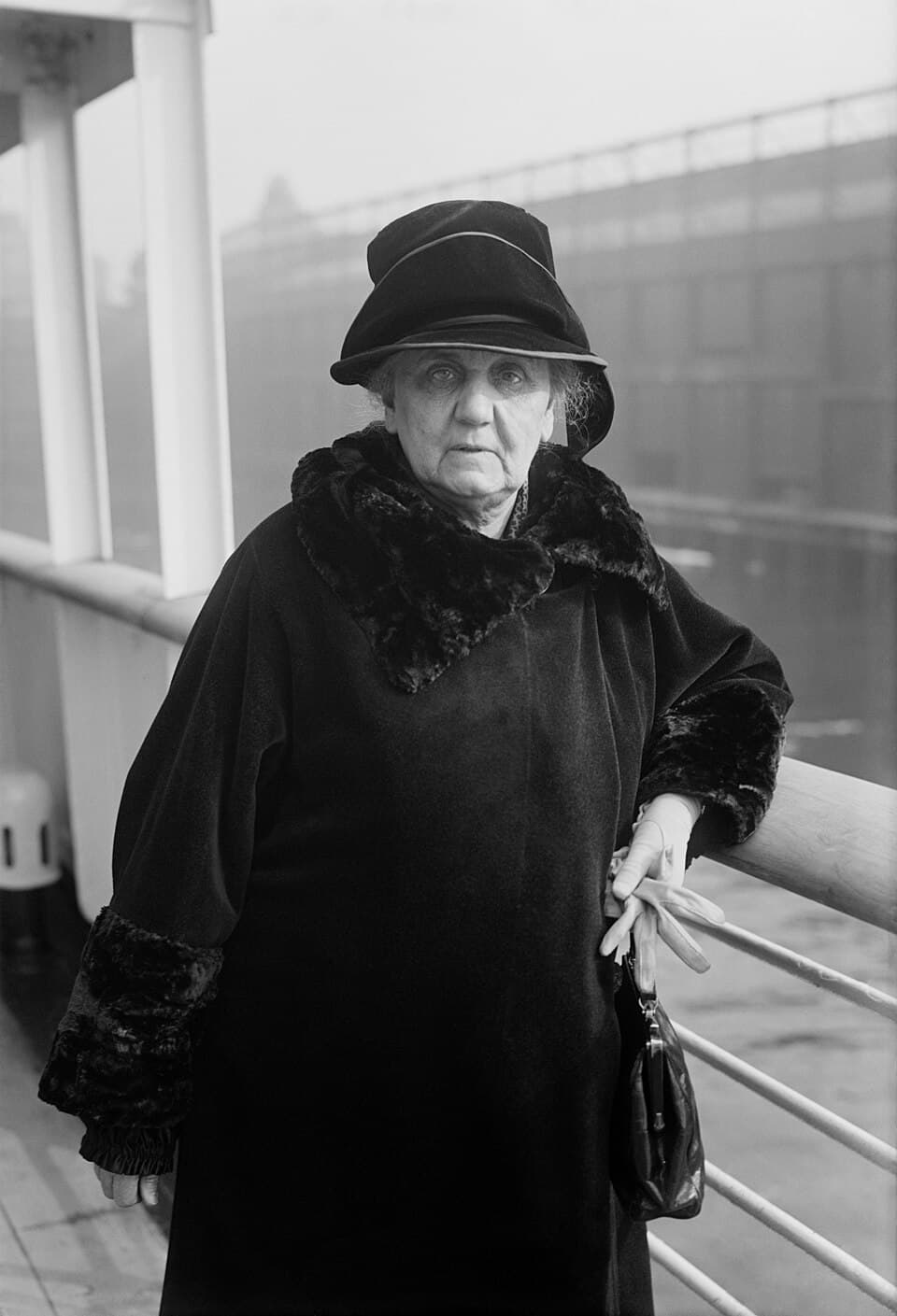
American · Activism · Politics
Jane Addams
September 6, 1860 – May 21, 1935
Early Life and Background
Jane Addams, born Laura Jane Addams on September 6, 1860, in Cedarville, Illinois, was the eighth of nine children in a prosperous family rooted in Midwestern civic life.[1][2][4][12][14] Her father, John Huy Addams, owned mills and served as an Illinois state senator, aligning closely with the Republican Party and maintaining a personal friendship with Abraham Lincoln.[2][6][10] Her mother, Sarah Weber Addams, died when Jane was young, a loss that left a lasting emotional mark.[6][10] The family environment combined material security with strong expectations of civic responsibility, thrift, and moral integrity.
Addams’s childhood was shaped by both privilege and physical vulnerability. She suffered from curvature of the spine and recurrent health problems, which limited some activities but heightened her sensitivity to suffering and social exclusion.[6] Her father’s respect for Quaker ethics and reform-minded Protestant ideals exposed her early to notions of social duty and justice. Living in rural Cedarville, she saw the sharp contrast between her own comfortable surroundings and the hardships faced by laborers and the poor—a contrast that later fueled her resolve to address urban inequality.
In 1877, Addams enrolled at Rockford Female Seminary (later Rockford College) in Illinois, a pioneering institution for women’s education.[3][12] She excelled academically, particularly in literature and philosophy, and became class president and valedictorian, graduating in 1881.[3][6][12] Rockford’s evangelical and reformist culture, influenced by social Christianity, emphasized women’s moral leadership in society. There, Addams absorbed a belief that faith and ethics required practical engagement with social problems, a conviction that would underpin her later settlement work.
Following graduation, Addams expected to pursue medical training, but family obligations and recurring illness intervened.[6] The death of her father in 1881 left her with both grief and an inheritance, as well as a period of uncertainty about her life’s direction. She undertook travels and intermittent study, searching for a vocation that reconciled intellectual aspiration with ethical commitment.
Formative Travels and Intellectual Development
In the 1880s, Addams’s travels to Europe proved pivotal. In 1883–1885 she toured the continent with friends and family, confronting social contrasts between wealth and poverty in industrial cities.[6] It was during a later trip in 1888 to London that she visited Toynbee Hall, a settlement house in the East End that brought university-educated men to live among the poor and provide educational and social services.[3][6] The experience electrified her imagination: Toynbee Hall offered a model for how privileged reformers might live in solidarity with the urban working class, combining practical assistance with democratic fellowship.
At the same time, Addams was absorbing philosophical ideas that would later align her with American pragmatism. Through reading and discussion, she encountered the writings of thinkers such as John Stuart Mill and, later, American philosophers like William James.[6][13] She would eventually develop her own social philosophy, emphasizing experiential knowledge, democratic participation, and ethical relations across social lines.
Her search for purpose also reflected gender constraints of the era. For a woman of means in the late nineteenth century, respectable options remained limited to marriage, teaching, charity, or missionary work. Addams, however, wanted a public role that matched the scale of industrial-era problems. Her visits to European cities, study of urban poverty, and impressions of Toynbee Hall convinced her that the United States needed its own settlement experiment, and that women could lead such efforts.
Founding Hull-House and Early Settlement Work
In 1889, Addams and her longtime friend Ellen Gates Starr moved into a dilapidated former mansion on Chicago’s Near West Side, establishing Hull-House as one of the first and soon the most influential settlement house in the United States.[3][4][7][10][12] They chose the neighborhood—crowded with immigrant families from Italy, Eastern Europe, and elsewhere—because it epitomized the challenges of industrial urban life: poor housing, low wages, limited access to education, and inadequate sanitation.
Hull-House quickly became a multifaceted community center. Addams and Starr offered kindergartens, day nurseries, sewing classes, clubs for youth and adults, and cultural programs such as art exhibits, music, and theater.[2][4][6][12] Night school classes provided English-language instruction, civics, and technical training. Over time, Hull-House expanded into a complex of buildings including a gymnasium, theater, labor museum, and cooperative housing.[12] Crucially, many residents were college-educated women who lived at the settlement, sharing meals and responsibilities while learning from their neighbors.
Addams insisted that settlement work not be mere charity. Instead, Hull-House embraced mutuality: residents learned from local families about the realities of factory work, exploitation, and cultural adaptation, while offering practical services and advocating for structural change. Hull-House residents produced detailed social surveys of the surrounding ward, documenting child labor, occupational hazards, housing conditions, and ethnic communities.[2][4][6] These findings informed city and state reform campaigns.
By the 1890s, Hull-House had become a recognized laboratory of Progressive reform. Addams supported efforts to improve factory inspection, reduce working hours for women, and abolish child labor.[2][4][6][10] She helped establish a visiting nurses program and a juvenile court system, and Hull-House served as a base for campaigns on playgrounds, school attendance, and protective labor legislation. Her work illustrated how social research, direct service, and political advocacy could be integrated.
Municipal Reform and Chicago Politics
Addams’s engagement with city politics deepened as she confronted the everyday consequences of corruption and neglect. In 1895 she became Chicago’s first female garbage inspector in the Nineteenth Ward, using her municipal authority to insist on regular waste collection and cleaner streets.[4][6][10] This seemingly minor role demonstrated how settlement workers could enter formal public service and exercise administrative power.
She worked closely with reform-minded allies such as Florence Kelley and other Hull-House residents on issues including child labor and workplace safety. The settlement’s investigations contributed to Illinois legislation regulating factory conditions and child labor, and Hull-House became associated with the broader Progressive movement’s campaigns for municipal ownership of utilities, housing regulation, and public health improvements.[2][4][6]
Addams’s involvement in civic affairs also led her into organizations such as the National Conference of Social Work, where she served as the first woman president, further legitimizing women’s leadership in social policy.[2] Through lectures and publications, she argued that democracy required active engagement with urban problems, and that women, drawing on their experiences with caregiving and community, had a special role to play in promoting social welfare.
Major Writings and Intellectual Contributions
Beyond her practical work, Addams was a prolific author whose writings articulated a distinct social philosophy. Her book "Democracy and Social Ethics" (1902) explored how traditional moral codes needed to adapt to industrial society, emphasizing empathy, reciprocal relations across class lines, and the moral significance of everyday social interactions.[4][6] In "Newer Ideals of Peace" (1907), she advanced arguments for peace rooted not only in diplomacy but in social justice, economic fairness, and international cooperation.[4][6]
Her most famous work, "Twenty Years at Hull-House" (1910), combined memoir and social analysis, recounting the establishment of the settlement and reflecting on its lessons for citizenship, democracy, and women’s public roles.[4][6] She also wrote on topics such as immigration, education, public health, and the moral challenges of urban life. These texts helped place her among leading public intellectuals of the Progressive Era.
Philosophers and historians have since recognized Addams as a significant figure in American pragmatist philosophy, alongside thinkers like John Dewey.[6][13] She understood knowledge as emerging from experience and social interaction, and she treated ethical problems as embedded in concrete situations rather than abstract rules. Her insistence on listening to marginalized voices anticipated later developments in feminist ethics and community-based research.
Women’s Suffrage and Feminist Activism
Addams was a prominent advocate for women’s suffrage and broader feminist reforms. She argued that women’s experiences with domestic responsibilities, caregiving, and community work gave them essential insights needed in public policy.[2][4][6][10] At Hull-House, she supported women’s clubs and education, and she wrote widely to defend women’s right to vote as a logical extension of their civic responsibilities.
She held leadership roles in organizations such as the National American Woman Suffrage Association and took part in international suffrage conferences. Her 1913 speech "The Need of Woman’s Vote" at the International Alliance of Women for Suffrage and Equal Citizenship in Budapest coincided with Illinois’s landmark decision to grant women broad voting rights, marking the state as a suffrage pioneer east of the Mississippi River.[4]
As a feminist thinker, Addams challenged Victorian ideals of separate spheres by demonstrating that women could lead complex institutions, influence legislation, and articulate sophisticated social philosophy. Her public presence—writing, lecturing, serving on boards—helped normalize women’s authority in matters of law, education, and international relations.
Peace Activism and Internationalism
Addams’s commitment to peace emerged early, but gained prominence with the outbreak of World War I. In 1899 she had already publicly critiqued militarism in her speech "Democracy and Militarism," arguing that war distorted democratic values and diverted attention from social reform.[4][6] During the war, she became one of the most famous American pacifists.
In 1915, Addams chaired the International Congress of Women at The Hague, where women from both neutral and belligerent nations gathered to propose diplomatic alternatives to continued fighting.[2][4][6] Out of these efforts emerged the Woman’s Peace Party in the United States and, later, the Women’s International League for Peace and Freedom (WILPF), both of which she helped found and in which she held leading positions.[2][4][6] These organizations linked peace advocacy to issues including women’s rights, labor standards, and social welfare.
Her principled opposition to war, especially U.S. involvement in World War I, came at great personal cost. Many newspapers and political figures denounced her as unpatriotic, and she became a target of government surveillance and public vilification during the Red Scare era.[2][4][6] Nonetheless, she maintained that lasting peace depended on addressing economic inequalities, colonial exploitation, and social injustices.
In 1931, Addams’s peace and humanitarian work were internationally recognized when she was awarded the Nobel Peace Prize, shared with Nicholas Murray Butler.[1][2][4][6][11] She was widely described as the first American woman to receive the Nobel Peace Prize, a milestone that underscored global acknowledgment of women’s leadership in peace movements.[4][8][9]
Awards, Honors, and Public Recognition
Across her career, Addams accumulated numerous honors reflecting her influence as a reformer and intellectual. She served as the first woman president of the National Conference of Social Work, symbolizing women’s growing authority in professional social welfare fields.[2] Universities awarded her honorary degrees, and reform organizations sought her counsel on legislation and policy.
The capstone of her recognition was the 1931 Nobel Peace Prize.[1][2][4][6][11] The Nobel Committee cited her pioneering settlement work, her international peace initiatives, and her advocacy for women and children. The award came after decades of criticism and suspicion directed at pacifists, and it helped rehabilitate her public image. It also validated the idea that social work and peace activism were central to international stability, not peripheral humanitarian concerns.
Her reputation extended beyond formal awards. By the 1920s and 1930s she was widely known as one of the most prominent women in the United States, often described as a "mother" of social work and a moral voice for the poor and disenfranchised.[3][4][10] Her writings reached broad audiences, and she was frequently invited to speak at universities, conferences, and civic forums around the world.
Personal Life and Relationships
Addams never married, a decision that afforded her independence but also deviated from prevailing expectations for women of her class.[4][6] Her closest long-term relationship was with Mary Rozet Smith, a wealthy Chicago philanthropist deeply involved with Hull-House. The two traveled together, exchanged intimate correspondence, and shared emotional and financial responsibilities for the settlement.[4] Many historians describe their relationship as a committed same-sex partnership, though constrained by the social norms and language of the time.
Addams’s personal life was inseparable from her work. Hull-House served as both her home and workplace, and the settlement community formed a kind of extended family. Residents and neighbors alike knew her for her humor, empathy, and readiness to listen. Despite bouts of ill health, she maintained a demanding schedule of writing, lecturing, and organizational leadership well into later life.[6]
Her spirituality, influenced by Protestant and Quaker traditions, emphasized ethical action rather than doctrinal rigidity. She relied on a moral vocabulary of sympathy, justice, and democracy, and she frequently invoked religious and ethical imagery to call readers and audiences to social responsibility, without binding her vision to any single denomination.[6][13]
Legacy and Historical Impact
Jane Addams’s legacy spans several fields: social work, women’s rights, peace activism, and political philosophy. She is widely recognized as a founder of the social work profession in the United States, demonstrating that work with the poor could be systematic, research-informed, and politically engaged rather than charitable alone.[3][4][6][9][10] Hull-House became a model for settlement houses nationwide and influenced later developments in public welfare, community organizing, and neighborhood-based services.
In the realm of women’s history, Addams stands as a key figure in expanding women’s public roles. She ran large institutions, sat on commissions, advised policymakers, and wrote major works of social theory, helping demonstrate that women could exercise authority in political, academic, and international arenas.[2][4][6] Her advocacy for suffrage and her own leadership positions in professional organizations broke barriers and served as precedents for future generations of women reformers and politicians.
As a peace activist, Addams helped redefine peace as more than the absence of war. She emphasized structural violence—poverty, exploitation, discrimination—and argued that social justice was essential to lasting peace.[6][13] Her work through WILPF and related organizations contributed to the development of transnational feminist networks and to early conversations about world organization that prefigured later bodies such as the United Nations.
Philosophically, Addams offered a form of social pragmatism that grounded ethical reflection in lived experience and community relationships.[6][13] Her emphasis on listening to marginalized voices, recognizing interdependence, and valuing care and reciprocity has influenced contemporary discussions in feminist ethics, social justice education, and community-based research.
Institutionally, her legacy is preserved through the Jane Addams Hull-House Museum in Chicago, the Jane Addams Papers Project, and numerous academic centers and social service organizations named in her honor.[12][3] These sites continue to interpret her life and work for new audiences, highlighting the ongoing relevance of settlement principles in addressing inequality.
Later Life and Death
In her later years, Addams faced mounting health challenges, including heart problems and ultimately cancer. Despite these difficulties, she continued to write and participate in peace conferences and WILPF activities into the 1920s and early 1930s.[1][4][6] She remained intellectually engaged, reflecting on the lessons of war, the failures of the League of Nations, and the rise of new international tensions.
On May 21, 1935, Jane Addams died in Chicago following surgery that revealed advanced disease.[1][2][4][6][12][14] She was seventy-four years old. After her death, her body was returned to Cedarville, where she was buried in the local cemetery, reconnecting her physically to the community that had shaped her early sensibilities.[4][12][14]
Her death prompted tributes from across the world. Newspapers and colleagues commemorated her as a "great citizen" and a "friend of the poor," acknowledging how her work had touched immigrants, workers, women, and children. Even some former critics conceded that her dedication to peace and justice had been ahead of its time.[2][4][10]
In the decades since, Addams has remained central to historical scholarship on the Progressive Era, women’s history, and social reform. Biographies, academic studies, and documentary projects continue to reinterpret her contributions in light of contemporary concerns about race, gender, labor, and global inequality. The enduring interest in her life reflects not only her historical significance but also the continuing relevance of her core insight: that democratic societies must take responsibility for the well-being of all their members, and that ethical action emerges from close engagement with the everyday lives of neighbors.
Dated achievements
8 indexed.
- Sep061860Activism
Birth of Jane Addams
Jane Addams was born in Cedarville, Illinois, on September 6, 1860.
View details Britannica: Jane Addams - Sep011889Activism
Founding of Hull-House, the first U.S. settlement house
Addams and Ellen Gates Starr founded Hull-House in Chicago, the first settlement house in the United States.