← All women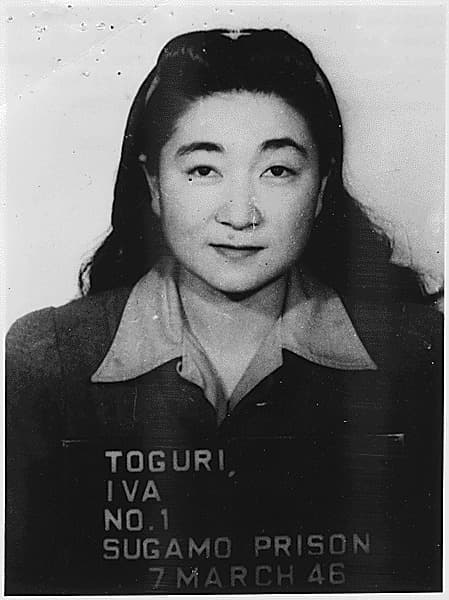
American · Law · Activism
Iva Toguri D’Aquino
July 4, 1916 – September 26, 2006
Early Life and Background
Iva Ikuko Toguri D’Aquino was born on July 4, 1916, in Los Angeles, California, to Japanese immigrant parents Jun and Fumi Toguri.[1][6][13] Her father had arrived in the United States in 1899 and her mother in 1913, part of the early wave of Japanese migration to the West Coast.[13] As a U.S.-born child of Japanese parents, she was a Nisei, and her birth on Independence Day would later be invoked symbolically by commentators reflecting on her contested loyalty and citizenship.[5][6]
The Toguri family operated a grocery business, and Iva grew up mainly in the Los Angeles area, including Compton.[11][13] She attended Compton High School and Compton Junior College before transferring to the University of California, Los Angeles (UCLA).[11][13] At UCLA she studied zoology, graduating in 1940 with a bachelor’s degree.[1][10][13] Contemporary accounts note that she voted Republican in the 1940 election, signaling participation in mainstream political life.[12]
Her upbringing integrated Japanese heritage with American civic and educational structures. Unlike many Japanese Americans who would later be forced into wartime incarceration, Iva left the United States before the mass removal of West Coast Japanese communities, for reasons that initially had nothing to do with international politics.
Journey to Japan and Stranded by War
In July 1941, Iva traveled to Japan to care for an ailing aunt, reportedly against her parents’ wishes.[1][5][6] She sailed with limited funds and a brief expectation of stay, intending to return to the U.S. after several months. However, escalating tensions between the United States and Japan soon altered her circumstances drastically.
When Japan attacked Pearl Harbor on December 7, 1941, diplomatic relations collapsed and travel between the two countries became difficult. Iva sought to return home but encountered obstacles including shipping restrictions and the U.S. State Department’s advice to remain in Japan due to security concerns about wartime travel.[1][6] Japanese authorities pressured her to renounce her U.S. citizenship; she refused, maintaining her American nationality even as a hostile climate emerged around her.[1][6]
As a foreign national in Japan during wartime, she experienced surveillance and rationing, and she struggled to support herself. Sources describe her taking clerical and typist jobs to survive.[1][5] Notably, she risked punishment by smuggling food and medicine to Allied prisoners of war (POWs) in camps near Tokyo, forging a connection with captured American and Allied servicemen that later influenced her role in broadcasting.[1][6]
Radio Tokyo and The Zero Hour
In 1943, Iva obtained a typist position at Radio Tokyo, part of Japan’s national broadcaster, NHK.[1][6][12] That year she was recruited by staff and Allied POW scriptwriters to serve as an announcer and disc jockey on a new English-language propaganda program called The Zero Hour, designed for Allied forces in the Pacific.[1][6][8]
The program was conceptualized by Japanese army officers but relied heavily on POW talent, including Australian and American prisoners who wrote and performed skits and selected music.[1][6] Iva’s on-air persona was "Orphan Ann", a breezy, jazz-inflected voice introducing songs and reading scripts with a humorous tone. She reportedly drew on American slang and popular culture, sometimes teasing Allied troops but also offering messages that many later interpreted as sympathetic rather than demoralizing.[1][6][13]
During this period, Allied servicemen collectively referred to various female English-language voices on Japanese radio as "Tokyo Rose", a generic nickname rather than a single individual’s identity.[1][8] Postwar investigations revealed that multiple women, Japanese and foreign, spoke on propaganda programs; Iva herself did not use "Tokyo Rose" on air.[1][6][8] Nonetheless, U.S. postwar media and prosecutors would later fix the moniker onto her.
As a U.S. citizen working on a Japanese station under wartime censorship, Iva occupied a precarious position. She asserted after the war that she had refused to broadcast overtly anti-American messages and that she had tried to maintain a light-hearted style that might even encourage or reassure Allied listeners.[1][6] POW colleagues later supported the view that she was not a committed propagandist but a music host navigating limited options for employment and survival.
Marriage and End of the War
In 1945, Iva married Felipe (or Filippo) D’Aquino, a Portuguese-Japanese businessman, in Tokyo, adopting the surname D’Aquino.[1][6][13] Their marriage reflected the cosmopolitan and unsettled character of wartime Tokyo, where foreign nationals and mixed-heritage individuals tried to maintain everyday lives despite bombing and shortages.
As the war approached its end, bombing intensified and food scarcity worsened. Iva continued intermittent work for Radio Tokyo until Japan’s surrender in August 1945.[1][6] Afterwards, she sought to return to the United States, now under Allied occupation. Her status as a U.S. citizen and as a woman associated with wartime broadcasting drew the attention of military authorities and journalists.
Postwar Arrest and the "Tokyo Rose" Myth
In the immediate postwar period, U.S. servicemen and reporters searched for "Tokyo Rose"—a figure they imagined as a seductive, treacherous American woman aiding Japanese propaganda. When it emerged that a U.S.-born woman had worked at Radio Tokyo, Iva became a focal point for this myth.[1][8]
In September 1945, she attempted to secure passage back to the United States.[1][6] Reporters, including Walter Winchell’s associates, interviewed her, and her willingness to speak publicly was later interpreted as self-identification with the "Tokyo Rose" legend, although she continued to use "Orphan Ann" as her professional name.[1][9] Media stories helped conflate her identity with the generic wartime label.
On September 5, 1945, U.S. authorities arrested Iva in Yokohama, initiating investigations into her broadcasts and potential treason.[4][13] She was detained and questioned, but an initial army and FBI inquiry reportedly concluded in 1946 that evidence was insufficient to support a treason charge, and she was released.[2][4] Nonetheless, she remained in Japan, effectively stateless and unable to return home, as public and political appetite for prosecution persisted.
Renewed Investigation and Indictment
By the late 1940s, political pressure to bring a "Tokyo Rose" to trial increased. Columnists and some members of Congress urged prosecution, and the Department of Justice reopened the case. The FBI gathered witnesses, including former servicemen, to testify about the impact of Iva’s broadcasts.[2][4]
On October 8, 1948, a federal grand jury in San Francisco indicted Iva Ikuko Toguri D’Aquino on charges of treason, alleging that she had adhered to and given aid and comfort to the enemy by participating in Radio Tokyo broadcasts intended to undermine American morale.[4] The indictment charged eight specific "overt acts"—defined broadcasts and statements—through which she allegedly committed treason.
A May 27, 1949 memorandum from the Department of Justice’s Criminal Division characterized her case as the first conviction of treason arising from wartime propaganda broadcasting, underscoring the novelty of applying treason law to a media figure rather than a spy or combatant.[4] At the same time, she was also described by later reference works as the first woman in U.S. history tried and convicted for treason in connection with wartime broadcasting.[14]
The Treason Trial in San Francisco
Iva’s trial opened in July 1949 in the U.S. District Court for the Northern District of California, attracting extensive press coverage.[9] The proceedings lasted about twelve weeks, making it one of the longest and most expensive criminal trials in the postwar era. The government presented former servicemen who testified that they had heard "Tokyo Rose" broadcasts and believed they were intended to demoralize troops.[2][9]
The defense, led by attorney Wayne Collins, argued that Iva’s role had been limited, that scripts were written by Allied POWs, and that any taunting had been playful rather than strategically damaging.[1][6] They emphasized her refusal to renounce U.S. citizenship under Japanese pressure and cited her efforts to aid POWs as evidence of loyalty.[1][6]
Media commentary during the trial often blurred distinctions between the multiple women called "Tokyo Rose" and the individual defendant. The New York Times and other outlets framed the case as a test of wartime loyalty and as a dramatic courtroom showdown embodying American anger toward Japan.[9] The jury deliberated for several days.
On October 6, 1949, the jury found Iva guilty on one of the eight overt acts: a specific broadcast in which she allegedly emphasized U.S. losses and Japanese successes in a way seen as aiding the enemy.[4][13] She was acquitted on the other counts. The judge sentenced her to 10 years in prison and a $10,000 fine, and she was stripped of U.S. citizenship under existing law.[4][13]
Imprisonment and Release
Following sentencing, Iva was transferred to the federal women’s penitentiary at Alderson, West Virginia.[4][11] There she served more than six years of her ten-year term. During incarceration she remained largely out of public view but persisted in asserting that she had never betrayed the United States, that her broadcasts were scripted by POWs, and that her intent had been entertainment rather than propaganda.[1][6]
On January 28, 1956, she was released on parole, benefiting from statutory reductions for good behavior.[4] She had served roughly six years and three months. After release, she settled in Chicago, Illinois, where she assisted in her family’s store and later operated a small gift shop.[1][5][6] She and her husband lived apart for periods, and she never fully escaped the stigma attached to the "Tokyo Rose" label.
The Department of Justice continued to defend the conviction, but an undercurrent of doubt began to form among some legal observers and journalists as they reviewed the record and considered the climate of anti-Japanese sentiment in which the trial had occurred.[5][9]
Life in Chicago and Emerging Doubts
In Chicago, Iva maintained a quiet life, rarely seeking publicity. She became active in local Japanese American circles and built a reputation as a modest shopkeeper who, despite being legally branded a traitor, remained proud of her American identity.[1][6] She also faced immigration authorities’ efforts to deport her, given the loss of citizenship tied to the treason conviction, and she fought these proceedings over many years.
By the 1960s and 1970s, broader awareness of the injustices inflicted on Japanese Americans during World War II grew, including recognition of the mass incarceration of West Coast communities. Within this evolving context, scholars and activists began to revisit high-profile cases such as Iva’s, noting that they had been prosecuted amid intense racial and political pressure.
Investigative journalists eventually uncovered serious issues in the evidentiary basis of her conviction. In the mid-1970s, a key exposé revealed that two prosecution witnesses had been coached and pressured by investigators to give incriminating testimony and later admitted that they had committed perjury.[9] This revelation radically altered public understanding of the case.
Campaign for Justice and Presidential Pardon
Japanese American organizations, civil liberties lawyers, and sympathetic commentators mobilized around Iva’s cause, arguing that she had been scapegoated as a convenient "Tokyo Rose" to satisfy public demand for a traitor figure.[2][6] They emphasized her refusal to renounce citizenship, her efforts to assist POWs, and the perjured testimony as evidence of a miscarriage of justice.
The emerging movement paralleled other redress campaigns for Japanese Americans, including efforts that would eventually lead to the Civil Liberties Act of 1988. In Iva’s case, however, the focus was on securing executive clemency rather than legislative compensation. Petitions and advocacy pieces reached the White House, and lawyers prepared detailed submissions challenging the trial’s integrity.
On January 19, 1977, President Gerald R. Ford granted Iva Toguri D’Aquino a full and unconditional pardon, restoring her U.S. citizenship.[4][5][13] According to contemporary accounts and later commentary, she is the first and only U.S. citizen convicted of treason to receive such a pardon, and her case remained unique in the annals of American clemency.[4][13][14] The decision was made on Ford’s last full day in office, underscoring its symbolic character.
The pardon did not judicially overturn the conviction, but it constituted an official acknowledgment that the government no longer considered her a traitor and that serious doubts existed about the fairness of her prosecution. For many observers, it served as a partial rectification of a wartime and postwar injustice.
Later Life, Recognition, and Death
After the pardon, Iva continued to live in Chicago, maintaining her shop and a largely private life.[1][6] She occasionally gave interviews, reiterating her love for the United States and her view that she had been wrongly targeted because of her ethnicity and wartime circumstances.[5][9] Her story came to be used in educational materials and documentaries as an example of how fear and racism can distort justice.
Shortly before her death, she received the Edward J. Herlihy Citizenship Award, a community honor recognizing her perseverance and reaffirmed citizenship.[5] This award symbolized local and community-level acknowledgement of her rehabilitation and dignity.
On September 26, 2006, Iva Toguri D’Aquino died of natural causes at her home in Chicago at age 90.[1][5][6][13] Obituaries in major outlets revisited her life story, highlighting the evolution from wartime disc jockey to convicted traitor to pardoned citizen. Many accounts stressed that the "Tokyo Rose" image had been a wartime construct applied retroactively to an individual whose actual conduct was more ambiguous and whose trial had been compromised by perjured testimony.[1][9]
Awards, Honors, and Public Recognition
In addition to the Edward J. Herlihy Citizenship Award, Iva’s principal form of national recognition was the presidential pardon itself, which functioned both as an act of mercy and as a political statement about historical injustice.[4][5] No major state or federal decorations accompanied the pardon, but it has been cited in legal and historical literature as an emblematic case of executive redress.
Reference works and institutional summaries—including entries by the FBI, Encyclopedia.com, Densho Encyclopedia, and academic biographies—now present Iva’s trajectory as one of controversy and eventual partial vindication.[2][5][6][14] They note her unique status as a female treason defendant, a wartime broadcaster, and a later symbol of Japanese American resilience.
Personal Life
Iva’s marriage to Felipe D’Aquino endured through the disruptions of postwar investigations and her imprisonment, though details of their private relationship remain sparsely documented.[1][6][13] The couple did not become public figures in their own right beyond Iva’s notoriety, and they reportedly lived modestly in Chicago.
Her family of origin, including her parents and siblings, played a significant role in supporting her after release, especially through the operation of the Chicago store where she worked. The Toguri family’s experience illustrates another facet of Japanese American history—families divided by wartime travel, with some members experiencing incarceration in the United States while others, like Iva, were trapped abroad.
Legacy and Historical Impact
Iva Toguri D’Aquino’s legacy lies at the intersection of media, law, race, and gender. She is widely remembered as the woman misidentified—or at least oversimplified—as "Tokyo Rose," a wartime legend rather than a singular person.[1][8] Her case demonstrated how popular myths can drive legal actions, especially when combined with national trauma and demands for retributive justice.
Legally, her prosecution and conviction marked the first use of the treason charge against a wartime propaganda broadcaster and the first treason conviction of a woman in that context, expanding the application of one of the Constitution’s gravest offenses beyond spies and soldiers.[4][14] The eventual revelation of witness perjury and the presidential pardon have made her case a staple in discussions of wrongful convictions, prosecutorial misconduct, and the challenges of adjudicating speech in wartime.
From a women’s history perspective, Iva’s story highlights the complicated roles women played in wartime media and the gendered imagery of betrayal. "Tokyo Rose" was imagined as a seductress undermining male soldiers; the simplistic narrative obscured the actual labor conditions and constraints faced by women broadcasters, particularly those in occupied or authoritarian contexts.[8] Iva, a Nisei woman navigating survival in enemy territory, was recast as an archetypal traitor in a way that magnified both her gender and ethnicity.
For Japanese American history, her experience is part of a broader pattern whereby individuals of Japanese descent were subjected to heightened suspicion, collective blame, and sometimes legal sanctions, despite constitutional guarantees. Alongside the mass incarceration of Japanese Americans and other civil liberties violations, her case underscores how wartime fear can erode due process and equal protection.
Today, historians and educators use Iva Toguri D’Aquino’s life to teach about the dangers of conflating myth with evidence, the importance of critical media literacy, and the need for vigilance against racialized narratives of disloyalty. Her eventual pardon and community recognition do not erase the harms she suffered, but they contribute to a continuing conversation about accountability and redress.
Assessment
In sum, Iva Toguri D’Aquino was a U.S.-born Japanese American radio personality whose role in wartime broadcasting placed her at the center of a powerful national myth. Stranded in Japan, she became "Orphan Ann" on The Zero Hour, a program crafted largely by Allied POWs. After the war, she was prosecuted as "Tokyo Rose"—the composite figure of soldiers’ stories—leading to a treason conviction and years in prison.[1][6][13]
Subsequent investigations, changing political climates, and growing awareness of Japanese American civil rights shifted perceptions, culminating in President Ford’s 1977 pardon and later community honors. Her life remains a cautionary tale about wartime justice and a testament to the resilience of a woman who refused to renounce her citizenship, insisted on her loyalty, and lived to see partial vindication of her name.
Dated achievements
7 indexed.
- Jul041916Science
Birth of Iva Toguri D'Aquino
Iva Ikuko Toguri was born in Los Angeles, California, to Japanese immigrant parents.
View details Densho Encyclopedia: Iva Toguri D'Aquino - Sep051945Science
Arrested by U.S. authorities in Yokohama
U.S. occupation authorities arrested Toguri in Yokohama, Japan, beginning her legal ordeal.