← All women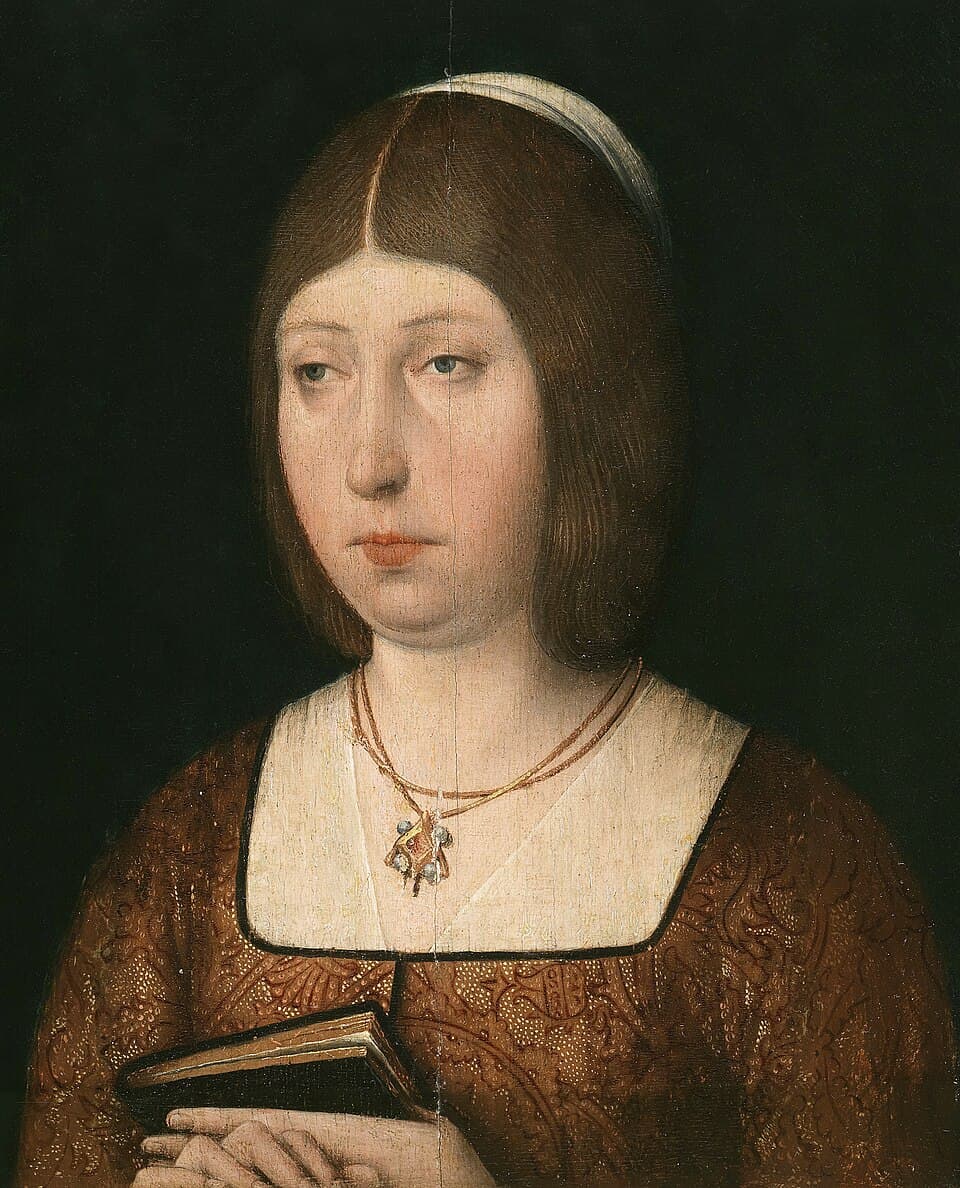
Castilian, Spanish · Politics · Exploration
Isabel I of Castile
April 22, 1451 – November 26, 1504
Early Life and Background
Isabella I of Castile (Spanish: Isabel I de Castilla; 22 April 1451 – 26 November 1504), later known as Isabella the Catholic (Isabel la Católica), was born in the royal palace at Madrigal de las Altas Torres, in the province of Ávila, in the Crown of Castile.[1][2][12] She was the daughter of John II of Castile and his second wife, Isabella of Portugal.[1][3][12] Through her father, she belonged to the Trastámara dynasty that had ruled Castile since the late fourteenth century.
Isabella’s childhood was shaped by dynastic instability and financial strain. When John II died in 1454, her half‑brother Henry IV succeeded to the throne, while Isabella and her younger brother Alfonso were moved with their mother to a household at Arévalo.[1][3][12] This residence was relatively modest by royal standards and marked by her mother’s periods of mental illness and withdrawal. Many historians emphasize that this environment fostered Isabella’s lifelong habits of frugality, personal piety, and emotional resilience.[3][6][10]
Although formal schooling for royal girls was limited, Isabella received instruction in religion, courtly manners, and the rudiments of governance appropriate to a princess. She was deeply influenced by the spiritual currents of late medieval Castile, especially the emphasis on confession, penitence, and reform within the Church. Confessors and learned clerics would later play important roles as advisers in her reign.[10][17]
Dynastic Politics and Career Beginnings
From an early age, Isabella’s position in the succession was contested. Henry IV’s reign was troubled by noble revolts and disputes over the legitimacy of his daughter, Juana, often called "la Beltraneja" in hostile sources.[1][3] Powerful magnates attempted to use Isabella and Alfonso as pawns in their factional struggles. In 1468, after Alfonso’s death amid civil conflict, an agreement at Toros de Guisando recognized Isabella as Henry’s heir, on condition that he would approve her marriage.[1][12]
Isabella’s marriage became a crucial political question. Various suitors—including a brother of the king of Portugal and the future Charles VIII of France—were proposed, each with significant diplomatic implications.[2][13] Defying some of these plans, Isabella chose to marry Ferdinand, heir to the Crown of Aragon. The two were wed in Valladolid in 1469, in a union arranged with the help of the Castilian nobleman Juan Pacheco and Aragonese advisers.[1][2][12] The marriage was contracted without Henry IV’s explicit consent, aggravating tensions over succession, but it laid the foundation for the future dynastic union of Castile and Aragon.
Throughout the early 1470s, Isabella’s claim to the throne was challenged by factions promoting Juana. The situation came to a head upon Henry IV’s death in December 1474. Isabella moved quickly to assert her rights; she was proclaimed Queen of Castile at Segovia, and on 13 December 1474 she made a formal pledge in the city’s main square to uphold the Church’s commandments, protect the integrity of Castile, and respect the rights of nobles and towns.[1] Her accession triggered a civil war against supporters of Juana, backed by Portugal, which lasted until 1479.[2][10]
Consolidation of Power and Governance
Isabella’s early reign focused on consolidating royal authority and restoring order. Together with Ferdinand, she embarked on a series of reforms in administration, justice, and finance. They strengthened the audiencias (high courts), expanded the role of the Santa Hermandad (a kind of rural police and militia), and introduced measures to curb banditry and noble violence.[2][3][15] The monarchs sought to professionalize the royal bureaucracy, appointing capable officials from the lesser nobility and educated classes rather than relying solely on powerful magnates.
Fiscal reform was another priority. The Crown reasserted control over revenues that had been alienated to nobles and towns and improved collection systems for royal taxes.[3][16] These changes created the financial base necessary for later military and overseas enterprises. Isabella’s personal involvement in oversight of accounts and appointments is repeatedly noted in contemporary sources and by later historians, illustrating her active role in governance rather than a merely ceremonial queenship.[3][10]
In ecclesiastical affairs, Isabella and Ferdinand pursued a policy of reform and royal control. They worked to improve clerical discipline, supported new religious foundations, and obtained from the papacy extensive rights of patronage over Church offices in their realms.[2][10] Isabella’s religiosity informed these measures, but they also served to integrate the Church more tightly into the emerging Spanish state.
The Reconquista and the Conquest of Granada
One of the central projects of Isabella’s reign was the completion of the Reconquista, the centuries‑long expansion of Christian kingdoms across the Iberian Peninsula. By the late fifteenth century, the Emirate of Granada remained the last significant Muslim polity in Iberia.[2][3]
Beginning in 1482, Isabella and Ferdinand launched a protracted military campaign against Granada.[2][3][9] The war involved sieges, negotiations, and shifting alliances, and it demanded sustained fiscal and logistical support. Isabella took a notable personal interest in the campaign: she spent extended periods in Andalusia near the front, organized supply lines, and used reformed royal institutions to mobilize resources.[3][15]
The conflict culminated on 2 January 1492, when Granada formally surrendered. Isabella and Ferdinand entered the city, receiving the keys of the Alhambra from Emir Muhammad XII (Boabdil). This event symbolized the end of Muslim rule on the Iberian Peninsula and the triumph of the Catholic Monarchs.[2][15] The Capitulations of Granada initially guaranteed religious and property rights to the Muslim population, but over time these provisions were eroded, leading to forced conversions, uprisings, and eventual expulsions under later rulers.[2][3]
The conquest of Granada enhanced Isabella’s prestige as a Christian ruler and freed military and financial resources for other ventures, especially overseas exploration. It also intensified her association with religious uniformity as an element of political unity.
The Spanish Inquisition and Religious Policy
Isabella’s reign is inseparable from the history of the Spanish Inquisition. In 1478, with papal authorization, Isabella and Ferdinand established the Tribunal of the Holy Office of the Inquisition in their kingdoms, initially targeting conversos—Jews who had converted to Christianity but were suspected of secretly practicing Judaism.[1][2][10] The Inquisition operated under royal control but was closely linked to ecclesiastical structures.
Over subsequent decades, inquisitorial tribunals expanded their activities, leading to trials, confiscations, and executions for heresy. While many monarchs in Europe pursued religious uniformity, the Spanish Inquisition became notorious for its severity and its intertwining of spiritual concerns with political and racialized categories of identity.[2][10]
Isabella’s religious policies culminated in the Alhambra Decree of 31 March 1492, which ordered the expulsion of practicing Jews from Castile and Aragon unless they accepted baptism.[1] Tens of thousands left, forming new Sephardic communities in North Africa, the Ottoman Empire, and elsewhere, while others converted under varying degrees of coercion. The decree reflected Isabella’s conviction that religious plurality endangered the faith of new Christians, but it also had profound economic, cultural, and human costs.
These policies have made Isabella a highly controversial figure: praised by some traditional Catholic writers for her zeal, and criticized by many historians for institutionalizing religious persecution and intolerance at the core of the Spanish state.[10][17]
Sponsorship of Transatlantic Exploration
Isabella’s most globally significant decision concerned transatlantic exploration. In the 1480s, Christopher Columbus, a Genoese mariner, presented his plan to reach Asia by sailing west across the Atlantic. After initial rejection by Portugal and hesitation in Castile, his proposals eventually came before Isabella and Ferdinand.[2][9][16]
Following lengthy deliberations, the monarchs agreed to sponsor an expedition. On 17 April 1492, they signed the Capitulations of Santa Fe, granting Columbus noble status, the admiralty of the Ocean Sea, and governance over lands he might discover, along with a share of the profits.[1] This agreement formally bound the Crown of Castile to his venture.
On 3 August 1492, Columbus departed from Palos de la Frontera with three ships, funded by a combination of royal and private monies.[9][16] After a transatlantic crossing, the expedition made landfall in the Bahamas on 12 October 1492, claiming islands for the Crown and establishing sustained European awareness of the American continents.[9]
Isabella continued to play a role in subsequent voyages and in shaping early colonial policy. She expressed concern in correspondence and instructions about the treatment and conversion of Indigenous peoples, urging that they be brought to Christianity but also that they not be unjustly enslaved.[10][12] Nonetheless, Spanish expansion led to massive disruption, exploitation, and demographic collapse among Native populations.
Isabella’s sponsorship of Columbus’s voyage initiated Spain’s rise as a major imperial power and transformed global history. It linked her reign to the beginning of the so‑called "Age of Discovery" and the long‑term formation of the Atlantic world.
Union of Castile and Aragon and State Formation
Isabella’s marriage to Ferdinand of Aragon had far‑reaching constitutional consequences. When Ferdinand became Ferdinand II of Aragon in 1479, their crowns were united in a dynastic union: Isabella was queen of Castile, Ferdinand king of Aragon, and together they ruled over multiple kingdoms, including Aragon, Valencia, Catalonia, and later Naples and Sicily.[2][3][9][12]
Although the union did not create a single centralized state—each kingdom retained its own laws and institutions—it laid the foundation for the entity that would be known as Spain. Isabella and Ferdinand coordinated foreign policy, military campaigns, and dynastic marriages across their domains, forging a composite monarchy with increasing international influence.[2][3]
Their joint rule, often referred to as that of the Catholic Monarchs, witnessed the expansion of royal powers, the reduction of noble autonomy, and the development of tools of governance that later Habsburg rulers would inherit. Isabella’s personal authority in Castile was especially strong; she signed documents, issued instructions, and was recognized by contemporaries as an equal partner in rule.[3][16]
Personal Life: Marriage and Children
Isabella’s marriage to Ferdinand was both a political alliance and a personal partnership. Contemporary accounts suggest mutual respect and collaboration, though tensions occasionally arose over jurisdiction and appointments.[3][13] The couple shared a commitment to strengthening their monarchy and advancing Catholic reform.
They had several children who played key roles in European dynastic politics:
- Isabella (born 1470), who married Manuel I of Portugal and later died in childbirth.
- John, Prince of Asturias, heir to the united crowns, who died young in 1497.
- Joanna (Juana), later known as Juana la Loca, who married Philip the Handsome of Habsburg; her son would become Charles V, Holy Roman Emperor and king of Spain.
- Maria, who also married Manuel I of Portugal.
- Catherine of Aragon, who married first Arthur, Prince of Wales, and then Henry VIII of England.[1][2][12][13]
Through these marriages, Isabella pursued an ambitious strategy of dynastic alliances, linking her family to the houses of Portugal, Habsburg, and Tudor and extending Spanish influence across Europe.
Awards, Honors, and Reputation in Her Lifetime
In 1494, Pope Alexander VI formally granted Isabella and Ferdinand the title of "Catholic Monarchs" (Reyes Católicos) in recognition of their efforts to strengthen the Church, combat heresy, and promote religious reform.[2][16] The epithet "the Catholic" became closely associated with Isabella in subsequent tradition.
Within Castile and Aragon, Isabella was admired by many contemporaries for her diligence, chastity, and piety. Chroniclers highlighted her active involvement in governance and her willingness to travel extensively through her realms, hearing petitions and attending to provincial concerns.[3][10] At the same time, her policies generated opposition and suffering among those targeted by the Inquisition or affected by expulsions and wars.
Later Life and Death
In her later years, Isabella faced a series of personal and political challenges. The deaths of her son John and her daughter Isabella of Portugal, as well as the fragile mental state of her heir Juana, complicated succession plans.[1][2][13] She also witnessed growing problems in the administration of the New World, including conflicts among Spanish settlers and abuses against Indigenous populations.
Isabella’s health declined in the early 1500s. She spent time at Medina del Campo and other residences, continuing to attend to business but increasingly preparing for death.[17][20] On 26 November 1504, she died "a little before noon" in the castle of La Mota at Medina del Campo, aged 53.[1][2][17][20] She had ruled Castile for thirty years.
In her will and testament, Isabella emphasized her devotion to the Catholic faith, instructed that certain injustices be remedied, and urged humane treatment of Indigenous peoples in America, including provisions about their freedom and conversion.[10][17][20] She designated her daughter Juana as her successor in Castile, with Ferdinand to act as regent in specified circumstances.
Legacy and Historical Impact
Isabella’s legacy is complex and far‑reaching. She is widely regarded as one of the most influential rulers in Spanish history, central to the formation of the Spanish monarchy and the opening of Spain’s overseas empire.[2][3][18][19] Her reign saw:
- The consolidation of royal authority in Castile and the reduction of noble power.
- The dynastic union of Castile and Aragon, forming the basis of a realm commonly called "Spain".
- The completion of the Reconquista through the conquest of Granada.
- The establishment of the Spanish Inquisition and policies of religious uniformity.
- The sponsorship of Columbus’s voyage and the beginning of sustained European presence in the Americas.
These achievements transformed Iberia and had global consequences, especially in the Americas and Europe. They also carried severe human costs, including persecution of Jews and conversos, repression of Muslims, and the devastation of Indigenous societies following Spanish expansion.
In historical writing, Isabella has been portrayed variously as a pioneering female monarch, a founder of early modern Spain, a champion of Catholic reform, and a central agent of intolerance and imperial conquest. Modern scholars emphasize both her strategic intelligence and political acumen and the moral ambiguities of her policies.[3][18][19] Her life remains a focal point for debates about the intersections of gender, religion, and power in late medieval and early modern Europe.
For women’s history, Isabella is notable as a queen who exercised substantive authority in military, diplomatic, and colonial affairs traditionally dominated by men. She negotiated marriages, commanded resources, and made decisions that reshaped world history.[3][6][10] At the same time, her example underscores that women’s exercise of power in the past could reinforce structures of coercion and exclusion, not only challenge them.
Isabella’s reign set patterns that her grandson Charles V and later Habsburg rulers would inherit, including the combination of dynastic union, imperial ambition, and religious policing. Her memory continues to be invoked in Spanish national narratives, Catholic histories, and global accounts of the "Age of Discovery," ensuring her enduring prominence in both scholarly literature and popular culture.
Dated achievements
8 indexed.
- Apr221451Science
Birth of Isabella I of Castile
Isabella is born at the royal palace in Madrigal de las Altas Torres, Ávila, Castile.
View details Isabella I of Castile - Wikipedia - Dec131474Science
Public proclamation and pledge in Segovia
In Segovia's main square, Isabella publicly pledges to uphold the Church, protect Castile's integrity, and respect noble and civic rights as she becomes queen.