← All women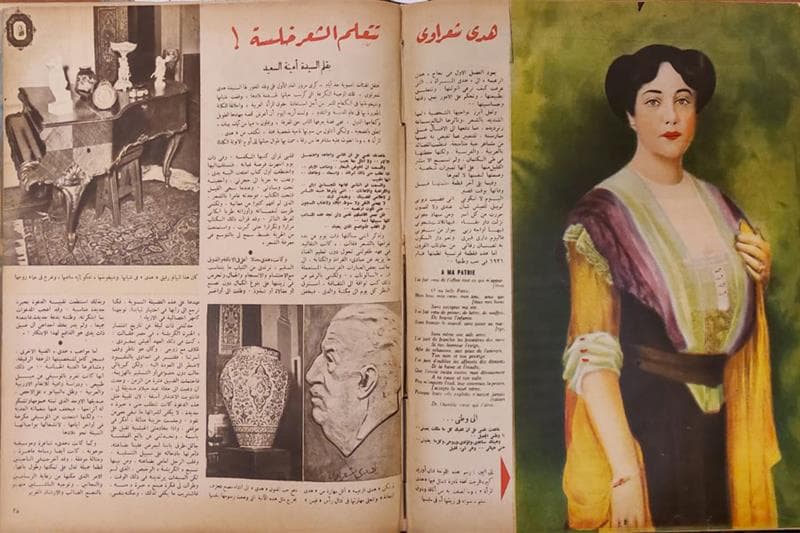
Egyptian · Activism · Politics
Huda Sha’arawi
June 23, 1879 – December 12, 1947
Early life and background
Huda Sha’arawi, born Nūr al-Huda Muhammad Sulṭān Sha‘rāwī, entered the world on 23 June 1879 on her family’s estate in the Upper Egyptian city of Minya.[1][2][4] She belonged to a wealthy, landowning household that occupied a prominent position in late nineteenth‑century Egyptian society. Her father, Sultan Pasha Sha‘arawi, accumulated substantial agricultural holdings and later became president of Egypt’s Chamber of Deputies, symbolizing the family’s integration into the emerging national political elite.[1][13] Her mother, Iqbal Hanim, of Turco‑Circassian descent, embodied the cosmopolitan Ottoman‑Egyptian milieu of the period.[4][13]
Like many girls of her class, Huda grew up in the gender‑segregated world of the harem—a domestic arrangement that confined women and children to a separate, guarded quarter of the household.[1][3] Physical seclusion, veiling in public, and strict codes of honor defined the boundaries of respectable femininity. Yet within this constrained environment she experienced relative intellectual freedom. Private tutors educated her in Arabic, French, and other subjects; she also learned Turkish and some Persian, and she read widely in Arabic and European literature.[1][13] The contrast between material privilege and personal restriction would later become a central theme in her memoir The Harem Years.
Her family life was complex. Sultan Pasha died when she was young, and household authority lay largely with older male relatives and senior women. Huda’s memories of polygamy and the unequal treatment of co‑wives and children shaped her early critique of patriarchal family structures. She witnessed child marriage, forced marriages, and the emotional toll of seclusion on women with little legal or economic power.[1][13] These formative experiences convinced her that women’s liberation required both legal reform and changes in social custom.
Marriage, education, and early stirrings of activism
At about thirteen, Huda was married to her much older cousin, Ali Sha‘arawi, in a union arranged to consolidate property and family ties.[1][13] According to later accounts, the marriage was troubled from the start. Ali had previously married another woman and initially refused to divorce her, leading Huda to separate from him soon after the wedding. She returned to her mother’s home and lived independently for several years, during which she continued her education and engaged in charitable work.[13]
During this period of partial separation she negotiated greater autonomy, including the right to set conditions for resuming marital life. When she and Ali eventually reconciled, she did so on terms that provided her more respect and freedom than typical for wives of her milieu.[1][13] The couple had two children: a daughter, Bathna, born in 1903, and a son, Muhammad, born in 1905.[13] Motherhood deepened her awareness of the importance of education and legal rights for women as guardians of the next generation.
Huda’s early involvement in philanthropy provided a socially acceptable channel for a woman of her status to appear in semi‑public settings. Around 1908–1909, she helped establish Mabarrat Muhammad ‘Ali, often described as the first philanthropic society run by Egyptian women.[13][16] The organization offered social services to poor women and orphans, directing elite women’s charitable energies toward structured, institutional assistance rather than informal almsgiving. By stepping into leadership roles inside such societies, Huda and her peers began to acquire organizational skills and public visibility.
In 1910, she founded a girls’ school that provided an academic curriculum instead of limiting instruction to domestic skills and midwifery.[1][13] At a time when most Egyptian girls’ education emphasized preparation for marriage and motherhood, this school prioritized languages, literature, and other scholarly subjects. It represented one of the earliest attempts by Egyptian women themselves to create alternative educational institutions that would qualify girls for higher education and professional life.
Career beginnings in nationalism and women’s organizing
The First World War and the intensifying struggle against British occupation created new political openings. Huda’s home in Cairo became a meeting place for nationalists, including leaders of the emerging Wafd Party, which demanded Egyptian independence. She began to see nationalist liberation and women’s emancipation as intertwined causes: foreign domination and male domination both restricted Egyptians’ ability to shape their own destiny.[1][9]
Her public political career took off during the 1919 Revolution, when mass protests erupted after the British exiled nationalist leader Saad Zaghlul and other Wafd figures. On 16 March 1919, Huda led a march of approximately 300 veiled women through Cairo in protest against British rule, a demonstration that exposed them to live fire and resulted in the death of at least one woman, Hamida Khalil.[15][18] This unprecedented women’s procession marked the first large‑scale, women‑led political demonstration in modern Egyptian history and secured Huda’s reputation as a militant nationalist leader.
Women’s participation in the 1919 uprising made it harder for male politicians to ignore them. In January 1920, Huda helped establish and then chaired the Wafd Central Committee for Women, formally integrating women into Egypt’s primary nationalist party.[12][16] Through this body, women organized further demonstrations, circulated petitions, and raised funds for the nationalist cause. Huda used the platform to press for explicitly feminist demands—education, legal reform, and suffrage—arguing that national progress required the full participation of women.
During the early 1920s she also presided over major women’s meetings that articulated a political program for equality. In 1920, she led a conference where women demanded equal access to education, women’s suffrage, and the abolition of polygamy.[13] These gatherings signaled a strategic shift: women were no longer merely supporting male nationalist leaders; they were formulating their own agenda and insisting it be part of the national conversation.
Founding the Egyptian Feminist Union and major activism in the 1920s
The early 1920s marked a turning point in Huda Sha’arawi’s activism. On 16 March 1923, returning to Cairo from an international women’s conference in Rome, she staged a dramatic gesture that would become legendary. As her train reached Cairo’s main station, she and fellow activist Ceza Nabarawi stepped onto the platform and publicly removed their face veils, an act observed by a large crowd of supporters.[1][5][9] Many women present followed their example.
While some Egyptian women had quietly abandoned the veil, this was the first widely reported, collective unveiling by such prominent figures. For Huda, the act symbolized rejection of enforced seclusion and a claim to women’s right to appear in public as citizens. The event sparked intense debate but also emboldened supporters who interpreted it as a break with a central pillar of patriarchal control in elite society.[5][9]
Later in 1923, she founded the Egyptian Feminist Union (EFU) and became its first president.[1][2][5] The EFU was the first national organization in Egypt dedicated explicitly to women’s rights. Its program called for expanding girls’ education, reforming marriage and divorce laws—including raising the minimum marriage age and restricting polygamy—improving maternal and child welfare, and eventually securing political rights such as suffrage.[1][13]
Under Huda’s leadership, the EFU quickly became both a service provider and a pressure group. It established schools and clinics, sponsored literacy classes, and operated welfare programs for poor women and children.[1][13] At the same time, it lobbied government ministries, submitted memoranda on proposed laws, and kept up a steady correspondence with international feminist organizations. The EFU joined the International Woman Suffrage Alliance, through which Huda attended congresses in Europe and forged links with activists from Britain, France, and elsewhere.[1][9]
Around 1925, Huda launched the EFU’s flagship journal, L’Égyptienne (The Egyptian Woman), edited by Ceza Nabarawi.[12][13] Published chiefly in French, the magazine reported on EFU activities, profiled prominent women, and commented on global feminist and peace issues. Its use of a European language allowed the EFU to speak directly to foreign audiences and to project an image of Egyptian women as modern, articulate, and politically engaged. Companion publications and Arabic material ensured that EFU messages also circulated domestically.
Throughout the 1920s, Huda and the EFU campaigned for legal reforms. One central focus was raising the minimum age of marriage for girls and improving women’s rights in divorce and guardianship. These efforts contributed to 1929 reforms that set the minimum marriage age for girls at 16, extended mothers’ guardianship rights, and improved women’s access to divorce when they could prove ill‑treatment.[13][16] Although these laws fell short of full equality, they represented historic advances and were widely associated with EFU advocacy.
Consolidation, international engagement, and later campaigns
In the 1930s, Huda Sha’arawi consolidated her status as Egypt’s leading feminist and became increasingly active on the international stage. She attended and sometimes led Egyptian delegations to women’s conferences in Europe and the Middle East, spoke at meetings of the International Woman Suffrage Alliance, and forged ties with figures such as French and British feminists.[1][9] Through these channels she insisted that Egyptian women be recognized as partners—not merely beneficiaries—in global feminist debates.
The EFU continued to press domestic reforms: expanding women’s access to secondary and higher education, opening civil service positions to women, and improving labor protections for female workers. In 1924, Sha’arawi played a key role in opening mainstream secondary education to Egyptian girls, either through new institutions or the admission of girls to existing high schools.[13] Increasing numbers of women went on to university and professional training, including medicine and law, in subsequent years.
Huda also took up issues of moral and social regulation. One long‑term goal was the abolition of licensed domestic prostitution in Egypt, which feminists saw as both a moral and social injustice. Although this reform was not achieved in her lifetime, abolition occurred about 18 months after her death, in 1948–1949, and has often been cited as a delayed fruit of campaigns in which she and the EFU were prominent.[13][16]
Throughout these years, Sha’arawi navigated complex relationships with male nationalist leaders and with the Egyptian monarchy. She supported movements for constitutional government and greater independence from Britain, but she also criticized political elites when they subordinated women’s demands to other priorities. Her insistence that women deserved full citizenship sometimes put her at odds with the Wafd and other parties, which tended to treat women as auxiliary supporters rather than equal partners.
Pan‑Arab feminism and the Arab Feminist Union
By the early 1940s, as World War II reshaped global politics and Arab nationalist aspirations intensified, Huda extended her focus beyond Egypt. She cultivated ties with women activists in Syria, Lebanon, Iraq, Palestine, and other Arab lands. These contacts culminated in the Arab Feminist Congress she organized in Cairo in 1944, the first transnational conference specifically devoted to women’s issues in the Arab world.[12][16]
Delegates to the congress discussed education, family law, and social reform, as well as the broader question of Arab unity and independence. The meeting adopted resolutions urging equal educational opportunities, improved legal status for women in marriage and divorce, and recognition of women’s political rights.[12] It also condemned colonialism and called for the defense of Palestine in the face of increasing Zionist immigration and British policies.
Building on the congress, Huda spearheaded the creation of the Arab Feminist Union (also known as the Arab Women’s Federation) later in 1944.[12][16] This union brought together organizations from Egypt, Syria, Lebanon, Iraq, Jordan, and Palestine under a single umbrella, with the aim of coordinating campaigns and giving Arab women a unified voice in regional and international forums. As its founding leader, Huda helped craft a platform that linked demands for educational and legal reform with opposition to colonial rule and support for Arab causes.
The Arab Feminist Union issued statements on questions of social legislation, women’s status, and key political issues, especially Palestine.[3][16] It organized solidarity actions, exchanged publications, and facilitated visits among activists. Through this structure, Huda and her colleagues sought to ensure that emerging pan‑Arab institutions would incorporate women’s rights into their agendas.
Major writings and intellectual contributions
Although best known as an organizer and public figure, Huda Sha’arawi also left a significant written legacy. Her most celebrated work is her posthumously published memoir The Harem Years, translated into English decades after her death.[11] In it she recounts her childhood and youth in the harem, her early marriage, and the evolution of her political consciousness up to the 1920s.
The memoir offers a rare, first‑person account of elite women’s lives in late nineteenth‑ and early twentieth‑century Egypt. It depicts the emotional and psychological toll of seclusion, the complexity of relationships among co‑wives and servants, and the ways women carved out spaces of agency within restrictive structures. Scholars have used the text to challenge exoticized Western depictions of the harem and to highlight women’s own interpretations of their experiences.[11][17]
Through articles in L’Égyptienne and other publications, Huda articulated a political philosophy that combined Islamic references, liberal principles, and nationalist language. She argued that nothing in Islam inherently required women’s oppression; rather, injustices stemmed from misinterpretation and custom. At the same time, she embraced ideas of individual rights and citizenship drawn from European liberalism, insisting that Egyptian women were entitled to education, legal capacity, and participation in public life as a matter of both justice and national interest.[1][9]
Her speeches and writings consistently linked the uplift of women to national progress. Illiterate, secluded mothers, she maintained, could not raise enlightened citizens or contribute fully to the building of a modern state. By contrast, educated, empowered women would strengthen the family and the nation alike. This argument resonated with reformist discourses in Egypt and across the Middle East, helping to legitimize feminist demands in the eyes of some male elites.
Awards, honors, and contemporary recognition
Formal state decorations for women activists were relatively rare in early twentieth‑century Egypt, and available sources do not emphasize official medals or titles awarded to Huda Sha’arawi. Her recognition came primarily in the form of organizational leadership, public acclaim, and international roles.
Within Egypt, she was widely acknowledged, even by her opponents, as the leader of the women’s movement. Press coverage of her speeches, demonstrations, and conferences frequently referred to her as the foremost spokeswoman for Egyptian women.[1][2] Her presidency of the Egyptian Feminist Union and later the Arab Feminist Union signaled the trust and respect she commanded among activists.
Internationally, Huda was honored through invitations to speak at major gatherings of the International Woman Suffrage Alliance and other bodies. She served on committees and councils dealing with women’s rights and peace issues, representing Egypt in arenas previously dominated by European and North American activists.[1][9] Her presence at these events challenged stereotypes about Middle Eastern women and brought Egyptian perspectives into global debates.
Posthumously, her status as a pioneer has been acknowledged through biographies, historical studies, and the naming of streets, schools, and institutions after her in Egypt and other Arab countries.[11][14] The date of the 1919 women’s demonstration she led, 16 March, is commemorated in Egypt as a symbolic day for women’s struggle, often linked in public memory to her leadership.
Personal life and character
Huda Sha’arawi’s personal life was marked by negotiations of power within marriage and family. Her early insistence on separating from her husband until he met her conditions demonstrated an unusual willingness to challenge patriarchal expectations for a young woman of her class. Once reconciled, she managed to carve out a partnership that allowed her to engage in extensive public activity.[13]
Contemporaries described her as dignified yet forceful, combining refined manners with an uncompromising commitment to principle.[11][14] She cultivated networks across class lines, recruiting both elite women and teachers, nurses, and workers into the EFU’s projects. Although most EFU leaders were from privileged backgrounds, Huda insisted on providing services to poor women and children, reflecting an ethic of social responsibility.
Her religious and cultural outlook was reformist rather than secularist in the narrow sense. She drew on Islamic concepts of justice and the historical example of learned and politically active Muslim women to argue that gender equality was compatible with faith. At the same time, she was comfortable speaking the language of international feminism and human rights, and she dressed and comported herself in ways that signaled cosmopolitan modernity.[1][9]
Later life, Palestine question, and death
By the mid‑1940s, Huda Sha’arawi was an elder stateswoman of feminism in Egypt and the Arab world. She continued to preside over the Egyptian Feminist Union and the Arab Feminist Union, mentor younger activists, and intervene in pressing regional issues. The question of Palestine emerged as a central concern, particularly as tensions mounted over plans for partition.
On 10 December 1947, after the UN General Assembly voted to partition Palestine, Huda chaired an emergency meeting of the Arab Feminist Union in Cairo.[3] There she delivered her final public speech, condemning the decision and expressing solidarity with Palestinians. The meeting adopted resolutions framing opposition to partition as both a nationalist and a women’s issue, underscoring her belief that feminist organizations had a duty to address questions of war, peace, and territorial injustice.
Two days later, on 12 December 1947, Huda Sha’arawi died of a heart attack at her home in Cairo.[1][2][3] She was 68. Her death came at a moment of profound transition for Egypt and the Arab world: independence struggles were reaching new phases, and debates about the shape of post‑colonial states were intensifying.
Her passing was widely mourned by feminists, nationalists, and intellectuals, who recognized that an era had ended. Yet the organizations she had built continued to function, ensuring that her influence would persist beyond her lifetime.[1][13]
Legacy and historical impact
Huda Sha’arawi is widely regarded as a founder of the modern Egyptian and Arab women’s movements.[1][2][9] Her legacy operates on several levels: as a symbol, as an institution‑builder, and as a contributor to legal and social change.
Symbolically, episodes such as the 1919 women’s march and the 1923 unveiling at Cairo station have become touchstones in narratives of Middle Eastern feminism. They dramatize the moment when elite women stepped from seclusion into public politics, challenging both colonial power and male authority. These stories are taught in schools, invoked in media, and referenced by contemporary activists, ensuring that her image remains part of collective memory.[5][11]
Institutionally, the Egyptian Feminist Union and the Arab Feminist Union pioneered models of organized women’s activism in the region. They combined service provision with advocacy, linked local concerns to international movements, and created spaces where women could develop leadership skills. Later organizations, both secular and Islamist, sometimes criticized aspects of the EFU’s class base or cultural orientation but nonetheless built on the precedents it established.[12][16]
In terms of concrete reforms, Sha’arawi’s campaigns contributed to advances in women’s education, the raising of the minimum marriage age, improved divorce and guardianship rights, and the eventual abolition of licensed prostitution.[1][13][16] None of these changes can be attributed to her alone—each resulted from the efforts of many activists and evolving social conditions—but she played a central role in articulating demands, sustaining pressure, and legitimizing the idea that women had the right to speak on such matters.
Her life also complicates simplistic narratives. She operated from a position of class privilege and often worked within elite circles, yet she sought to use that privilege to benefit poorer women. She embraced aspects of European modernity while affirming her Egyptian and Islamic identity. For later generations of scholars and activists, she represents both an inspiration and a point of debate: a reminder that feminist histories are entwined with questions of class, nation, and culture.
Today, Huda Sha’arawi’s name continues to appear in academic studies, popular histories, and feminist manifestos. Her memoir The Harem Years remains a key text in gender history curricula, and her image circulates in digital media commemorations of pioneering women.[11][14][17] Across the Arab world and beyond, she is remembered as a woman who transformed personal rebellion against the constraints of the harem into a far‑reaching movement for women’s rights and social justice.
Dated achievements
10 indexed.
- Jun231879Activism
Birth in Minya, Egypt
Born as Nūr al‑Huda Muhammad Sulṭān Sha‘rāwī in Minya, Egypt, into an upper‑class family shaped by the harem system and political prominence.
View details Huda Sha'arawi - Wikipedia - Mar161919Activism
Leads mass women’s anti‑British demonstration in Cairo
Leads about 300 veiled women in a historic anti‑British march in Cairo, the first major women‑led political demonstration in modern Egypt.