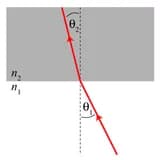
Hänchen earned her physics doctorate under Fritz Goos, with a dissertation on light penetration into the rarer medium during total reflection.
In 1943, amid the turmoil of the Second World War, Hilda Hänchen completed her doctoral studies in physics at the University of Hamburg, working under the supervision of physicist Fritz Goos. Her dissertation addressed a subtle and highly technical problem in optics: the penetration of totally reflected light into the rarer medium—a phenomenon that challenged the simplistic classical picture of total internal reflection as an instantaneous, lossless process occurring exactly at the interface between two media.
Earning a doctorate in physics was an exceptional achievement for a woman in Germany during this period. Wartime conditions had disrupted academic life across the country, and opportunities for women to pursue rigorous scientific training remained limited by both social convention and institutional bias. That Hänchen was able to complete original theoretical and experimental work on a genuinely difficult problem in wave optics speaks to both her scientific ability and her determination.
This doctoral research laid the essential theoretical and experimental groundwork for the discovery that would later bear her name in combination with her mentor's: the Goos–Hänchen effect. The exact calendar date of her doctoral defense is not preserved in available public sources, so this entry is recorded with the year only, but its scientific importance as the foundation for her later celebrated work is well documented.