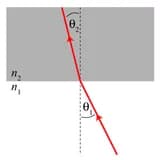
Hänchen and Fritz Goos published the definitive experimental confirmation of the lateral displacement of totally reflected light beams, now called the Goos–Hänchen effect.
In 1947, Hilda Hänchen, together with her doctoral advisor Fritz Goos, published a landmark paper reporting the definitive experimental observation of what is now universally known in optics and photonics as the Goos–Hänchen effect. This effect describes a small but measurable lateral shift experienced by a light beam when it undergoes total internal reflection at the interface between two media of differing refractive indices—a subtle departure from the idealized geometric-optics prediction that reflection occurs exactly at the boundary with zero displacement.
The 1947 paper built directly on Hänchen's 1943 doctoral dissertation and represented years of careful experimental refinement under wartime and postwar conditions in Germany. Their combined work provided rigorous empirical confirmation of a phenomenon that had been theoretically anticipated decades earlier by Isaac Newton and later revisited mathematically, but never conclusively demonstrated with such precision.
The Goos–Hänchen effect has since become foundational to modern optics, with applications ranging from waveguide design and integrated photonics to quantum optics and even seismology (via analogous elastic-wave effects). That Hänchen's name is permanently attached to this phenomenon—an unusual honor for a woman physicist of her era working as a junior collaborator—reflects the genuine significance of her experimental contribution. Her isFirst status here recognizes this as a foundational, barrier-breaking scientific discovery co-credited to a woman physicist in a field almost entirely dominated by men at the time.