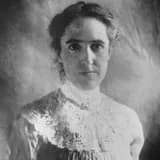
Henrietta Swan Leavitt was born in Lancaster, Worcester County, Massachusetts, USA.
Henrietta Swan Leavitt was born on July 4, 1868, in Lancaster, Massachusetts, the eldest of seven children born to George Roswell Leavitt, a Congregationalist minister, and Henrietta Swan Kendrick. Her family was of old New England Puritan stock, with ancestors including John Leavitt, an early Massachusetts Bay Colony settler.
Growing up in a devout, education-valuing household, Leavitt was afforded opportunities unusual for women of her era, eventually attending Oberlin College before transferring to the Society for the Collegiate Instruction of Women (later Radcliffe College), affiliated with Harvard University. There, in her senior year, she took a course in astronomy that sparked a lifelong passion.
Her birth in the mid-nineteenth century placed her at the cusp of significant change for women in science: though barred from full participation in academic astronomy as men were, women of her generation increasingly found employment as "computers" at observatories, performing meticulous calculations and data analysis. Leavitt's later career would become one of the most historically significant examples of this phenomenon, and her origins in a modest, faith-centered Massachusetts household stand in stark contrast to the global, cosmological scale of her ultimate scientific legacy—the discovery of the period-luminosity relationship that would allow humanity to measure the size of the universe itself.