← All women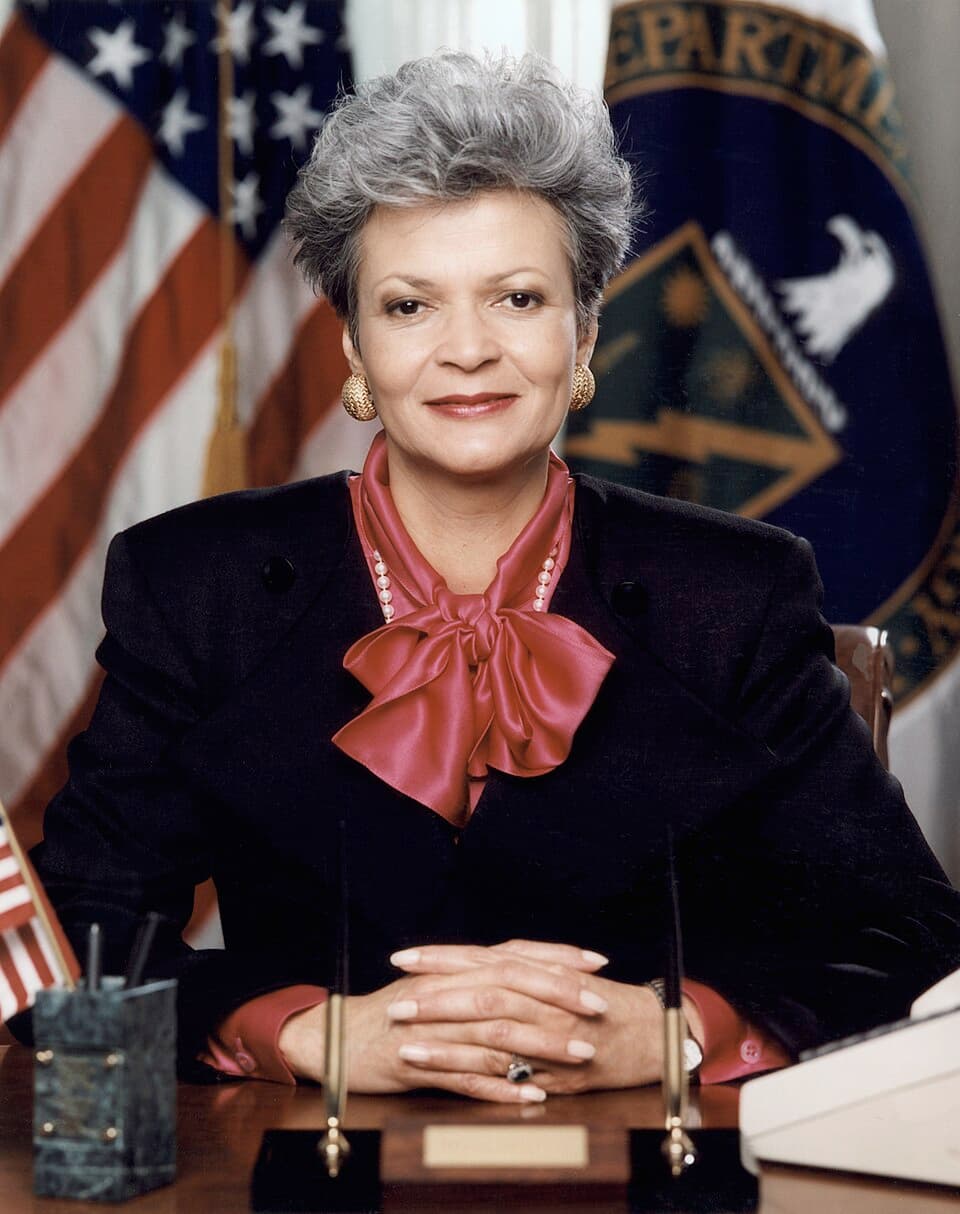
American · Politics · Law · Activism
Hazel R. O'Leary
May 17, 1937 – present
Early Life and Background
Hazel Reid O’Leary (born Hazel Rollins Reid) was born on May 17, 1937, in Newport News, Virginia, a segregated seaport city on the Virginia Peninsula.[4][6] Her father, Dr. Russell Edward Reid, was a physician at Whitaker Hospital—later Newport News General Hospital—serving the local Black community.[4][6] Her mother, Hazel Palleman Reid, maintained the household and was active in community life.[1][4] Growing up in the Jim Crow South, O’Leary experienced the constraints of legally enforced segregation, even as she witnessed the professional dedication of Black clinicians and educators around her.[4]
O’Leary’s parents placed a strong emphasis on education and opportunity. In some accounts, her family moved her to New Jersey during her youth to ensure access to high‑quality schooling; there she attended a high school for the arts, broadening her exposure beyond the rigid racial lines of the South.[3] In other sources, she is noted as a graduate of Huntington High School in Newport News, a segregated Black high school, underscoring the challenges she faced.[13] Despite differences in detail, the sources agree that her formative years combined the realities of segregation with sustained encouragement to pursue advanced education.
These early experiences shaped O’Leary’s lifelong commitment to public service and equity. The contrast between her father’s professional status and the broader discrimination faced by Black families gave her a firsthand understanding of structural inequality. This background would later inform her insistence on transparency, accountability, and fairness in energy policy, environmental regulation, and higher education leadership.
Education and Intellectual Formation
After high school, O’Leary enrolled at Fisk University in Nashville, Tennessee, one of the nation’s most distinguished historically Black colleges and universities (HBCUs).[3][4] Fisk had long been a center of African American intellectual life, known for its rigorous academics and activism. There she studied history and government, immersing herself in coursework that examined U.S. political institutions, civil rights, and global affairs.[4][13]
O’Leary earned her B.A. from Fisk University in 1959, graduating with honors during a pivotal moment in the modern civil rights movement.[3][4][13] Being part of an HBCU community connected her to networks of Black professionals, scholars, and activists who were challenging segregation and expanding opportunities for African Americans. This environment helped cultivate her interest in law and public policy.
Determined to deepen her expertise, O’Leary continued her education at Rutgers University School of Law in Newark, New Jersey.[3][4] She entered law school in the mid‑1960s, a period of intense legal ferment surrounding civil rights, voting rights, and regulatory law. In 1966, she earned her Juris Doctor (J.D.) from Rutgers.[2][4][13] As a Black woman in a predominantly white and male profession, O’Leary confronted gender and racial biases while mastering the tools of statutory interpretation, litigation, and administrative law.
This combination of an HBCU liberal‑arts education and a mainstream law degree positioned O’Leary uniquely at the intersection of Black intellectual traditions and national legal practice. It equipped her to operate in both community‑focused and high‑level governmental contexts, a dual perspective that would later define her approach to energy regulation and transparency.
Career Beginnings in Law and Regulation
Following law school, O’Leary entered public service in New Jersey. She worked as an assistant prosecutor in Essex County, building courtroom experience and learning the practical dimensions of criminal law and procedure.[3][6] She subsequently served as an assistant attorney general for the state of New Jersey, a role that expanded her responsibilities to statewide legal issues and regulatory enforcement.[4][6]
Her early legal career emphasized public interest and administrative law, rather than private practice. O’Leary later became general counsel for the U.S. Community Services Administration, a federal agency focused on community development and anti‑poverty programs.[6] In this capacity she dealt with federal regulations and funding mechanisms, deepening her understanding of how policy is translated into operational practice.
By the mid‑1970s, O’Leary’s expertise in law and regulation drew her into the emerging field of energy policy. Under Presidents Gerald Ford and Jimmy Carter, she joined the federal government as an energy regulator, taking on positions that addressed oil and gas pricing and supply.[6] The energy crises of the 1970s, marked by oil embargoes and price shocks, made energy regulation a central public policy concern. This context set the stage for her later prominence at the U.S. Department of Energy.
Rise in Energy Policy and Corporate Leadership
O’Leary’s energy‑sector work accelerated when she joined the newly created U.S. Department of Energy (DOE) under President Jimmy Carter. Within DOE, she led the Economic Regulatory Administration (ERA), the agency responsible for enforcing federal price controls on various types of energy, including oil and natural gas.[3] Managing ERA required navigating complex markets, legal challenges, and political pressures, reinforcing her reputation as an expert in energy regulation.
After her government service in the Carter administration, O’Leary moved into the private sector, joining Northern States Power Company (NSP), a Minneapolis‑based utility holding company.[3][6] At NSP she held senior roles focusing on environmental issues, public affairs, and eventually became president of its gas distribution subsidiary.[3] Her work in the utility industry broadened her perspective on corporate decision‑making, regulatory compliance, and technological innovation in energy production and distribution.
O’Leary also co‑founded and served as vice president and general counsel for O’Leary Associates, an energy consulting firm that advised on regulatory and policy matters.[6] Through this mix of public and private roles, she acquired an unusually comprehensive view of the energy landscape—from federal oversight to corporate operations and consumer impacts.
By the early 1990s, O’Leary was widely regarded as an experienced energy expert with a rare combination of regulatory, legal, and corporate experience.[4] This multidisciplinary background made her a compelling candidate for national leadership at a time when the Department of Energy was grappling with Cold War legacies, environmental concerns, and the emerging importance of renewable energy technologies.
Secretary of Energy: Appointment and Historic Firsts
In 1993, President Bill Clinton nominated Hazel R. O’Leary to be the 7th United States Secretary of Energy.[1][2][4] She was unanimously confirmed by the Senate, and on January 21, 1993, she was sworn into office.[16][17] With this event, O’Leary became the first woman and first African American to serve as Secretary of Energy, and the first Secretary of Energy to have worked for an energy company or electric utilities.[2][3][9]
At the time she took office, DOE was often described as one of the government’s most secretive and mistrusted agencies, heavily involved in nuclear weapons research, testing, and environmental clean‑up.[6][14] O’Leary inherited a department with vast classified holdings and a complex legacy of Cold War policies. Her appointment was therefore notable not only for its symbolic importance in representation but also for the substantive challenges she faced.
Media and institutional sources quickly recognized the historic nature of her role. A Daily Press profile on April 4, 1994 highlighted that O’Leary, a 56‑year‑old Newport News native, had become the nation’s first female and African‑American “energy chief” and emphasized her vow to open up DOE’s operations to public scrutiny.[6] Utility and educational organizations likewise celebrated her as a trailblazer for women and African Americans in energy policy.[3][5]
The Openness Initiative and Declassification of Cold War Records
One of O’Leary’s most consequential initiatives as Secretary of Energy was the Openness Initiative, launched shortly after she took office. She reorganized the agency’s Office of Classification, turning it into the Office of Declassification, symbolically and practically committing DOE to greater transparency.[1][3][10]
Under her leadership, DOE began to declassify millions of pages of Cold War–era documents related to nuclear testing, radiation experiments, and environmental contamination.[3][5][10][13] These records revealed that, between the 1940s and early 1970s, the U.S. government had sponsored human radiation experiments in which hospital patients, civilians, and military personnel were exposed to ionizing radiation, often without fully informed consent.[5][11]
On December 28, 1993, O’Leary publicly appealed to the executive and legislative branches to consider compensation for individuals harmed by these studies, framing the issue as a matter of federal responsibility and ethics.[11] Her stance went beyond simple disclosure; she advocated for justice and redress for affected populations, pushing Congress and the White House to address the legacy of Cold War practices.
O’Leary’s openness policies drew both praise and criticism. Supporters argued that she transformed DOE from a clandestine entity into a more accountable public agency, fostering public trust and enabling independent analysis of nuclear policy.[4][14] Critics in some national‑security circles worried about the potential risks of extensive declassification. Nonetheless, her initiatives are widely credited with exposing abuses and informing subsequent debates about nuclear testing, environmental remediation, and human‑subjects protections.[5]
Energy Policy, Renewable Technologies, and Fiscal Management
Beyond transparency, O’Leary played an active role in shaping the Clinton administration’s energy agenda. She supported increased funding and policy support for renewable energy and energy‑efficient technologies, including the commercialization of efficient appliances and advanced energy systems.[3][5] Her departmental leadership emphasized the importance of moving toward cleaner energy sources such as solar and wind, alongside more efficient use of existing fuels.[3][10]
O’Leary also worked to strengthen fiscal responsibility within DOE. Reports from the period note that under her leadership the department achieved significant cost savings, with some accounts citing $10 billion in savings for American taxpayers over her tenure.[8] This focus on efficiency complemented her push for openness, demonstrating that transparency and fiscal discipline could coexist as core values in a federal agency.
In nuclear policy, O’Leary encouraged the Clinton administration to end U.S. nuclear testing, supporting a transition toward arms‑control measures and emphasizing the environmental and health impacts of ongoing testing.[1] She highlighted the dangers posed by major nuclear power plants and advocated for improved regulation and oversight.[5] Through these efforts, she sought to align energy policy with public health and environmental considerations.
Awards, Honors, and Public Recognition
O’Leary’s work as Secretary of Energy earned her formal recognition as well as widespread public and media attention. In 1994, her Openness Initiative was credited with securing the James Madison Award from the American Society of Access Professionals, honoring her contributions to government transparency; one utility‑sector account gives the specific date of March 16, 1994 for this award.[3]
Journalistic and encyclopedic sources widely describe O’Leary as among the most effective Cabinet appointments of the Clinton administration, citing her unique blend of public‑sector and private‑sector experience and her commitment to open government.[4][14] She became a frequent speaker and commentator on energy policy, ethics in science, and leadership, invited to institutions such as the University of Tennessee Space Institute to discuss her “Journey to Success.”[8]
Her role as the first woman and first African American Secretary of Energy has been continually noted in reference works, including Wikipedia, Simple English Wikipedia, Britannica, and biographical compilations such as The HistoryMakers and BlackAmericaWeb.[1][2][5][7][9] These sources highlight her as a major figure in Black history and women’s history, emphasizing both her barrier‑breaking appointment and the substantive reforms she undertook.
End of Tenure as Secretary of Energy
O’Leary’s tenure as Secretary of Energy lasted through the entirety of President Clinton’s first term. According to DOE records and multiple reference sources, her service ended on January 20, 1997, the date marking the close of that term.[2][16][17] During these four years, she oversaw the department’s transition into a more open institution and advanced a policy agenda that integrated renewable energy, environmental awareness, and cost‑conscious management.
Her departure from DOE followed allegations concerning travel expenditures and related controversies that attracted media scrutiny. Subsequent accounts emphasize that investigations did not yield substantive findings of misconduct against her.[5] Nonetheless, the episode illustrates the complex scrutiny faced by high‑profile women and minorities in Cabinet‑level roles.
After leaving federal office, O’Leary returned to consulting and public speaking, remaining a prominent voice on energy, ethics, and leadership while considering opportunities to contribute in other sectors.
Leadership of Fisk University and Support for HBCUs
In the early 2000s, O’Leary’s professional trajectory came full circle when she was chosen to lead her alma mater. On February 10, 2004, she was announced as the 14th president of Fisk University.[2][12] She formally assumed office in August 2004, beginning nearly a decade of leadership at one of the country’s most historically significant HBCUs.[2][12]
As president, O’Leary confronted financial and institutional challenges facing Fisk, including the need to stabilize budgets, strengthen academic programs, and preserve cultural assets such as the university’s renowned art collections.[3][12] She worked to increase fundraising, engage alumni, and raise Fisk’s national profile, drawing on her political and corporate networks.
Commentators have emphasized that O’Leary “generated energy for HBCUs,” using her platform to advocate for the importance of historically Black institutions in U.S. higher education.[12] Her presidency is generally dated from 2004 to 2013, reflecting her extended commitment to the university and the broader HBCU community.[2][5][12] Under her stewardship, Fisk navigated difficult financial terrain while continuing to educate new generations of students in the liberal arts, sciences, and professional fields.
Personal Life
Hazel Reid married John F. O’Leary, a former deputy secretary of energy, on April 24, 1980Carl, as noted in biographical references.[4][12] John F. O’Leary died in 1987, leaving Hazel a widowed mother as she continued her ascent in public and corporate leadership.[4]
Biographical sources portray O’Leary as balancing her demanding professional life with family responsibilities, a common but often under‑documented dimension of women’s career trajectories. Her marriage to a fellow energy expert likely enriched her understanding of the sector’s technical and political dimensions, even as her own career increasingly diverged into independent leadership roles.
Legacy and Historical Impact
Hazel R. O’Leary’s legacy rests on both symbolic firsts and substantive policy achievements. As the first woman and first African American Secretary of Energy, she expanded the representational boundaries of the U.S. Cabinet, demonstrating that Black women could lead complex national‑security‑related departments.[2][5][9] Her appointment and tenure are frequently cited in Black history and women’s history narratives as milestones in federal leadership.
Substantively, her Openness Initiative reshaped expectations of transparency in energy and nuclear policy. By declassifying millions of documents and exposing the history of human radiation experiments, she enabled victims, scholars, journalists, and policymakers to scrutinize past abuses and call for ethical reforms.[3][5][10][11] Her December 1993 appeal for compensation for radiation‑experiment survivors positioned DOE at the forefront of governmental accountability debates.[11]
O’Leary also helped integrate renewable energy and energy efficiency into mainstream federal policy discussions.[3][5] She supported research and commercialization efforts, including energy‑efficient appliances and advanced technologies, at a time when climate change and environmental sustainability were beginning to gain broader public attention.
In higher education, her presidency at Fisk University underscored the role of HBCUs in cultivating leadership and preserving African American intellectual traditions. Her stewardship during a challenging financial period contributed to ongoing efforts to keep Fisk and similar institutions viable and influential.[2][12]
Beyond specific policies, O’Leary’s career demonstrates how Black women leaders can leverage legal training, regulatory expertise, and corporate experience to transform federal agencies and educational institutions. Her story illustrates the interplay between representation, transparency, and institutional reform in late‑20th‑ and early‑21st‑century American history.
Later Life and Status
After stepping down as president of Fisk University around 2013, O’Leary largely retired from day‑to‑day institutional leadership, though she has continued to appear in public forums and oral‑history projects. The HistoryMakers, a national African American oral‑history archive, has documented her life and career, preserving her reflections on energy policy, openness, and leadership.[1]
As of the latest available sources, Hazel R. O’Leary is living, with no reported date of death.[2][7][9] Her career continues to be referenced in contemporary discussions of Black women’s leadership, government transparency, nuclear ethics, and the future of HBCUs. She remains an important figure for researchers examining the intersection of race, gender, and high‑level policy making in the United States.
Dated achievements
10 indexed.
- May171937Politics
Birth of Hazel R. O'Leary
Hazel Reid O'Leary was born in Newport News, Virginia, later becoming a lawyer, energy regulator, utility executive, and U.S. Secretary of Energy.
View details Hazel R. O'Leary - Wikipedia - Jun011959Law
Graduated from Fisk University
O'Leary graduated from Fisk University, a historically Black institution, with a bachelor's degree, laying the foundation for her legal and public service career.