← All women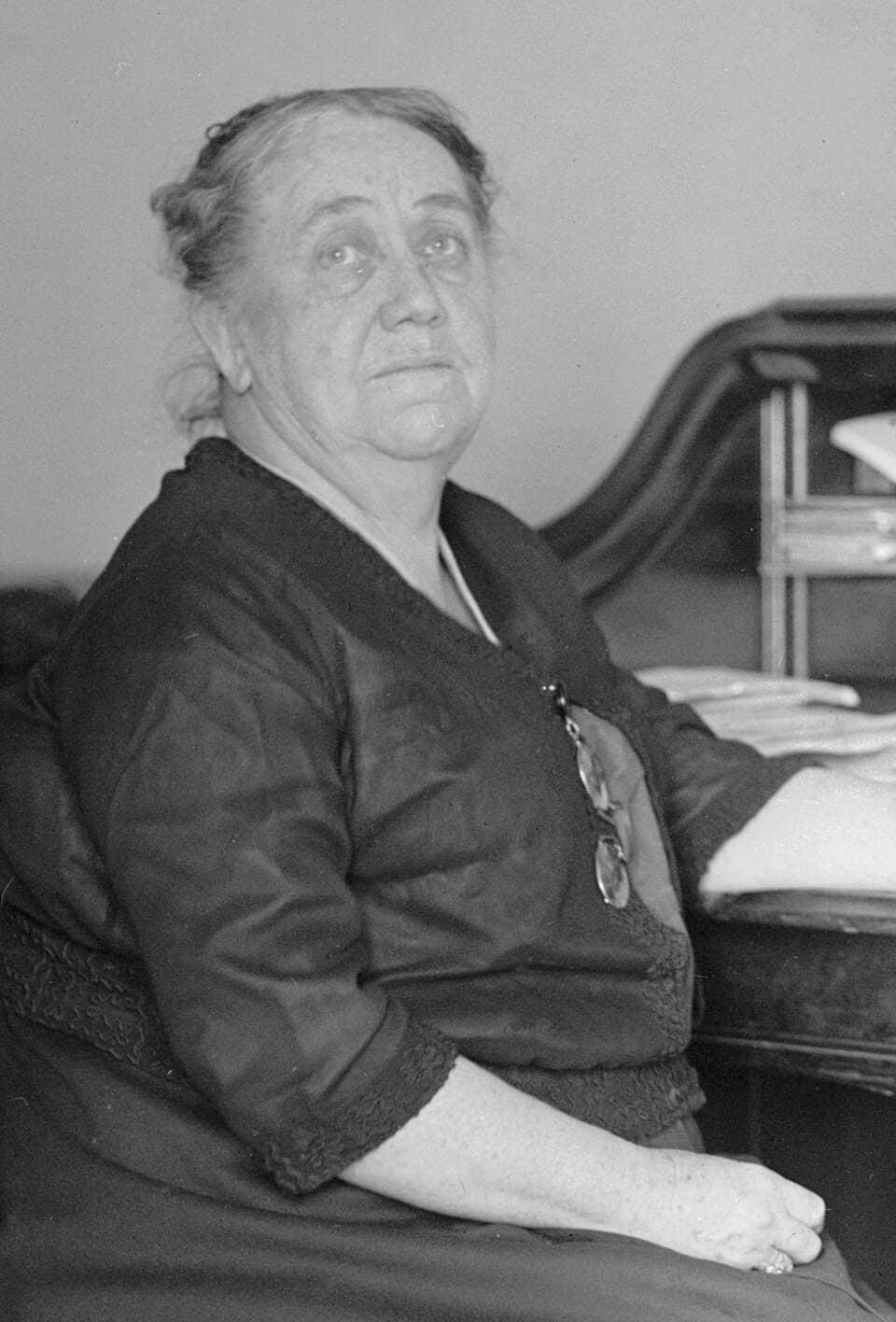
American · Activism · Politics
Harriet Taylor Upton
December 17, 1853 – November 2, 1945
Early life and background
Harriet Taylor Upton was an American suffragist, political organizer, and author whose work helped move women from the margins of public life into the formal structures of U.S. party politics.[2][4][6] She was born December 17, 1853, in Ravenna, Ohio, the elder of two children and only daughter of Ezra Booth Taylor, a lawyer and later judge and congressman, and Harriet (Frazer) Taylor.[1][2][8][11][13]
Her family background placed her close to law and politics from an early age. Ezra Taylor built a successful legal practice and became a circuit court judge before his appointment and subsequent election to the U.S. House of Representatives in 1880.[1][2][11] According to biographical and local historical accounts, Harriet’s upbringing in a home where public affairs and legal issues were regularly discussed gave her an unusual familiarity with political processes for a nineteenth‑century girl.[1][2]
In 1861–62, the Taylor family moved from Ravenna to Warren, Ohio, in Trumbull County, a community that would remain central to Upton’s life and later become a hub of suffrage activity.[1][5][11] She attended public schools there and graduated from Warren High School (often identified with the later Warren G. Harding High School) in 1873, a relatively advanced level of education for women at the time.[1][5][11] Local histories emphasize that she showed literary talent and a sociable temperament from a young age, traits that later aided her in fundraising and public speaking.[2][5]
Harriet’s formative political education accelerated when her father entered national office. After Representative James A. Garfield vacated his Ohio congressional seat to enter the U.S. Senate, Ezra Taylor was appointed and then elected to Congress; Harriet accompanied him to Washington, D.C., serving as his hostess and companion.[2][5][9] There she met leading political figures and social reformers, including Susan B. Anthony, forging connections that would later prove decisive in her suffrage work.[2][5][9]
Career beginnings and entry into reform
Before committing herself fully to woman suffrage, Upton experimented with several roles common for middle‑class women of her generation. She wrote children’s stories and historical sketches and became active in local women’s clubs and patriotic organizations in Warren.[2][3][5] Some accounts note that she initially viewed suffrage skeptically and at one point worked against it, reflecting ambivalence among many middle‑class women about the movement in the late nineteenth century.[3]
By around 1890, however, Upton’s views shifted decisively. Influenced by her Washington experiences and her relationships with national leaders, she joined the National American Woman Suffrage Association (NAWSA), which had been formed through the merger of rival suffrage organizations led by Susan B. Anthony, Elizabeth Cady Stanton, Lucy Stone, and others.[2][5][6][9] Her familiarity with political institutions and party culture made her a natural intermediary between suffrage activists and lawmakers.
At the local level in Warren, Upton helped organize suffrage associations and civic groups. She became a key figure in the formation of the Suffrage Association of Warren, serving as its first president and using her home as a meeting place.[1][5] She also participated in the temperance movement and was involved in the founding of local chapters of the Daughters of the American Revolution (DAR) and the American Red Cross, reflecting the overlapping networks of reform, patriotism, and social welfare that characterized women’s activism at the time.[5]
Rise within the suffrage movement
Upton’s organizational skills and fundraising abilities quickly brought her to the attention of national suffrage leaders. In 1895 she was elected treasurer of NAWSA, a position she held for approximately fifteen years, with sources placing her tenure roughly from the mid‑1890s to 1910.[2][5][6][9] As treasurer, she handled the organization’s finances, organized fundraising campaigns, and helped professionalize the movement’s administrative operations.
Her home base of Warren became a strategic center of suffrage activity. In the early twentieth century, NAWSA temporarily moved its national headquarters to Upton’s residence at 380 Mahoning Avenue NW, Warren, where it remained from 1903 to 1909.[1][11][12] This made the modest Ohio city one of the operational capitals of the national suffrage movement, bringing leading activists to Warren for meetings, strategy sessions, and training.[1][11]
On the state level, Upton assumed leadership of the Ohio Woman Suffrage Association (OWSA). She served as its president from 1899 to 1908 and again from 1911 to 1920, guiding campaigns for municipal and state suffrage measures and helping coordinate Ohio’s contributions to the national drive for a federal amendment.[1][2][6][9] Under her leadership, Warren became widely recognized as a hub of Ohio suffrage organizing.[1][6]
Upton’s work included extensive speaking tours, convention planning, and campaign management. She edited the suffrage periodical The Progress from 1902 to 1910, using it to circulate news, arguments, and organizing strategies among activists.[6] During key referendum campaigns in Ohio in 1912 and 1914, she served as suffrage campaign manager, coordinating statewide efforts to secure male voters’ approval for enfranchising women, although these particular referendums ultimately failed.[6]
Major works, political accomplishments, and public offices
Upton’s public career combined suffrage activism, party politics, and authorship.
One of her earliest formal political breakthroughs came on April 4, 1898, when she was elected to the Warren Board of Education after Ohio women gained the right to vote for and hold school board offices in 1894.[6] She was the first woman elected to that body and went on to serve for many years, eventually becoming board president.[5][6] This position gave her direct experience in governance and helped normalize women’s presence in elected office at the local level.
In addition to suffrage, Upton engaged with broader reform issues. During the 1910s, she participated in lobbying efforts for child labor legislation, aligning with Progressive Era campaigns to regulate industrial work and protect children, though available sources do not tie specific bills or dates directly to her individual actions.[2][5] Her reform interests also extended to social welfare and public health through her leadership in local Red Cross work.[5]
Upton’s literary output complemented her activism. She authored children’s books and historical works, often focusing on U.S. presidents, first families, and regional history.[2][3][5][6] Titles attributed to her include biographies and anecdotal collections about presidents and their wives as well as histories of the Western Reserve region of Ohio. Through these writings, she contributed to popular understandings of national history and highlighted the roles of women in political households.
Her most nationally visible political accomplishment came in the pivotal election year of 1920. As the Nineteenth Amendment neared ratification, the Republican Party sought to appeal to newly enfranchised women. In this context, Upton was chosen as the first woman vice chair of the Executive Committee of the Republican National Committee (RNC), becoming the first woman to serve on the party’s national executive body.[2][4][6][9] This elevation, recorded during the period of the June 1920 Republican National Convention, recognized her organizational talents and her longstanding ties to the party.
In that role, she helped direct women’s work in the 1920 presidential campaign, including efforts on behalf of Ohio Republican nominee Warren G. Harding.[2][4][9] Her position represented a major step toward integrating women into the formal power structures of national parties, moving beyond auxiliary women’s divisions to meaningful authority in electoral strategy.
Awards, honors, and recognition
During her lifetime, Upton was known as one of Ohio’s most prominent suffrage leaders and was widely respected within NAWSA and Republican circles.[1][2][6][9] She received informal recognition through repeated elections to leadership posts: treasurer of NAWSA, president of the Ohio Woman Suffrage Association, and vice chair of the RNC Executive Committee.
Her most enduring honors, however, have come posthumously. The family home at 380 Mahoning Avenue NW, where she lived for decades and where NAWSA maintained its headquarters from 1903 to 1909, has been preserved as the Harriet Taylor Upton House and is listed on the National Register of Historic Places.[1][11][12] The site operates as a museum and educational center devoted to her life, the suffrage movement, and local history.
The State of Ohio has formally recognized her contributions through a Remarkable Ohio historical marker in Warren, highlighting her roles as suffragist, author, and political leader and noting the national significance of her work.[1][13] Historical societies in Trumbull County and in Pasadena, California, have likewise commemorated her as an “unsung heroine” of the fight for women’s rights.[1][10]
In addition, contemporary public history projects—including digital initiatives such as Her Hat Was in the Ring!, scholarly encyclopedias, and media features for Women’s History Month—regularly spotlight Upton among key U.S. suffrage figures.[2][6][9] These recognitions, though not conventional awards, demonstrate her growing prominence in the historiography of women’s political activism.
Personal life
Upton’s personal life intertwined closely with her public work. In 1877, according to some sources, she married attorney George W. Upton, although several local and institutional histories give the date as 1884; all agree that the marriage occurred in the 1880s.[1][3][5][6] The couple had no children.[1][5] George Upton’s legal career and support for Harriet’s activism appear to have provided her with both the financial stability and social standing to devote extensive time to voluntary and political work.
The couple settled at the Warren residence that would later bear her name. Upton lived there from the 1880s until about 1931, using the house not only as a private home but also as a meeting place for suffrage and civic groups and, for several years, as NAWSA’s national headquarters.[1][11][12] Her management of the household, frequently praised in local accounts, coexisted with an extraordinary public schedule of travel, speaking, and organizational leadership.[1][5]
Contemporaries described Upton as energetic, practical, and humorous, with a talent for both hospitality and negotiation.[2][5] Her friendships with other suffragists, especially Susan B. Anthony, were important both personally and politically. Biographical sketches emphasize that her relationship with Anthony evolved from admiration to genuine partnership, with Upton considered a trusted lieutenant in NAWSA’s leadership.[2][5][9]
Later life, party leadership, and post‑suffrage activism
After the ratification of the Nineteenth Amendment in 1920, Upton continued to work to ensure that women used their new political power effectively. She participated in the early development of the League of Women Voters and is credited with helping found a local League chapter, encouraging newly enfranchised women to study issues, exercise the franchise, and run for office.[2][5]
Within the Republican Party, her influence extended beyond her 1920–1924 tenure as vice chair of the RNC Executive Committee. In 1924, during a visit to Washington, D.C., she was recognized for her pioneering role as one of the earliest women to hold a high‑ranking party post; that same year, she resigned her RNC leadership position but remained active in party affairs.[9] She continued to advocate for women’s participation in electoral politics and to comment on the importance of women’s votes, famously noting that Republicans expected women’s ballots to swing elections.[6]
Upton attempted to move from party leadership into legislative office when she ran, unsuccessfully, for the U.S. House of Representatives in 1926.[6][9] Although she did not win, her candidacy reflected the new possibilities that enfranchisement and party involvement had opened for women. In 1928, she served as an assistant state campaign manager for the Republican Party in Ohio during the presidential campaign, further underscoring her recognized expertise in political organizing.[6][9]
By 1931, Upton retired from active public life and left Warren for Pasadena, California, where she spent her remaining years.[1][2][11] Even in retirement, she remained a symbol of the suffrage generation whose work had permanently altered the landscape of American politics.
Legacy and historical impact
Harriet Taylor Upton’s legacy operates on several levels: as a state and national suffrage leader, as a bridge between reform movements and party politics, and as a regional figure whose home and memory anchor public history initiatives.
Within the suffrage movement, Upton was crucial in the often overlooked areas of finance, administration, and state organizing. As NAWSA treasurer for about fifteen years, she helped keep the organization solvent and professional at a time when it was expanding its membership, publications, and lobbying activities.[2][6][9] Her stewardship of NAWSA’s finances and her role in hosting its headquarters in Warren placed her at the organizational heart of the movement.
In Ohio, she stands out as one of the most important suffrage leaders of her generation. Her long presidency of the Ohio Woman Suffrage Association, her management of referendum campaigns, and her ability to make Warren a statewide hub for activism highlight the importance of state and local leadership in national reform efforts.[1][2][6][9] Her election to the Warren Board of Education in 1898 provided a model of how women could use incremental political opportunities to demonstrate their capabilities in office.
Perhaps her most distinctive contribution was helping to move women into the formal structures of the major political parties. As the first woman vice chair of the Republican National Executive Committee, Upton helped demonstrate that women could serve not merely as a voting bloc or as leaders of auxiliary women’s divisions, but as full participants in party governance and electoral strategy.[2][4][6][9] Her work during and after the 1920 campaign laid groundwork for the growing presence of women in party leadership throughout the twentieth century.
Upton’s literary efforts and historical writings also contributed to public memory of presidents, first families, and regional history, while implicitly showcasing women’s perspectives on political life.[2][3][5][6] Although these works are less well known today than her activism, they reflect the broader cultural influence she exercised beyond organizational leadership.
Modern recognition of her legacy has grown through preservation and public history. The Harriet Taylor Upton House in Warren, now a museum, allows visitors to connect physically with the place where key suffrage strategies were devised and where NAWSA once headquartered.[1][11][12] Ohio historical markers and local histories emphasize her role in putting Warren “on the map” of national women’s history.[1][7][13] In Pasadena, California, where she died, historical narratives increasingly highlight her as an “unsung heroine” of the twentieth‑century fight for women’s rights.[10]
In scholarly and educational contexts, Upton is now regularly included in biographical dictionaries, encyclopedias, and digital projects focused on women’s political history.[2][3][6][9] These accounts, taken together, portray her as a vital connector figure—linking grassroots suffrage activism, state campaigns, national organizational infrastructure, and the evolving world of party politics.
Later life and death
Following her retirement from active political life around 1931, Upton settled in Pasadena, where she lived quietly compared with her earlier decades of public engagement.[1][2][11] She remained interested in political developments and the fortunes of the Republican Party, but her major organizational roles had passed to a younger generation of women leaders.
Harriet Taylor Upton died on November 2, 1945, in Pasadena, California, from causes associated with hypertensive heart disease, according to National Register documentation.[1][2][8][11][13] She was ninety‑one years old, having lived through the Civil War, Reconstruction, the Progressive Era, World War I, the winning of woman suffrage, the Great Depression, and World War II.
At the time of her death, many of her contributions were better remembered locally in Warren and within certain suffrage circles than in national public consciousness. Over time, however, historical scholarship and public commemoration have increasingly restored her to a prominent place in U.S. women’s history. The precise dates of her birth and death—December 17, 1853, and November 2, 1945—now mark the lifespan of a woman whose work quietly but powerfully reshaped the possibilities for women in American political life.[1][2][8][11][13]
Dated achievements
4 indexed.
- Dec171853Science
Birth in Ravenna, Ohio
Harriet Taylor was born in Ravenna, Ohio, daughter of judge and future U.S. Representative Ezra B. Taylor.
View details EBSCO Research Starters: Harriet Taylor Upton - Apr041898Science
First woman elected to the Warren, Ohio Board of Education
Upton became the first woman elected to the Warren Board of Education after Ohio women won school-vote rights in 1894.