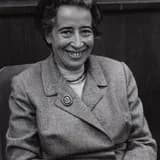
Hannah Arendt died of a heart attack in New York City at age 69, leaving her final work, The Life of the Mind, unfinished.
Hannah Arendt died on December 4, 1975, in her apartment in New York City, succumbing to a sudden heart attack. She was 69 years old. At the time of her death, she was in the midst of writing her final major work, The Life of the Mind, a three-part philosophical inquiry into thinking, willing, and judging, which was left unfinished—the manuscript for the third volume, on judgment, was found still in her typewriter.
Arendt's death marked the end of a remarkable intellectual career that spanned continents and decades, from her early academic training in Weimar Germany, through exile in France, to her decades as a public intellectual in the United States. She had become one of the most influential and controversial political theorists of the twentieth century, known for works including The Origins of Totalitarianism, The Human Condition, and Eichmann in Jerusalem.
Her death was mourned widely in academic and intellectual circles, and tributes poured in from former students and colleagues at the New School for Social Research, where she had been teaching, as well as from the broader community of philosophers and political theorists whose work she had profoundly influenced. Her ashes were buried at Bard College, alongside those of her husband Heinrich Blücher, at the Hannah Arendt/Heinrich Blücher gravesite that remains a site of academic pilgrimage. Her unfinished final work was later edited and published posthumously by her friend and literary executor Mary McCarthy.