← All women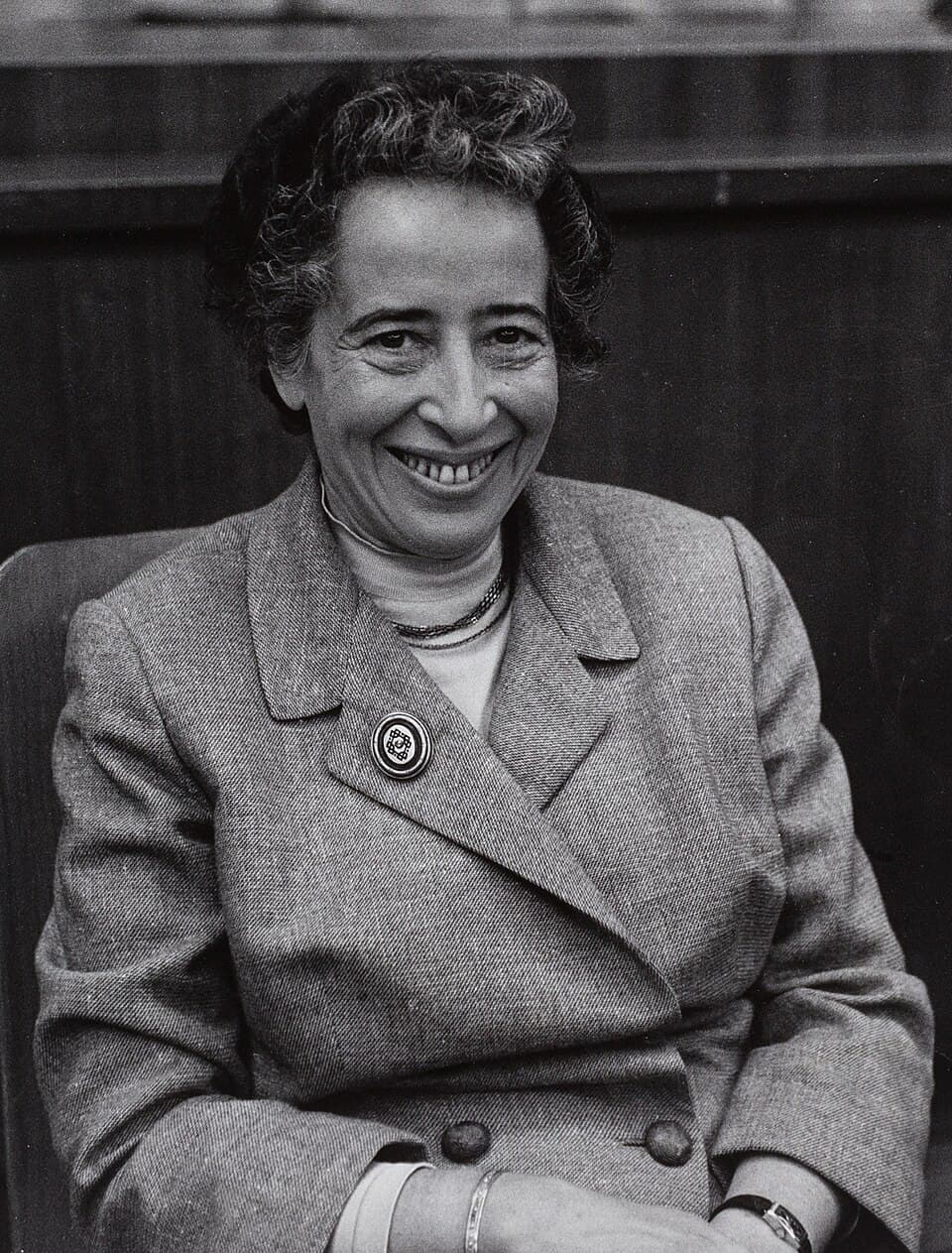
German, American · Politics · Literature · Activism
Hannah Arendt
October 14, 1906 – December 4, 1975
Early Life and Background
Hannah Arendt (born Johanna Cohn Arendt) was born on 14 October 1906 in Linden, then a suburb of Hanover in the German Empire, into a middle‑class, secular Jewish family.[3][5][12][16] Her parents, Paul Arendt, an engineer, and Martha (born Cohn) Arendt, were assimilated Jews who valued education and intellectual life.[7][12][19] Soon after her birth, the family moved to Königsberg, in East Prussia, where Arendt spent much of her childhood.[6][16]
Arendt’s early years were marked by both intellectual stimulation and personal hardship. Her father suffered from syphilis and died when she was seven, leaving her mother to raise her.[19] Martha Arendt’s political interests, especially in Social Democracy and Zionism, and the family’s experience of being a minority in German society, helped shape Arendt’s sensitivity to issues of identity, marginalization, and political belonging.[12][16][19]
She received a rigorous classical education at a Humanistische Gymnasium, studying Latin and Greek, and quickly distinguished herself as a precocious reader of philosophy and theology.[2][7][19] As a teenager she read Immanuel Kant and Søren Kierkegaard, among other thinkers, and engaged in intense self‑directed study, a pattern that would continue throughout her life.[2][7]
During World War I and the turbulent Weimar years, Arendt witnessed the collapse of the old order and the fragility of democratic institutions in Germany. These formative experiences, combined with antisemitism around her, later informed her analyses of totalitarian movements, nationalism, and the plight of refugees and the stateless.[2][12][16]
University Education and Intellectual Formation
In 1924, Arendt began formal university studies in philosophy, theology, and classical philology at the University of Marburg.[2][16][19] There she studied under Martin Heidegger, whose existential phenomenology profoundly influenced her early thinking.[2][7][19] Heidegger’s emphasis on "being‑in‑the‑world" and authenticity, as well as his charismatic teaching style, made a lasting impression. Arendt and Heidegger also entered into a complex personal relationship, which later became a subject of scholarly controversy.[2][19]
Arendt continued her studies at the University of Freiburg with Edmund Husserl and then at the University of Heidelberg under Karl Jaspers.[2][7][16] Jaspers, a key figure in existential and political philosophy, became both her doctoral supervisor and lifelong friend. He encouraged her independent spirit and ethical seriousness, stressing the importance of communication, responsibility, and the public dimension of philosophy.[2][7][19]
In 1929, Arendt completed her doctoral dissertation, Der Liebesbegriff bei Augustin ("The Concept of Love in Augustine"), at Heidelberg.[2][7] The work examined ideas of love, neighborliness, and the worldliness of human relations in the thought of St. Augustine, foreshadowing Arendt’s lifelong interest in how human ties and commitments shape political life.[2][7][19] The dissertation earned her a Ph.D. in philosophy, marking the formal beginning of her career as a scholar.
Career Beginnings and Confrontation with Nazism
After completing her doctorate, Arendt moved to Berlin, where she initially pursued academic work and began research on the emerging problem of antisemitism in German society.[2][16][19] The rise of the Nazi movement rapidly changed the context of her life. In 1933, after Adolf Hitler’s appointment as Chancellor and the consolidation of Nazi power, Arendt became involved with the German Zionist Organization, collecting and analyzing antisemitic statements and propaganda.[16][19]
Her efforts drew the attention of the Gestapo, and in 1933 she was arrested and briefly detained.[2][17][19] Following her release, Arendt concluded that remaining in Germany was too dangerous. She fled to Paris in 1933, joining the stream of political refugees escaping Nazi persecution.[2][3][16] This flight marked the beginning of her long exile and shaped her later reflections on statelessness, rights, and the vulnerabilities of minorities.
In Paris, Arendt lived as a stateless person for eight years.[2][3] She worked for Jewish relief and refugee organizations, including Agudath ha‑Noar ha‑Yehudi and Youth Aliyah, helping to organize the emigration of Jewish youth to Palestine.[2][16][19] Her responsibilities included practical coordination, political advocacy, and engagement with diverse Zionist perspectives, deepening her understanding of Jewish politics and the complexities of nationalism.
During these years, Arendt also wrote essays and reviews in German, further developing her voice as a public intellectual. Her experiences in France—internment, bureaucratic obstacles, and the constant precariousness of life without citizenship—later provided empirical grounding for her analysis of "the stateless" and "the right to have rights."[2][3][16]
Flight from Europe and Immigration to the United States
With the German invasion of France in 1940 and the expanding reach of Nazi persecution, Arendt’s situation became even more perilous. She was briefly interned in the Gurs camp in southern France, one of the many detention centers where foreign nationals and Jews were held.[3][12][16] Managing to secure release, she went into hiding and worked with other refugees to obtain exit visas.
In 1941, Arendt, her husband, and her mother finally managed to leave Europe, traveling via Spain and Portugal and arriving in the United States as refugees.[2][3][17] Stateless upon arrival, Arendt lived in New York City and gradually entered the city’s vibrant intellectual milieu, which included fellow émigrés and American scholars. She remained without citizenship for a decade, an experience that continued to inform her thinking on human rights.
Arendt became a U.S. citizen in 1951, formalizing her place in the American political community.[2][17] This transformation from European refugee to American citizen paralleled her shift from German to primarily English‑language writing and opened opportunities for academic appointments and wider influence.
Major Works and Intellectual Contributions
Arendt’s first major book, The Origins of Totalitarianism, was published in 1951.[2][3][5][8] The study analyzed Nazism and Stalinism as new forms of rule that broke with traditional authoritarian and tyrannical regimes. Arendt argued that totalitarian movements mobilize mass loneliness, destroy legal and moral frameworks, and aim at total domination through ideological terror.[2][5] She traced these developments to modern antisemitism, imperialism, and structural transformations in European society. The book quickly established her as a leading interpreter of twentieth‑century politics.
In The Human Condition (published 1958), Arendt turned from totalitarianism to an exploration of the vita activa—the active life of human beings.[2][3][5][8] She distinguished between labor, work, and action: labor as cyclical, necessity‑bound activity; work as the production of durable artifacts; and action as political, relational, and bound up with speech and plurality.[2][5] Arendt argued that modern society’s elevation of labor and consumption and its suspicion of public action had undermined genuine politics. The book became foundational for debates in political theory, sociology, and philosophy about freedom, public space, and the meaning of human activities.
Another landmark work was Eichmann in Jerusalem: A Report on the Banality of Evil, first appearing as a series of articles in The New Yorker and then published as a book in 1963.[2][3][5][8][10] Reporting on the 1961 trial of Adolf Eichmann, a key organizer of the Holocaust, Arendt introduced the controversial phrase "the banality of evil" to capture the way ordinary bureaucrats could commit horrific crimes through thoughtlessness and conformity rather than fanatical hatred.[2][3][5] She argued that Eichmann was notable for his incapacity to think from the standpoint of others, not for monstrous motives. The book sparked intense criticism, especially over her comments on Jewish leadership during the Holocaust, but it profoundly influenced later discussions of moral responsibility, obedience, and systemic violence.
Across these and other works—such as Between Past and Future, On Revolution, and Men in Dark Times—Arendt developed core themes: the importance of natality (the capacity for new beginnings); the role of public space and speech in politics; the dangers of ideologies that erase plurality; and the need for judgment in the face of unprecedented events.[2][5][7] Her work resisted systematic metaphysics, instead weaving historical narrative and conceptual reflection.
Toward the end of her life, Arendt delivered the Gifford Lectures at the University of Aberdeen in 1972, which formed the basis of her unfinished project The Life of the Mind.[2][17] In these lectures, she explored the activities of thinking, willing, and judging as distinct mental operations, extending arguments she had begun in earlier essays on responsibility and the relationship between philosophy and politics.
Academic Career and Barrier‑Breaking Achievements
After establishing herself in New York’s intellectual community, Arendt held a series of research and teaching positions. She worked for Schocken Books, wrote for journals, and became increasingly recognized in academic circles.[2][16][19] In the 1950s, she taught at The New School for Social Research, an institution known for its openness to exiled scholars and innovative social thought.[1][5][14]
In 1953, Arendt became the first woman to secure a full‑time professorship at Princeton University, a major milestone in the history of women in American higher education.[1][3][16][19] This appointment broke gender barriers at an elite institution that had long excluded women from its senior academic ranks. Although the precise date is not documented in the available sources, the year marks a turning point: Arendt’s recognition as a leading theorist was strong enough to overcome prevailing biases against female scholars.
She later held appointments at the University of Chicago and continued to teach at The New School, influencing generations of students in political theory, philosophy, and social thought.[2][3][14][16] Arendt’s pedagogical style combined close reading of texts with open discussion of current events, challenging students to think critically rather than accept received doctrines.
Reporting on the Eichmann Trial
In 1961, Arendt traveled to Jerusalem to cover the trial of Adolf Eichmann for The New Yorker.[3][17] The trial, one of the first globally publicized legal reckonings with the Holocaust, provided Arendt with a concrete case through which to examine questions of guilt, responsibility, and the nature of evil. Her dispatches combined courtroom observation with philosophical reflection.
Arendt’s depiction of Eichmann as neither a demonic figure nor a mere cog in the machine, but as an unthinking functionary, challenged many prevailing narratives about perpetrators of mass crimes.[2][3][5] The controversy that followed centered not only on her characterization of Eichmann but also on her criticisms of how the trial was conducted and her analysis of Jewish councils during the Holocaust.[2][3][19] The intense debates demonstrated the difficulty of confronting traumatic history and made Arendt a central, if contested, voice in Holocaust studies.
Awards, Honors, and Recognition
Arendt’s intellectual contributions were recognized through major awards and honors. In 1970, she received the Sonning Prize for Contributions to European Civilization, a prestigious Danish award granted to individuals who have significantly advanced European culture.[3][17] The prize underscored her importance not only as a commentator on totalitarianism but as a thinker trying to reconstruct the conditions for a humane public life after political catastrophe.
Beyond formal awards, Arendt’s stature was reflected in her invitations to lecture at leading universities, the translation of her works into numerous languages, and the growing secondary literature on her thought during her lifetime.[2][5][7] Her ideas influenced political theorists, philosophers, historians, and activists, and she became an important figure in both Jewish intellectual history and broader European and American debates about democracy.
Personal Life
Arendt’s personal relationships were intertwined with her intellectual development. In 1929, she married Günther Stern (later known as Günther Anders), a philosopher and writer.[5][16][19] The marriage eventually ended in divorce. In 1940, while in France, she married the German‑Jewish poet and Marxist thinker Heinrich Blücher.[5][16][19] Blücher, who had no formal academic training, became an important intellectual companion. Their conversations significantly influenced Arendt’s thinking, especially regarding revolutionary politics and the role of the working class.
Arendt and Blücher had no children, but their home in New York served as a gathering place for émigré and American intellectuals.[16][19] She maintained close friendships with figures such as Karl Jaspers and various writers and scholars in the United States and Europe. Her relationship with Heidegger, resumed after the war, remained complicated due to his involvement with National Socialism, but Arendt defended the philosophical value of his work while firmly rejecting his political choices.[2][19]
Arendt’s Jewish identity was central to her self‑understanding. She wrote extensively on Jewish politics, antisemitism, and the problem of assimilation, and she consistently saw her own experience of persecution and exile as integral to her intellectual vocation.[2][12][16][19]
Later Work and The Life of the Mind
In her later years, Arendt turned more explicitly to questions of thinking, willing, and judging. Her Gifford Lectures in 1972 developed a framework for analyzing mental activities as distinct yet interconnected, drawing on thinkers from Plato and Kant to modern literature and political experience.[2][17]
She envisioned a three‑part work, The Life of the Mind, with volumes on thinking, willing, and judging. At the time of her death, the first two parts had been substantially completed, while the section on judging remained largely in outline.[2][5] Posthumous publication of this work extended her influence into debates on moral philosophy and hermeneutics, especially through her reflections on the connection between thinking and the refusal to commit evil.
Later Life and Death
Arendt continued to live and teach in New York City throughout the 1960s and 1970s, balancing writing, lectures, and public engagement.[2][3][16] She remained involved in discussions about civil rights, student movements, and the crises of late twentieth‑century politics, though she resisted alignment with any single ideological camp.
On 4 December 1975, Arendt died of heart failure in New York at the age of 69.[4][5][10][12][16] Her death occurred while she was still actively engaged in her intellectual projects, leaving some work unfinished but a vast corpus of published and unpublished material. She was buried at Bard College in New York State, a site that now houses the Hannah Arendt Collection and the Hannah Arendt Center for Politics and the Humanities.[1][17]
Legacy and Historical Impact
Hannah Arendt is widely regarded as one of the most significant political theorists of the twentieth century.[2][3][5][7] Her analyses of totalitarianism, the fragility of rights, and the importance of public action reshaped how scholars and citizens alike conceptualize modern political life. Unlike many philosophers who sought systematic theories, Arendt cultivated a style that combined historical narrative, literary examples, and conceptual reflection, emphasizing the unpredictability of human affairs and the centrality of plurality.[2][7]
Her concept of the "banality of evil" continues to provoke discussion about the psychology of perpetrators, the dangers of bureaucratic rationality, and the moral obligations of ordinary individuals in unjust systems.[2][3][5] The idea has been applied in studies of genocide, corporate wrongdoing, and everyday complicity, demonstrating the breadth of her influence beyond academic philosophy.
Arendt’s work has also become central to women’s intellectual history. As a woman who achieved prominence in male‑dominated institutions and became the first woman to hold a full‑time professorship at Princeton, she opened pathways for later generations of female theorists.[1][3][16][19] Feminist scholars have engaged both critically and appreciatively with her ideas, debating her views on social questions while embracing her insistence on the political significance of plurality and natality.
Institutions such as the Hannah Arendt Center at Bard College, extensive archives at the Library of Congress, and ongoing scholarly conferences attest to her enduring relevance.[1][17][19] Her works remain widely read, taught, and translated, and contemporary political crises—from authoritarianism and refugee flows to debates over civic responsibility—often send readers back to Arendt for guidance.
In sum, Hannah Arendt’s life—from her birth in 1906 in Linden, through exile and statelessness, to her death in New York in 1975—embodies the dramatic history of the twentieth century. Her writings offer tools to think through that history and the problems that persist in the twenty‑first century, making her a foundational figure in any serious almanac of women’s and political history.[2][3][5][12][19]
Dated achievements
2 indexed.
- Oct141906Science
Birth of Hannah Arendt
Johanna 'Hannah' Cohn Arendt was born in Linden, near Hanover, Germany, into a secular German-Jewish family.
View details Hannah Arendt - Wikipedia (German) - Dec041975Science
Death of Hannah Arendt
Hannah Arendt died of a heart attack in New York City at age 69, leaving her final work, The Life of the Mind, unfinished.