← All women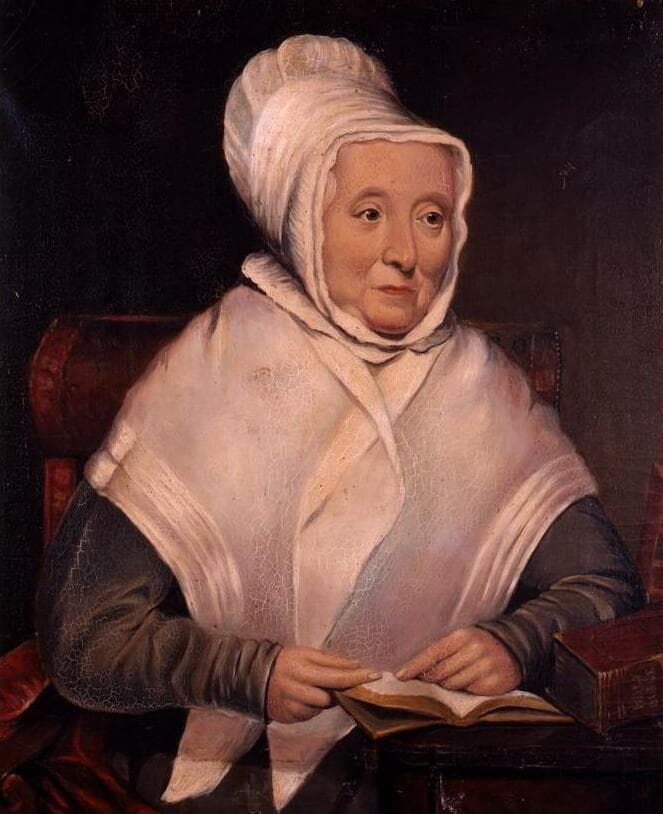
American · Literature
Hannah Adams
October 2, 1755 – December 15, 1831
Early Life and Background
Hannah Adams (2 October 1755 – 15 December 1831) was an American author whose pioneering works on comparative religion and history made her one of the first women in the United States to support herself as a professional writer. Born in Medfield, Massachusetts, she entered the world in a modest rural community of colonial New England, far from the formal academies that shaped most scholars of her era.
Adams was the second of five children of Thomas Adams, a bookseller and farmer, and Elizabeth Clark Adams. Her upbringing combined economic fragility with unusual access to books and learned conversation. Divinity students from nearby Harvard College boarded in the Adams home, and through them Hannah acquired rudimentary knowledge of Latin, Greek, and Hebrew, as well as a deep curiosity about religious history. This informal tutoring substituted for the formal schooling from which girls were largely excluded in mid‑18th‑century Massachusetts.
Her childhood was marked by hardship. Her mother died when Hannah was around twelve, and her father suffered recurring financial difficulties. These troubles forced Adams to leave any structured study and contribute to the family’s support by making lace and later by working as a tutor. Nonetheless, she continued to read voraciously, particularly in theology and history, and developed what contemporaries described as a "studious" and "devout" disposition.
The combination of intellectual exposure and economic necessity was formative. In the patriarchal society of colonial and revolutionary New England, women were expected to remain confined to domestic roles. Adams’s experience of learning from male students while confronting poverty would later shape both her methodological commitment to fairness in describing religious groups and her determination to convert knowledge into livelihood.
Career Beginnings and Development
Adams’s path to authorship began in the late 1770s and early 1780s, amid the upheavals of the American Revolution and its aftermath. As war disrupted commerce and family finances, she sought ways to earn money compatible with her frail health. Tutoring younger children and making lace provided some income but were irregular and poorly paid.
Her turn toward scholarly work was sparked by access to a manuscript derived from Broughton’s religious dictionary that described several Protestant denominations. Adams later recalled that this manuscript "awakened my curiosity," leading her to seek out every book she could find that discussed "various sentiments" among Christian sects. She quickly became dissatisfied with the polemical tone of many authors, who labelled opponents "heretics" or "fanatics."
Determined to produce a more impartial reference, Adams began compiling notes on different religious groups, trying to distill their own statements of belief. This ambitious project, carried out without institutional backing, required extensive reading at a time when books were costly and libraries limited. She borrowed volumes from ministers and friends, took careful notes, and developed the comparative method that would define her career: presenting each sect "from their own perspective" rather than through hostile commentary.
By the early 1780s, Adams had amassed enough material to consider publication. Without independent means, she relied on a subscription model, soliciting advance commitments from clergy, educated laypeople, and acquaintances to finance printing. This approach introduced her to a network of supporters, some of whom would later provide financial assistance and social connections. Her first major book emerged directly from this painstaking compilation.
Major Works and Intellectual Contributions
Adams’s first major work, published in 1784, was titled An Alphabetical Compendium of the Various Sects Which Have Appeared in the World from the Beginning of the Christian Era to the Present Day, often referred to as A View of Religious Opinions. It organized Christian denominations and other religious groups alphabetically, offering concise descriptions of their doctrines and practices. Her commitment to describing sects in terms acceptable to their adherents marked a significant innovation; later commentators have called her the first historian of religions to attempt such an impartial survey.
The compendium went through several editions, both in the United States and Britain. In later printings, it was retitled A Dictionary of Religions, and in its fourth edition (1817) it appeared as A Dictionary of All Religions and Religious Denominations. Each new edition expanded the range of religious movements covered, incorporating developments such as Unitarianism and reflecting Adams’s ongoing research. The work became a widely used reference among clergy, students, and lay readers in a period of growing denominational diversity in the Atlantic world.
In addition to her comparative religious dictionary, Adams turned to historical writing. In 1799, she published A Summary History of New England, a regional history aimed at general readers. The book traced the settlement and development of New England, emphasizing political and religious themes. Its publication led to a notable controversy with the prominent clergyman and geographer Rev. Jedidiah Morse, who accused her of infringing on his own historical project. Adams defended her originality, and the dispute drew attention to questions of intellectual property and fairness, especially significant because she was a female author confronting a male critic in public.
Adams also engaged directly with Christian theology. Her 1801 work, Evidences of Christianity, presented arguments for the truth of Christianity, drawing on historical and rational considerations. In 1804, she published The Truth and Excellence of the Christian Religion Exhibited, which offered biographical sketches of lay Christians whose lives exemplified her understanding of faith’s moral and social strengths. These texts reflect her own evolving religious views, which inclined toward Unitarian Christianity and emphasized moral character and rational belief.
Her most ambitious historical project appeared in 1812 as The History of the Jews, From the Destruction of Jerusalem to the Present Time, published in Boston. This work, one of the earliest extended English‑language histories of post‑Second‑Temple Jewish experience by an American author, traced the dispersion of Jews, their sufferings under various regimes, and their cultural and religious endurance. Adams corresponded with European intellectuals, including the Abbé Grégoire, to gather materials, and her narrative attempted a sympathetic portrayal of Jewish communities, unusual in an era when Christian writers often treated Judaism solely in theological terms.
She continued to write on religious topics throughout her life. In 1816, Adams published Concise Account of the London Society for Promoting Christianity Amongst the Jews, encouraging American support for missionary efforts and reflecting contemporary debates about Christian outreach. In 1824, her Letters on the Gospels appeared, aimed at helping young people read the New Testament intelligently and devotionally. These letters, written in accessible prose, reveal her pedagogical instincts and concern for religious education.
Adams also produced autobiographical writings. She composed an autobiography intended to be published after her death, partly to aid an infirm sister. This text documented her struggles with poverty, illness, and the challenges of authorship, offering rare insight into a woman’s intellectual self‑presentation in the early Republic. After her death, her life story and writings were integrated into A Memoir of Miss Hannah Adams, published in 1832, which helped shape later understanding of her career.
Awards, Honors, and Recognition
Although Adams did not receive formal academic degrees or institutional positions—almost unheard of for women in her time—she was recognized by contemporaries and later commentators for her achievements. Clergy and lay patrons in Boston and beyond formed subscription lists to support the publication of her works, and some provided small annuities to ease her financial burdens.
Adams’s books were used by ministers preparing sermons, by laypeople seeking to navigate the expanding landscape of denominations, and by scholars interested in religious and historical information. Her method of presenting religious groups in neutral terms won praise for its fairness, and she was consulted by figures in the emerging Unitarian movement. She maintained correspondence with European intellectuals, including French Catholic reformer Abbé Grégoire, who encouraged her work on Jewish history.
In the early 19th century, Adams was recognized as one of the first American women to earn a living through writing. Institutions such as the Boston Athenæum later treated her as an early example of a woman admitted as a professional author, although precise dates of such recognition are difficult to reconstruct. Modern reference sources—including encyclopedias, women’s history projects, and religious biography databases—consistently describe her as a pioneering figure in comparative religion and women’s authorship.
Her posthumous memoir with portrait further cemented her reputation. The portrait, reproduced and analyzed by groups such as the Library Company of Philadelphia, is one of the few visual records of an early American woman author who lived by her pen. In memorial culture, the fact that she became the first person buried in Mount Auburn Cemetery, one of the nation’s earliest garden cemeteries, has been noted as an honor reflecting the esteem in which she was held.
Personal Life
Adams’s personal life was marked by dedication to family and faith as well as by the limitations imposed by gender and health. She never married, a circumstance that both freed and constrained her. On the one hand, remaining single allowed her to devote time to reading and writing rather than to the intensive domestic responsibilities expected of wives and mothers in New England. On the other, it left her financially vulnerable, without the economic support that marriage often provided.
She lived primarily with relatives in the Boston area and took responsibility for supporting herself and, at times, assisting her family. Her autobiography and later memoir emphasize her careful economy and the anxiety that accompanied irregular income from book sales and subscriptions. Ill‑health, including periods of weakness that prevented sustained physical labor, reinforced her reliance on intellectual work.
Religiously, Adams moved in circles influenced by Congregationalism and emerging Unitarianism. She attended worship, corresponded with ministers, and developed a personal piety that combined traditional Christian devotion with rational inquiry. Her writings suggest a deep commitment to religious liberty and mutual understanding among different faiths, likely shaped by both her reading and her own experience as a woman who had to argue for the legitimacy of her intellectual work.
Her relationships with patrons, such as sympathetic Boston clergy and educated lay supporters, constituted an important social network. These individuals not only purchased her books but sometimes intervened to assist her financially or recommend her work to others. While not romantic relationships, these ties illustrate the gendered dynamics of patronage in the early Republic: a woman author navigating male‑dominated institutions to secure support and protection.
Later Life and Death
In her later years, Adams continued to write and revise her works despite mounting physical frailty. She remained in Massachusetts, rarely traveling, and lived modestly on the proceeds of her publications, subscriptions, and occasional gifts from friends. Her residence in the Boston area kept her close to intellectual and religious debates, even as she stayed largely on the margins of formal academic structures.
Adams’s health declined gradually, but she maintained her interest in religious questions and historical study. She prepared autobiographical materials with the intention that they be published posthumously, in part to provide financial assistance to a sister in poor health. These preparations reflected her ongoing sense of responsibility to family and her understanding of the literary marketplace.
On 15 December 1831, she died in Brookline, Massachusetts, at the age of seventy‑six. Some historical sources have reported alternate dates, such as 15 November 1831 or 1832, reflecting the challenges of documenting women’s lives in the period. However, major modern reference works—including leading encyclopedias and biographical dictionaries—concur on the December 15, 1831 date, which has become the accepted scholarly consensus.
Following her death, Adams was buried in Mount Auburn Cemetery in Cambridge (and Watertown), Massachusetts, and is widely identified as the first person interred there. Mount Auburn, established in 1831 as one of the earliest American "rural" or garden cemeteries, combined landscaped grounds with burial plots and became a model for later cemeteries across the United States. Adams’s inaugural burial at the site connected her personal story to larger shifts in American attitudes toward death, commemoration, and public space.
In 1832, A Memoir of Miss Hannah Adams was published, drawing on her autobiographical writings and the recollections of acquaintances. The memoir ensured that her life would not be forgotten and provided future historians with rich detail about her experiences as a woman author in the early Republic.
Legacy and Historical Impact
Hannah Adams’s legacy is multifaceted, spanning comparative religion, Jewish historiography, American regional history, and women’s intellectual and economic history.
In the field of religion, her Alphabetical Compendium and its expanded Dictionary of All Religions and Religious Denominations represent an early and influential attempt to survey religious diversity with fairness and precision. By describing denominations from their own perspective, she departed from the polemical traditions that had dominated much theological writing. This approach anticipated later academic methods in religious studies and contributed to a culture of religious liberty and mutual understanding in the young United States.
Her History of the Jews stands as a landmark in the Anglophone writing of Jewish history. Though shaped by the assumptions of her time, the work offered American readers one of their first substantial narratives of Jewish experience beyond biblical accounts, including persecution, diaspora life, and intellectual achievement. Modern scholars of Second Temple and post‑Second‑Temple Judaism recognize her book as an early, if imperfect, contribution to the field.
As a historian of New England and a writer of Christian apologetics, Adams helped popularize historical and theological knowledge for general audiences. Her works were not confined to elite scholars but aimed at ordinary readers seeking to understand their religious and civic environment. This orientation toward accessibility and education aligns her with wider movements in the early Republic to cultivate an informed citizenry.
For women’s history, Adams’s importance is profound. She is widely regarded as the first American woman to support herself as a professional writer, transforming her intellectual labor into livelihood at a time when women rarely published and even more rarely profited from serious prose. Her example demonstrated that women could claim authority in matters of religion and history, negotiate with publishers, and defend their work in public controversies.
Her life also illuminates the constraints on women’s intellectual careers. Lack of formal education, dependence on male patrons, economic insecurity, and health problems all shaped her choices. Yet Adams’s ability to persist, to produce multiple editions and new works over decades, and to secure a modest living from authorship testified to both her tenacity and the evolving possibilities for women in the early United States.
Modern institutions—including historical societies, religious archives, and women’s history projects—continue to highlight Adams in exhibitions and digital resources. She appears in biographical dictionaries, encyclopedia entries, and specialized studies of early American religion and Jewish history. Her portrait is reproduced by libraries as a symbol of early women in the book trades, and her grave at Mount Auburn forms part of the cemetery’s narrative about notable residents.
Adams’s story underscores the need to recover and analyze the contributions of women whose work shaped intellectual life but who lacked the formal titles and positions that typically confer historical fame. As a self‑taught scholar who made literature her profession, Hannah Adams stands as a testament to the possibilities—and limits—of female intellectual agency in the 18th and early 19th centuries.
Dated achievements
8 indexed.
- Oct021755Science
Birth in Medfield, Massachusetts
Hannah Adams was born in Medfield, Massachusetts, the second of five children of Thomas Adams and Elizabeth Clark Adams.
View details Hannah Adams - Wikipedia - Jan011784Science
Publishes first major religious reference work
Adams published 'An Alphabetical Compendium of the Various Sects,' an early encyclopedic survey of world religions.