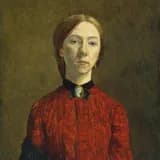
Gwen John died in Dieppe, France, on 18 September 1939, aged 63, having spent most of her career living and working in France.
Gwen John died on 18 September 1939 in the French coastal town of Dieppe, at the age of 63, just over two weeks after the outbreak of the Second World War. Accounts suggest she had traveled to Dieppe, possibly intending to return to England given the deteriorating international situation, and that her health — already fragile in her final years — collapsed suddenly; she reportedly died alone, with her body only identified some time later, and she was buried in the New British Cemetery in Dieppe.
By the time of her death, John had lived in France for most of four decades, having settled permanently near Paris in 1904. She had modeled for and been the lover of the sculptor Auguste Rodin, developed a deeply personal, muted style of portraiture and interior painting, and converted to Roman Catholicism around 1913, a faith that increasingly shaped both her subject matter — nuns, solitary women, convent interiors — and her reclusive way of life in her later years.
At the time of her death, John's reputation remained modest compared to that of her brother Augustus John, a hugely famous society portraitist. It would not be until the posthumous memorial exhibition at the Matthiesen Gallery in London in 1946, and especially the feminist re-evaluation of art history from the 1970s onward, that Gwen John's quiet, psychologically penetrating paintings would be recognized as among the most original and important produced by any British artist of her era, male or female. Today she is celebrated in major collections including Tate Britain, the National Museum of Wales, and the National Museum of Women in the Arts.