← All women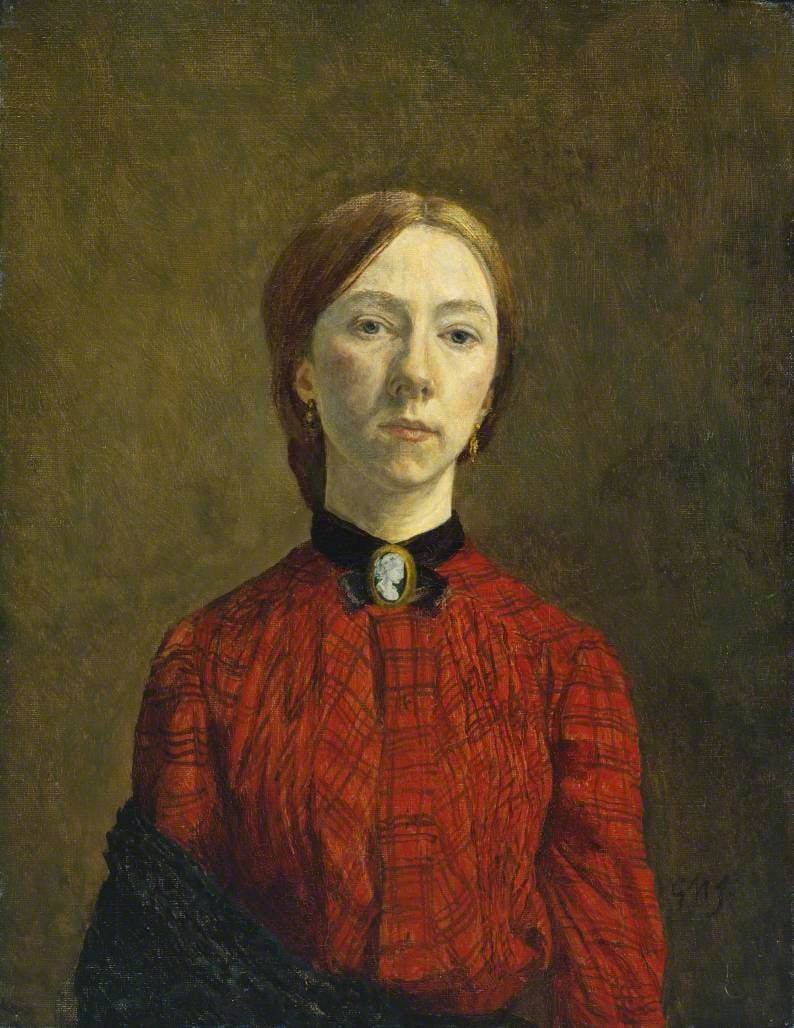
Welsh, British · Arts
Gwen John
June 22, 1876 – September 18, 1939
Early life and family background
Gwen John (born Gwendolen Mary John) was born on 22 June 1876 in Haverfordwest, Pembrokeshire, Wales, the second child of Edwin William John and Augusta Smith John. She grew up in a family of four children, including her younger brother Augustus John, who also became a celebrated artist. The family environment was important to her development: although her mother died when Gwen was young, the household provided early exposure to drawing and artistic ambition, and the siblings’ later careers suggest that creative talent was closely nurtured in the John family.
John’s childhood in Wales and later move into metropolitan art education shaped both her identity and her career. She remained deeply associated with Wales throughout her life, even though most of her mature work was made in France. That duality—Welsh by birth, internationally modern in outlook—became central to her historical significance. She is now recognized not simply as Augustus John’s sister, but as a major painter in her own right.
Education and first artistic training
In the 1890s, Gwen John entered the Slade School of Fine Art in London, one of the major British art schools and one of the first to admit women on serious terms. Her admission mattered because access to formal art education was still limited for women, and the Slade was among the institutions that helped open professional training to female artists. At the Slade, John benefited from an environment that encouraged observational drawing and the study of the figure, skills that remained important in her later work.
She also traveled to Paris and studied at Académie Carmen, the school operated by James McNeill Whistler. This period exposed her to continental modernism and to the Paris art world that would become central to her mature career. Her education was therefore both British and international, combining academic discipline with the subdued, atmospheric sensibility that would become characteristic of her paintings.
Early career and move to France
John began exhibiting in the early 1900s, including a joint exhibition with Augustus John at the Carfax Gallery in London in 1903. The following year she settled in Paris, where she would live and work for most of her life. This move was decisive: France gave her access to a vibrant artistic milieu and to the possibilities of independence that were often harder to sustain in Britain for a woman artist of her generation.
In Paris she worked for a time as a model for artists, including Auguste Rodin. Her relationship with Rodin has often attracted attention because it combined professional modeling, personal intimacy, and artistic exchange. More than a thousand letters between John and Rodin survive in the Musée Rodin, underscoring the intensity and duration of their connection. Yet this relationship should not be reduced to biography alone: John used the work to support herself while continuing to paint, illustrating the economic realities facing women artists who lacked independent income or institutional backing.
Her years in Paris also coincided with the development of the small-scale, intimate style for which she is best known. She painted women, interiors, still lifes, and self-portraits in muted tones, often using a restrained palette and compressed compositions. By design, her work resists grand narrative and instead builds emotional force through stillness, repetition, and quiet concentration.
Mature style and major themes
John’s mature paintings are distinguished by their intimacy, restraint, and tonal subtlety. She frequently painted anonymous women seated in sparse interiors, self-portraits, and domestic settings. Her pictures are often small in scale, carefully structured, and reduced to near-monochrome harmonies. Rather than emphasizing dramatic gesture or psychological revelation in a theatrical sense, John sought a more contemplative mode, making her work feel inward and meditative.
Critics have often connected her art to the aesthetics of quietness and privacy. Her use of thinly applied paint and subdued color produces surfaces that can appear matte and fresco-like. That technical approach contributes to the stillness of her imagery and separates her from the more painterly bravura associated with some contemporaries. Her work also aligns with modernist interests in form, mood, and the everyday interior, while remaining distinctively personal.
John’s figures, especially women, have been central to her later reputation. She often painted them without identifying narrative roles, allowing the subject to become both specific and universal. This has made her an important figure in feminist art history, because her work offers an alternative to the heroic, public, and male-centered traditions that dominated much early 20th-century art discourse.
Religion, personal life, and discipline
Around 1913, Gwen John converted to Roman Catholicism, a choice that shaped the spiritual and contemplative tone of much of her later work. Her faith was not merely personal decoration; it influenced the atmosphere of her interiors and the discipline with which she approached painting. Catholic devotion, solitude, and routine became interwoven with her artistic life, contributing to the austerity that many later viewers associate with her mature style.
John never married and had no children. Her private life has often been discussed in relation to her independence and her preference for solitude. She was linked romantically to Rodin, but the broader pattern of her life was one of self-directed work and withdrawal from publicity. That relative seclusion should not be mistaken for lack of ambition. Rather, it reflected the difficult position of a woman artist who chose seriousness, privacy, and artistic control over the social visibility often expected in the art world.
Exhibitions, recognition, and contemporary reception
John’s contemporaneous recognition was limited. In 1911 she met the American collector John Quinn, who helped promote her work in the United States and acquired examples for his collection. This contact expanded her visibility beyond France and Britain, but her reputation in life remained modest. She was overshadowed by Augustus John in public celebrity and by Rodin in the broader history of modern sculpture and drawing.
During the 1910s and 1920s, she continued to paint in France despite wartime disruption. She produced works such as The Convalescent in 1918–1919, a painting often discussed as representative of her postwar maturity, with its subdued palette and inward-looking subject matter. By the 1920s she had acquired a small but serious reputation among avant-garde collectors and artists, though she remained far from famous.
In the 1930s, as her health declined, she continued to work on domestic interiors and solitary female figures. This persistence is important: even when visibility was low and physical strength weakened, she maintained an art practice that was consistent in vision and method. Her late work reinforced the themes that now define her reputation—privacy, devotion, and the dignity of ordinary interior life.
Posthumous reputation and legacy
Gwen John died on 18 September 1939 in Dieppe, France. At the time of her death, she had not yet received the level of recognition that would later attach to her name. That changed after a 1946 memorial exhibition in London helped bring her work to broader attention. In the late 20th century, art historians and feminist scholars re-evaluated her painting as central to the development of modern British art, rather than as a minor counterpart to the work of male contemporaries.
Her legacy is now secure. She is widely regarded as one of the most important British artists of the 20th century and a leading Welsh painter. Museums and galleries have increasingly highlighted her achievements, and her work is studied for its formal precision, emotional restraint, and radical refusal of spectacle. Her self-portraits, interiors, and women’s portraits are particularly valued for the way they transform quiet observation into a modern artistic language.
John’s historical importance also lies in what she overcame. She pursued professional art training at a time when women were still fighting for access to the same education as men; she built an independent practice across national borders; and she developed an unmistakable voice despite living in the shadow of more famous men. Her life demonstrates how modern art history can be enriched by artists who worked quietly, persistently, and outside the most visible centers of fame.
Selected assessment
Gwen John’s career can be read as a sustained meditation on solitude, interiority, and the possibilities available to women in modern art. She did not build her reputation through large public commissions or avant-garde manifestos. Instead, she created a body of work in which scale, tone, and stillness become vehicles for seriousness. That achievement was historically significant in its own time and became even more important later, when critics and scholars came to see her as a major figure in the story of 20th-century painting.
Dated achievements
2 indexed.
- Jun221876Science
Birth in Haverfordwest, Wales
Gwendolen Mary John was born in Haverfordwest, Pembrokeshire, Wales, on 22 June 1876.
View details Gwen John | Britannica - Sep181939Science
Death in Dieppe, France
Gwen John died in Dieppe, France, on 18 September 1939, aged 63, having spent most of her career living and working in France.