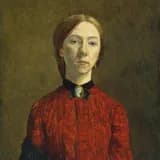
Gwendolen Mary John was born in Haverfordwest, Pembrokeshire, Wales, on 22 June 1876.
Gwendolen Mary John was born on 22 June 1876 in the market town of Haverfordwest, Pembrokeshire, in southwest Wales, the second of four children of Edwin William John, a solicitor, and Augusta John. Her younger brother, Augustus John, would go on to become one of the most celebrated and flamboyant British painters of his generation, and for much of Gwen's life — and for decades afterward — her own achievements were overshadowed by his fame.
The John children lost their mother, Augusta, in 1884, when Gwen was only eight years old, and the family subsequently moved to the seaside town of Tenby. This early bereavement and the somewhat austere, emotionally reserved household presided over by her father are often cited by biographers as formative influences on Gwen John's introspective temperament and her later preference for quiet, contemplative subject matter over the more theatrical and social art of her brother.
Despite the constraints placed on women's access to professional training in the late Victorian period, John pursued a serious artistic education, entering the Slade School of Art in London in 1894 — one of the few institutions of the era that admitted women to rigorous, life-drawing based instruction. Her birth in a small Welsh town, far from the artistic centers of London or Paris, makes her subsequent international career as an painter working alongside figures such as Auguste Rodin and James McNeill Whistler all the more historically notable, and she is today regarded as one of the most significant Welsh-born artists of the twentieth century.