← All women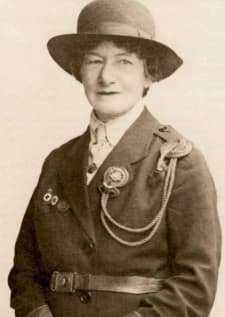
British · Activism
Girl Guides
December 16, 1858 – June 2, 1945
Overview
Agnes Smyth Baden-Powell (16 December 1858 – 2 June 1945) was a British organiser, author, and social reformer best known as the co‑founder and first president of the Girl Guides Association, the pioneering youth movement for girls that became the basis of modern Girl Guiding and Girl Scouting worldwide.[1][5][13] Working closely with her brother, Robert Baden-Powell, the founder of the Boy Scouts, she helped shape a programme that offered girls training in character, citizenship, and practical skills at a time when their public roles were highly constrained.[1][5] Agnes also wrote one of the movement’s earliest handbooks, How Girls Can Help to Build Up the Empire (1912), which articulated its aims and methods.[1] Her organisational work and advocacy provided a crucial bridge between Victorian ideals of femininity and the emerging 20th‑century belief in girls’ capacity for leadership and outdoor competence.
Early Life and Background
Agnes Smyth Baden-Powell was born on 16 December 1858 in London, England, into a large, intellectually active family.[1][15] She was one of the children of the Reverend Baden Powell, a mathematician and clergyman, and his third wife, Henrietta Grace Smyth, who came from an artistic and cultured background.[1] The family atmosphere combined scientific curiosity, religious reflection, and engagement with public affairs, shaping the outlook of the children, including Agnes and her younger brother Robert.
Like many middle‑class Victorian girls, Agnes’ formal education was limited compared with that of her brothers, but she was encouraged to take an interest in natural history, practical crafts, and intellectual pursuits.[1] Various accounts note her aptitude for organisation and her curiosity about the natural world, interests that later fed into her support for youth activities and outdoor learning.[16] The Baden-Powell children also experienced periods of financial difficulty and social change after the death of their father, which likely reinforced Agnes’ appreciation of self‑reliance—an important theme in the programmes she later helped develop.
Influence of Family and Early Activities
Agnes’ life cannot be understood apart from the influence of her brother Robert Baden-Powell, whose military career and experiments with youth training culminated in the publication of Scouting for Boys in 1908.[5][13] His work introduced the idea that structured outdoor games, patrol systems, and badges could develop character and citizenship in boys. As the Boy Scout movement rapidly grew, Agnes watched both its popularity and the controversy it stirred.
Agnes herself was active in voluntary and practical work. A Canadian Girl Guides fact sheet notes that she started a Boy Scout troop in 1908 “in hopes of finding a man to take it over,” highlighting her willingness to engage directly in youth leadership when necessary.[8] She also felt strongly that girls should receive comparable training, and she initiated a Girls’ Emergency Corps, aimed at creating “a corps of girls trained to act in emergencies.”[8] This corps reflected her belief that girls could be useful in public crises, not only in domestic settings, and anticipated many of the service and preparedness themes that would become central to Girl Guiding.
Origins of the Girl Guides Movement
The immediate impetus for the Girl Guides came from the response of girls to the new Scout movement. In 1909, groups of girls attended a Boy Scout rally at the Crystal Palace in London and called themselves “Girl Scouts,” making clear their desire for inclusion.[14] The sight of uniformed girls performing Scout drills attracted media attention and public debate. While some observers supported their enthusiasm, others objected to girls taking part in what they saw as masculine, quasi‑military activities.[5][13]
Facing negative publicity and social resistance to mixed activities, Robert Baden-Powell concluded that girls needed a separate organisation tailored to contemporary views of femininity yet still offering real opportunities for training and adventure.[5][13] After first aid societies declined to take responsibility for such a programme, he turned to Agnes, asking her to organise the new movement.[1][5] According to Encyclopedia.com and other sources, Agnes agreed, albeit initially with some reluctance, to undertake what was a demanding organisational task in a skeptical environment.[9]
Early Publications and Programme Design
Before the formal establishment of the Girl Guides Association, Agnes and Robert began experimenting with printed materials to outline a character‑training programme for girls. Spanish‑language sources describe the publication in 1909 of two pamphlets: Pamphlet A: Baden-Powell Girl Guides, a Suggestion for Character Training for Girls and Pamphlet B: Baden-Powell Girl Guides, a Suggestion for Character Training for Girls.[2] Pamphlet A contained guidance on starting groups, while Pamphlet B detailed proposed programme activities.[2] These texts are considered precursors to the full Girl Guides handbook and demonstrate Agnes’ role in adapting Scout concepts to girls’ needs.
In designing the programme, Agnes had to navigate the tensions between Edwardian expectations of “womanly” behaviour and her own belief that girls could benefit from practical, outdoor, and civic training.[4][7] Japanese sources emphasise that she personally held “Victorian” views about femininity and domestic roles, which contributed to a cautious approach that stressed gentility and propriety.[4] Nevertheless, the emerging Girl Guides programme included camping, first aid, signalling, and other skills, framed as supporting women’s future responsibilities and service to the community.[5][12]
Formal Founding of the Girl Guides Association
A crucial milestone came on 31 May 1910, when the Girl Guides Association was formally constituted in the United Kingdom and Agnes was appointed its first president.[10] A South African historical entry states clearly that “on 31 May 1910, the Girl Guides were formed with Agnes Baden-Powell as the First President of the Girl Guides movement.”[10] Other sources, including Britannica and the World Association of Girl Guides and Girl Scouts (WAGGGS), confirm that the Girl Guides were founded in Great Britain in 1910 under Agnes’ leadership, though they do not specify the day.[5][12]
Within a short period, the new association attracted significant interest. By April 1910, some 6,000 girls had registered as Girl Guides, indicating rapid uptake and the success of efforts to organise local companies and patrols.[1] The association adopted a structure similar to the Boy Scouts, including ranks, badges, and a promise and law adapted for girls.[13] Agnes’ role as president placed her at the centre of administrative decisions, training events, and public representation, as she travelled to visit companies and promote the movement.[8]
Handbook Authorship: "How Girls Can Help to Build Up the Empire"
One of Agnes’ most important contributions was co‑authoring the early Girl Guides handbook. In 1912 she and Robert produced How Girls Can Help to Build Up the Empire, often described as the first official Girl Guides handbook.[1][10] The text presented practical guidance on outdoor skills, health, thrift, and service, while framing girls’ activities within the language of imperial citizenship and moral duty common to the era.[1]
The handbook emphasised that girls, like boys, could develop character and contribute to society through organised training. It included instructions on camping, signalling, and first aid, alongside lessons on domestic responsibility and loyalty.[1] By articulating a clear programme and rationale, Agnes helped legitimise the movement in the eyes of parents, educators, and public authorities. The book also offered a template that could be adapted in other countries as Guiding and Girl Scouting spread internationally.[12][13]
Organisational Leadership and Structural Development
Agnes served as president of the Girl Guides Association from its founding in 1910 until the late 1910s.[9] Canadian and other sources indicate she remained president until 1917, when a royal figure took over the role, and then continued as vice‑president until her death.[8][9] Under her leadership the movement developed its internal governance structures, training schemes, and public events.
She formed committees of supportive women and men to oversee the Guides’ work, including programme design, publications, and relations with schools and churches.[8] Agnes frequently travelled in uniform to visit camps and local companies, reinforcing the movement’s visibility and encouraging leaders.[8] She wrote articles for the Girl Guides’ Gazette and other publications, helping to maintain cohesion and shared identity across a growing network of groups.[8]
During this period, Guiding began to expand beyond the United Kingdom, with similar organisations forming in other countries, often drawing directly on Agnes’ handbook and the British model.[12][13] Although later leaders, including her sister‑in‑law Olave Baden-Powell, would become more publicly associated with the global movement, Agnes’ early organisational labour laid the foundation on which this international growth depended.[7][16]
Programme Innovations: Rosebuds and Brownies
As the movement matured, Agnes recognised the need for age‑appropriate sections for younger girls. German‑language sources credit her with founding the Rosebuds—a section for young girls—around 1914.[3] Rosebuds were later renamed Brownies, a term that remains widely used in Guiding organisations today.[3]
This innovation allowed the movement to offer simplified activities tailored to younger children, introducing them to the ideals of helpfulness, cooperation, and self‑discipline before they joined full Guide companies. The creation of Rosebuds/Brownies also reflected Agnes’ ability to adapt the movement to changing social expectations and developmental insights, ensuring that Guiding could serve girls across a broader age range. Over time, Brownies became one of the most recognisable sections of Girl Guiding, illustrating the lasting influence of Agnes’ structural decisions.[3][13]
Changing Leadership and Relationship with Olave Baden-Powell
By the 1910s and 1920s, the Girl Guides had grown significantly in membership and prestige. In 1920, Agnes resigned as president in favour of Princess Mary, daughter of King George V, who was an active supporter of the Guides.[8] This transition brought royal patronage and additional public attention to the movement. Agnes remained as vice‑president, continuing her involvement in travel, camping, and writing for Guiding publications.[8]
Meanwhile, Robert’s wife Olave Baden-Powell emerged as a charismatic figure in Girl Guiding and later became World Chief Guide.[3][4] Some sources suggest that Agnes’ more traditional views on femininity and her cautious organisational style meant that the movement’s growth was slower under her leadership than it might otherwise have been.[4] As Olave took on greater responsibilities and provided energetic public representation, the centre of Guiding leadership gradually shifted.
Despite these changes, Agnes remained respected as the movement’s first president and originator. Later historians and Guiding organisations have emphasised that without her willingness to organise the Girl Guides in 1910, the movement might not have gained its initial stability and legitimacy.[7][16]
Personal Life
Relatively little is recorded about Agnes Baden-Powell’s personal life outside her family relationships and public work. She did not marry and is often described in contemporary documents simply as “Miss Baden-Powell.”[17] Her unmarried status was not unusual among women who devoted themselves to voluntary work and organisational leadership in the late Victorian and Edwardian periods, and it likely made it easier for her to give extensive time to Guiding.
Agnes maintained close ties with her siblings, particularly Robert, whose requests and suggestions significantly shaped her activities.[1][5] While she shared some of the era’s conservative views on gender roles, her practical work with the Girl Guides reflected an underlying belief in girls’ capacity for responsibility, outdoor competence, and public service. Accounts of her travels in uniform and willingness to camp under canvas with Guides underscore a personal style that combined propriety with active engagement.[8]
Later Life
In her later years, Agnes continued to support the Girl Guides as vice‑president and honorary leader, travelling to events, visiting camps, and contributing articles to the Girl Guides’ Gazette.[8] Even as other leaders took on more prominent global roles, she remained a symbol of the movement’s origins and a living link to its early experiments in girls’ training and citizenship.
Agnes’ health eventually declined with age, but she stayed involved in Guiding activities into the 1940s.[8] The movement she had helped found had by then spread to many countries and diversified its programmes, including sections for younger girls and various badge systems. Internationally, national Guide and Girl Scout associations were forming federations, a process that would later culminate in organisations such as the World Association of Girl Guides and Girl Scouts (WAGGGS).[12]
Death
Agnes Baden-Powell died on 2 June 1945 in London.[1][2][3] Encyclopedia and various national Guiding histories confirm the month and year of her death, while English, Spanish, and German‑language Wikipedia entries specify the date as 2 June.[1][2][3][9] At the time of her death, she still held the position of vice‑president of the Girl Guides Association and was remembered within the movement as its first president and founding organiser.[8][9]
Her passing occurred near the end of the Second World War, a conflict in which Girl Guides and Girl Scouts had played notable roles in civil defence, relief work, and community support. The skills and values she had promoted—preparedness, service, and practical competence—proved their worth under wartime conditions, underscoring the long‑term significance of her vision for girls’ training.
Legacy and Historical Impact
Agnes Baden-Powell’s most enduring legacy is the Girl Guides movement, which has grown into one of the largest voluntary organisations for girls and young women in the world.[7][12][13] By agreeing in 1910 to organise a separate association for girls, she ensured that they would have structured opportunities for leadership, outdoor activity, and community service analogous to those offered to boys in the Scout movement.
Her work helped reshape societal expectations of girls’ capabilities. While the early programme was framed within the language of imperial citizenship and conventional femininity, its practical activities—camping, first aid, signalling, public service—gave girls the chance to build confidence and skills in public and outdoor settings.[1][5][10] Over time, as Guiding modernised its values and language, the movement would play an increasingly important role in promoting girls’ education, leadership, and rights, but these later developments rested on the organisational foundation Agnes created.
Historians and Guiding organisations have in recent years given more attention to Agnes’ story, noting that she has sometimes been overshadowed by her brother Robert and sister‑in‑law Olave in public memory.[7][16] Articles such as “Agnes Baden-Powell: beyond Girl Guiding” and biographies including The First Girl Guide: The Story of Agnes Baden-Powell aim to restore her to a central place in the narrative of the movement’s origins.[7][18] Modern tributes, including posts by WAGGGS marking her birthday, describe her as “the first Girl Guide and leader of the original Girl Guide Association,” acknowledging her pioneering role.[17]
Agnes’ legacy continues wherever girls and young women participate in Guiding and Girl Scouting programmes that emphasise self‑reliance, teamwork, and service. The concepts she helped implement—age‑section structures such as Brownies, handbooks outlining practical skills, and a promise and law tailored to girls—remain integral to these organisations.[3][13] For women’s history, she stands as a key figure in the transition from Victorian philanthropy to modern youth work and as an early architect of a global movement dedicated to empowering girls.
Dated achievements
1 indexed.
- Jan011910Science
Founded the Girl Guides Movement
Agnes Baden-Powell established the Girl Guides in Great Britain in 1910, creating the first organized girls' guiding movement after girls demanded their own version of Scouting.
View details Agnes Baden-Powell - Britannica