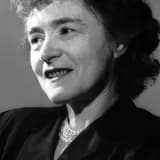
Gerty Cori became the first woman awarded the Nobel Prize in Physiology or Medicine, shared with Carl Cori and Bernardo Houssay, for discovering the Cori cycle.
On October 29, 1947, the Nobel Committee announced that Gerty Cori would share the Nobel Prize in Physiology or Medicine with her husband and longtime research partner Carl Ferdinand Cori, and separately with Argentine physiologist Bernardo A. Houssay. The Coris were honored 'for their discovery of the course of the catalytic conversion of glycogen,' a body of work encompassing the elucidation of the Cori cycle and the isolation of the Cori ester (glucose-1-phosphate).
This award made Gerty Cori the first woman in history to receive the Nobel Prize in Physiology or Medicine, and the third woman overall to win a Nobel Prize in the sciences after Marie Curie and her daughter Irène Joliot-Curie. She was also the first American woman to win a Nobel Prize in any scientific category, having become a naturalized U.S. citizen years earlier.
The recognition was historically significant not only for the science itself—illuminating how the body stores and metabolizes glucose, work with enormous later implications for understanding diabetes and glycogen storage diseases—but as a landmark breach of the near-total exclusion of women from top scientific honors. Cori had spent decades working in subordinate, poorly paid positions despite being an equal intellectual partner to her husband, facing institutional discrimination that nearly ended her research career before it began. Her Nobel win forced broader recognition of women's capacity for top-tier scientific achievement.