← All women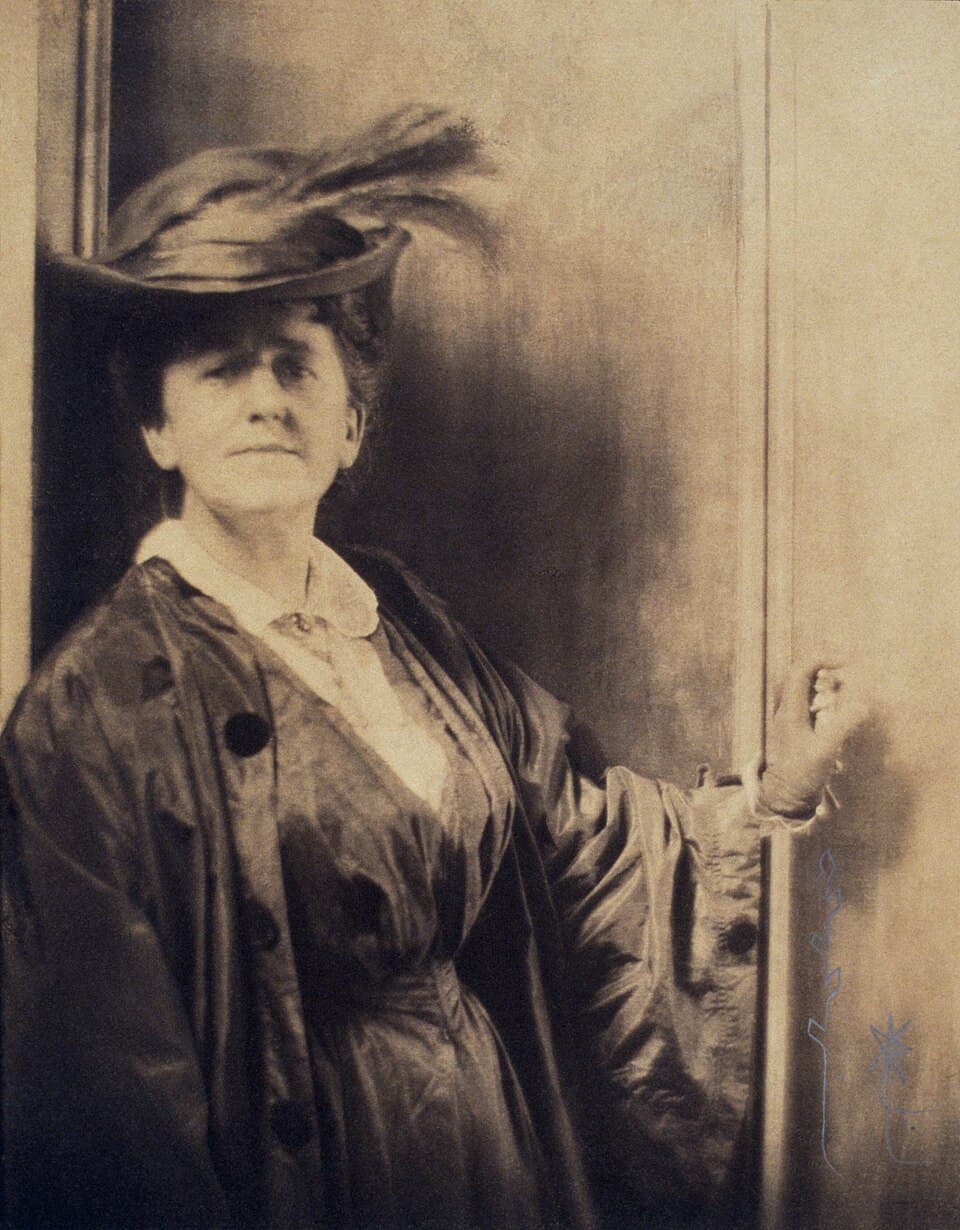
American · Arts
Gertrude Käsebier
May 18, 1852 – October 13, 1934
Early Life and Background
Gertrude Käsebier, born Gertrude Stanton on 18 May 1852 in Fort Des Moines, Iowa (now Des Moines), emerged from the social and geographic margins of the United States to become one of the most influential photographers of the early 20th century.[1][2][8][16] Her father, John W. Stanton, worked as a merchant and later as a silver miner in the Colorado Territory, while her mother, Gertrude (Miller) Stanton, managed the household.[16][19] The family moved west to Colorado when she was a child, placing her in a frontier environment that exposed her to both the hardships and openness of the American West.[7][11][19]
In 1864, following her father’s death in a mining accident, the family relocated to Brooklyn, New York, seeking stability and new opportunities.[16][19] The move brought Gertrude into one of the country’s fastest‑growing urban centers at a formative age. Brooklyn’s dense social world and proximity to New York’s cultural institutions would later prove crucial to her artistic development.
Little is documented about her formal schooling in these early years, but surviving accounts suggest that she married young and dedicated herself primarily to family life before turning seriously to art.[11][16][19] This trajectory—domestic responsibilities first, artistic ambitions later—was typical for middle‑class women of her generation. Nevertheless, the combination of frontier origins, urban adolescence, and delayed but intense artistic training shaped the independent perspective she would bring to portraiture.
Marriage, Family, and Delayed Artistic Training
In the early 1870s, Gertrude Stanton married Eduard (Edward) Käsebier, a German‑born businessman.[3][16][19] Sources commonly date the marriage to 1873, though detailed records are scarce.[16][19] The couple had three children: Hermine, born in 1878; Gertrude, born in 1880; and Harold, born in 1886.[3][16] For roughly two decades, Käsebier’s primary responsibilities lay in raising her children and managing household affairs.
Her marriage was often described as difficult. Several biographical studies note that the relationship was strained and that Käsebier’s eventual artistic independence was achieved despite, rather than because of, her husband’s support.[16][19] This tension later informed her sympathetic images of mothers and children and contributed to her nuanced understanding of domestic life as both nurturing and constraining.
Only in her late thirties did she begin to pursue formal artistic training. In 1889, at about age 37, she enrolled at the Pratt Institute in Brooklyn to study portrait painting.[6][11][16][18] This decision was unusual for a married woman with children at the time and signaled her determination to build a professional identity in the arts. At Pratt, she studied under instructors who emphasized design, composition, and the expressive potential of visual media. She also came into contact with the institute’s photography program, which treated the camera not merely as a mechanical device but as a tool for creative expression.[6][11]
Transition from Painting to Photography
Between 1889 and 1893, Käsebier’s focus gradually shifted from painting to photography.[6][16][18] According to later accounts, a trip to Europe in the early 1890s, particularly time spent in Germany, played a crucial role in this transition.[7][13] There she studied photographic chemistry, learning the technical processes behind negatives, printing, and tonal control. Mastery of these chemical techniques allowed her to apply painterly concepts—such as soft focus, atmospheric depth, and controlled lighting—to photographic work.
Returning to Brooklyn, she apprenticed with a chemist and then with a professional portrait photographer, gaining practical experience in studio management and client relationships.[6][13][19] By 1894–1895, she was working in photographic studios and exhibiting her own images.[16] Early recognition came from pictorialist circles that valued her ability to combine technical precision with emotional nuance.
These years situated Käsebier at the intersection of craft and art. She learned the business of photography—how to run a studio, attract clients, and price work—while simultaneously exploring the aesthetic possibilities of the medium. Her dual commitment to artistic quality and professional viability would later underpin both her commercial success and her advocacy for photography as a suitable career for women.[3][16][19]
Opening of Her Studio and Rise in Pictorialism
By 1896, Käsebier opened a professional portrait studio in Brooklyn, New York, transitioning fully into the role of working photographer.[16][19] Within a year or two she established a more prominent studio on Fifth Avenue in Manhattan, catering to an affluent clientele.[4][11][13][17] Her studio quickly became known for portraits that were both technically refined and emotionally expressive.
In 1898, she garnered wide attention at the first Philadelphia Photographic Salon, a significant exhibition for pictorialist photographers.[16] Her work stood out for its soft focus, luminous tonal range, and intimate domestic themes. That same period saw her begin a series of portraits of Sioux performers affiliated with Buffalo Bill’s Wild West Show (c. 1898–1900).[3][16][19] Rather than depicting these sitters as exotic curiosities, Käsebier presented them with dignity and individuality, often in studio settings that emphasized their presence rather than the spectacle of the show.
In 1899, she achieved a notable commercial success when her photograph The Manger sold for $100, an unusually high price for a photograph at the time.[16] This sale underscored the market’s growing recognition of photography as fine art and demonstrated that a woman photographer could command prices comparable to those of male contemporaries.
Linked Ring and International Recognition
Around 1900, Käsebier’s stature was confirmed internationally when she became one of the first women admitted to the British photographic society The Linked Ring, an influential pictorialist group founded in 1892.[4][8][16] Some sources identify her as the first woman member; others describe her as one of the first two women admitted, reflecting minor discrepancies in the historical record.[4][8] Membership in the Linked Ring placed her alongside leading photographers in Britain and Europe and provided a platform for exhibiting her work abroad.
The Linked Ring valued photography as a form of artistic expression and sought to distance pictorial practice from purely commercial or scientific uses of the medium. Käsebier’s inclusion in this circle signaled that her work met the highest international standards of artistic photography. It also constituted a barrier‑breaking milestone, demonstrating that women could be accepted into elite, male‑dominated photographic societies on the strength of their work.[4][16]
Photo‑Secession and Collaboration with Alfred Stieglitz
Käsebier’s relationship with Alfred Stieglitz, the leading American advocate for art photography, was central to her early 20th‑century career. By the late 1890s, Stieglitz had become aware of her work and praised her talent. In 1902, she joined him and several others in founding the Photo‑Secession, a group dedicated to promoting photography as a fine art in the United States.[2][4][11][18]
Photo‑Secessionists emphasized individual expression and high technical standards, often using gum bichromate and platinum printing to achieve subtle tonal effects. Käsebier quickly emerged as one of the movement’s leading members. Her portraits of mothers, children, artists, and intellectuals exemplified the group’s belief that photography could capture psychological depth and human complexity.
In January 1903, Stieglitz chose Käsebier to be prominently featured in the first issue of his journal Camera Work, giving her a major platform for critical and public recognition.[6][17] Reproductions of her photographs in Camera Work introduced her style to a wider audience and reinforced her status as one of the foremost pictorialists of the era.
Artistic Themes and Major Works
Käsebier’s photographic oeuvre is best known for several recurring themes:
- Motherhood and domestic life: Her images of mothers and children, often rendered in soft focus with diffused natural light, explored the emotional intensity and tenderness of domestic relationships. Works such as Blessed Art Thou Among Women and The Manger embody this focus on maternal experience.[2][3][11][17]
- Portraits of Native Americans: Her portraits of Sioux performers from Buffalo Bill’s Wild West Show, taken between about 1898 and 1900, stand out for their respectful, individualized treatment of subjects frequently stereotyped in popular culture.[3][7][16][19] These images now serve as a valuable visual record and demonstrate her commitment to collaborative portraiture.
- Celebrity and artistic portraits: Käsebier photographed numerous cultural figures, including playwrights, artists, and intellectuals, often spending considerable time with sitters to capture what she called "likenesses that are biographies."[17][18] This approach reflected her belief that the camera could reveal character rather than merely surface appearance.
Technically, she favored soft focus and carefully modulated tonal values, aligning with pictorialist aesthetics while maintaining clarity in the sitter’s expression. Her prints often used platinum processes, prized for their subtle grays and permanence.[2][11][18] Critics of the period regarded her work as among the finest examples of expressive portrait photography.
Break with Stieglitz and Professional Independence
Despite their early collaboration, Käsebier’s relationship with Alfred Stieglitz deteriorated over time. By 1907, significant disagreements had emerged regarding the role of commerce in art photography and the control Stieglitz exercised over exhibition opportunities.[6][9][16] Käsebier maintained a successful portrait studio and believed in the legitimacy of earning a living through photography, whereas Stieglitz increasingly championed a purist, anti‑commercial stance.
The conflict culminated in a public break between Käsebier and Stieglitz and effectively severed her ties with the Photo‑Secession.[6][9][16] For Käsebier, the split was costly in terms of access to certain exhibition venues and critical networks. Yet it also affirmed her commitment to professional autonomy and to the idea that art photography could coexist with commercial practice.
Her continued success after the break demonstrated that a woman photographer could sustain both artistic integrity and financial independence outside the orbit of a dominant male tastemaker. This episode has since been read as an important moment in the politics of early art photography, revealing the gendered and economic tensions within avant‑garde circles.[9][16][19]
Advocacy for Women Photographers
Käsebier’s career was not only personally successful; it also contributed to broader efforts to open photography as a profession for women. In 1910, she played a key role in helping to establish the Women’s Professional Photographers’ Association of America, an organization designed to support women photographers through networking, education, and mutual advocacy.[16]
She frequently spoke publicly and wrote about photography as suitable work for women, emphasizing that it allowed for creative expression and economic independence.[3][16][19] Her own trajectory—from mother and late‑starting art student to highly regarded portraitist—served as a powerful example for younger women. She hired and mentored female assistants in her studio, fostering a community of women practitioners at a time when they often faced exclusion from mainstream professional groups.
In 1912, Alfred Stieglitz, despite their personal and professional rift, referred to Käsebier as "beyond dispute the leading portrait photographer in this country," a statement that underscores the respect she commanded even among critics and rivals.[17][19] Such praise reinforced the legitimacy of women’s artistic and professional aspirations in photography.
Later Career, Health, and Retirement
Throughout the 1910s and 1920s, Käsebier continued to operate her portrait studio and exhibit her work, though at a somewhat reduced pace. She adapted to changing tastes in photography, including the rise of more straightforward, less painterly styles, while maintaining her own characteristic emphasis on psychological depth and tonal subtlety.[11][18][19]
Around 1927, declining health and age led her to retire from active professional work.[19] She had spent roughly three decades as a working photographer, a length of career that itself was unusual for a woman of her generation. After retirement, she lived quietly in New York, with fewer new works but enduring recognition among collectors and institutions.
Later Life, Death, and Posthumous Recognition
Gertrude Käsebier died in New York City on 13 October 1934, at the age of 82.[1][2][5][16] As noted, some sources give 12 October as the date of death,[3][4] but multiple scholarly references, including Britannica, Encyclopedia.com, and German and Polish biographical entries, support the 13 October date.[1][2][5][16] She was survived by her children, who helped preserve aspects of her archive.
In the years immediately following her death, her work remained known within specialist photographic circles but was less prominent in general art histories. However, the mid‑20th‑century revival of interest in early art photography brought new attention to her contributions. In 1929, shortly before her death, the Museum of Modern Art in New York mounted Gertrude Käsebier, Photographer, an exhibition of approximately forty‑five prints drawn largely from the museum’s collection.[11] This show was among MoMA’s early solo exhibitions devoted to a photographer and confirmed her status as a key figure in the medium.
Later institutional recognition included a growing number of retrospectives, acquisitions, and scholarly studies. Museums such as the Art Institute of Chicago, the International Center of Photography, and various national collections now hold significant groups of her prints.[6][17][18][20] In 1979, she was posthumously inducted into the International Photography Hall of Fame and Museum, an honor that formally acknowledged her pioneering role in both Pictorialism and women’s professional photography.[8]
Legacy and Historical Impact
Käsebier’s legacy rests on several intertwined contributions:
- Pioneering portrait photography: Her insistence that portraits should function as "biographies" of the sitter anticipated later psychological approaches to photography and influenced generations of portraitists.[17][18]
- Advancement of Pictorialism: As a founder of the Photo‑Secession and a member of the Linked Ring, she helped shape the aesthetic ideals of Pictorialism, demonstrating that photography could rival painting in expressive power.[2][4][11][18]
- Representation of women and domestic life: Her images of motherhood and domestic scenes offered complex, empathetic portrayals of women’s experiences, challenging sentimental or trivial representations common in contemporary visual culture.[2][3][11]
- Cross‑cultural portraiture: Her respectful, collaborative photographs of Native American performers provide a significant counterpoint to the stereotyped imagery prevalent in late‑19th‑century mass media.[3][7][16][19]
- Professionalization of women photographers: Through her studio practice, organizational work, and public advocacy, she expanded the possibilities for women to pursue photography as a career, contributing to the gradual normalization of women’s participation in the field.[3][16][19]
Historians now regard Gertrude Käsebier as one of the leading American photographers of the early 20th century, alongside contemporaries such as Clarence H. White and Alvin Langdon Coburn.[4][9][18] Her work is routinely included in major surveys of photographic history and women’s art. Scholarship on women photographers has emphasized her role as a bridge figure: someone who navigated the constraints of Victorian domestic ideals while forging a modern professional identity.
For women’s‑history researchers, Käsebier’s life illustrates the complex intersections of gender, commerce, and artistic ambition. She proved that a woman could attain international recognition in a male‑dominated art form, help define its aesthetic standards, and actively reshape its professional structures. Her photographs continue to be exhibited and studied for their beauty, emotional depth, and historical insight, ensuring that her influence endures well beyond her own era.[2][11][15][18]
Dated achievements
5 indexed.
- May181852Arts
Birth of Gertrude Käsebier
Birth of Gertrude Stanton (later Gertrude Käsebier) in Fort Des Moines, Iowa, marking the beginning of a life that would reshape artistic portrait photography.
View details Encyclopedia.com – Käsebier, Gertrude (1852–1934) - Jan011896