← All women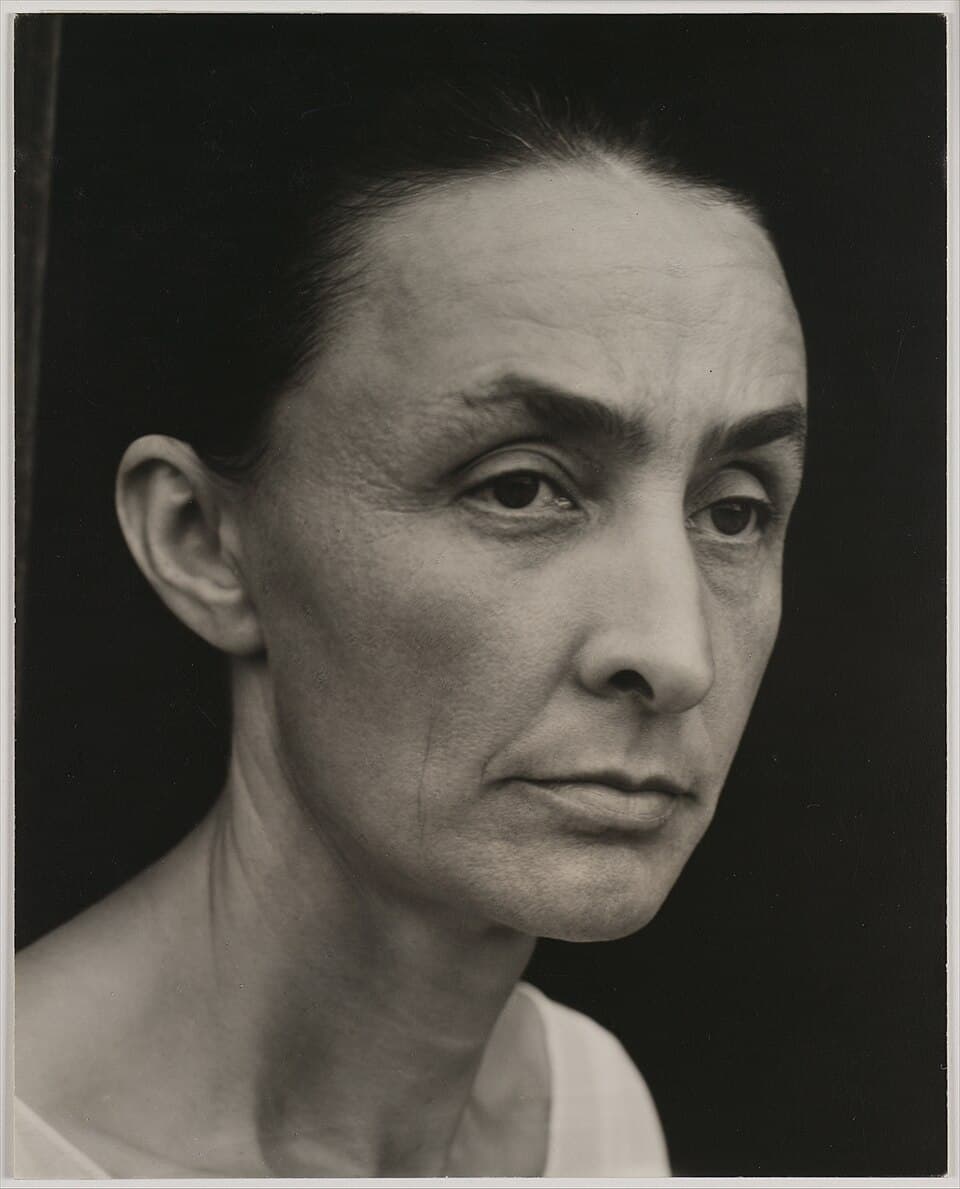
American · Arts
Georgia O’Keefe
November 15, 1887 – March 6, 1986
Early Life and Background
Georgia Totto O’Keeffe was born on 15 November 1887 on her family’s dairy farm near Sun Prairie, Wisconsin.[1][2][14] She was the second of seven children and the first daughter of Francis Calyxtus O’Keeffe, of Irish descent, and Ida Totto O’Keeffe, whose family was of Hungarian origin.[1][14] Growing up in a rural environment, she developed an early and intense connection to nature—fields, plants, animals, and the changing seasons—that would profoundly shape her artistic vision.
O’Keeffe attended local schools and from an early age showed strong interest and talent in drawing. By around age nine, she had decided that she wanted to become an artist, an ambition encouraged by her mother and some teachers but unusual for a girl in the late nineteenth century.[6] Her family moved several times during her youth, including a period in Williamsburg, Virginia, where she attended the Chatham Episcopal Institute (now Chatham Hall) and received formal art instruction.[1] This early training introduced her to basic principles of drawing and composition and reinforced her determination to pursue art professionally.
Formal Education and Early Career
On 23 September 1902, O’Keeffe enrolled at the School of the Art Institute of Chicago, one of the premier art schools in the United States.[4] There she studied academic drawing and painting and was exposed to the vibrant cultural life of Chicago. Her performance was strong—she ranked near the top of her class—but the trajectory was abruptly interrupted when she contracted typhoid fever and had to withdraw from the school on 4 June 1903.[4] The illness forced a prolonged convalescence and temporarily halted her formal artistic education.
In 1907, seeking to continue her training, O’Keeffe moved to New York City and, beginning 1 October 1907, attended the Art Students League of New YorkWilliam Merritt Chase, working intensively from life and exploring still lifes and figure studies. She won the League’s William Randolph Hearst prize for one of her student works and spent a summer in Lake George, experiences that exposed her to sophisticated artistic networks and strengthened her technical skills.[1]
Despite her success, O’Keeffe became dissatisfied with the prevailing academic and realist styles. Around 1908–1910 she worked briefly as a commercial illustrator in Chicago, then turned increasingly toward teaching to support herself.[6] In 1905 she had attended summer classes at the University of Virginia, where she was introduced to the ideas of artist and educator Arthur Wesley Dow
Dow’s theories profoundly influenced O’Keeffe’s thinking about art. By 1912, she had fully adopted his principles in both her teaching and her own work, focusing on the arrangement of line, color, and space to convey emotion and structure.[1][4] At this time she taught art in schools in Virginia and later in South Carolina and Texas, including at Columbia College and at West Texas State Normal College (now West Texas A&M University).[6] Teaching allowed her to reflect systematically on composition and provided enough financial stability to pursue her own experiments. In 1915, while teaching in South Carolina, O’Keeffe underwent a radical self‑reinvention. Following Dow’s ideas and dissatisfied with her earlier work, she destroyed much of her previous output and began a new series of abstract charcoal drawings that explored pure line, rhythm, and simplified organic forms.[6][18] Starting on 1 October 1915, she produced a group of charcoal works that reduced landscape and emotional states to sweeping curves and stark contrasts.[1][4][18] These drawings marked a decisive turn toward non‑representational modernism and became a crucial turning point in her career. O’Keeffe shared the drawings with her friend Anita Pollitzer, a fellow artist and member of the National Woman’s Party. Pollitzer was deeply impressed and brought them to photographer and gallerist Alfred Stieglitz in New York.[18] Stieglitz, already a central figure in promoting modern art and photography through his gallery 291, recognized their originality immediately, calling them some of the most exciting work he had seen by an American artist. On 1 May 1916, Stieglitz first exhibited O’Keeffe’s charcoal drawings at Gallery 291 without informing her in advance.[1][18] Displayed among works by European and American modernists, the drawings introduced her to the New York avant‑garde and marked her public debut in a major contemporary art venue. For a woman artist working far from urban centers, this unanticipated show was an extraordinary opportunity. In April 1917, Stieglitz organized O’Keeffe’s first solo exhibition at 291, presenting a wider range of charcoals and watercolors.[1][18] The one‑person show signaled that he considered her a leading figure, not merely a curiosity, within modern art. Critics noted the boldness and abstraction of her approach, and the exhibition helped establish her as a significant American modernist. Following the closure of 291, Stieglitz continued to show her work at his later galleries, including the Anderson Galleries, the Intimate Gallery, and An American Place. Throughout the 1920s, O’Keeffe’s paintings of enlarged flowers, abstracted landscapes, and city scenes gained increasing attention. By 1922 she had achieved wide recognition in New York, becoming a prominent figure in American modernism through regular exhibitions and critical reviews.[1][4][3] The early 1920s saw O’Keeffe develop some of her most iconic subjects. Her large‑scale flower paintings, such as "Black Iris" and "Red Canna," magnified blossoms beyond life size, emphasizing curves, color transitions, and interior structures.[2][11] These works invited viewers into an intimate, often ambiguous visual space, sometimes prompting sexualized interpretations, which O’Keeffe herself resisted. She insisted that her goal was to make people really see the subject by eliminating distracting context. On 21 December 1924, O’Keeffe married Alfred Stieglitz in New York, formalizing a partnership that had already shaped their careers.[1][18] Stieglitz produced hundreds of photographs of O’Keeffe, portraying her both clothed and nude, which contributed to her public image as a powerful, modern woman and a muse but also raised complex issues of representation and agency. Their relationship involved mutual artistic support, intense correspondence, and periods of personal strain, including Stieglitz’s extramarital affair. On 1 January 1925, the couple moved into the Shelton Hotel, then one of New York’s tallest buildings.[1][4] From high floors of the skyscraper, O’Keeffe began her series of cityscapes focusing on New York’s architecture and nighttime illumination. Works such as "Radiator Building—Night, New York" captured the dramatic verticality, geometric structure, and electric lights of the city, translating urban modernity into abstracted compositions. O’Keeffe’s city paintings were historically significant because they reframed the skyscraper—an emblem of American capitalism and technological progress—as a serious subject for high art, interpreted by a woman artist. They expanded understandings of American modernism beyond European‑inspired abstraction to include indigenous urban forms.[8] On 1 March 1927, the Brooklyn Museum presented a solo exhibition of O’Keeffe’s work.[18] This was among the earliest museum shows in the United States devoted to a living woman modernist painter, signaling an important institutional recognition of her significance. The exhibition introduced her work to larger museum audiences and demonstrated that women artists could receive serious curatorial attention in major public collections. By the late 1920s, O’Keeffe was one of the most celebrated artists in the country. In 1929 she made her first extended stay in New Mexico, further exploring the Southwest’s distinctive environment.[1][4][14] She began painting desert landscapes, animal bones, and adobe architecture, developing motifs that would become central to her oeuvre. These works combined spare compositions and luminous color to evoke the vastness and clarity of the region’s light. On 1 May 1930, O’Keeffe undertook her first visit to New Mexico, staying at Ghost Ranch and traveling through the surrounding high desert.[1][4][14] The trip was transformative. She collected bones and studied eroded cliffs and mesas, finding in their stark forms a new set of subjects that aligned with her interest in simplified shapes and strong tonal contrasts. Over subsequent summers, she returned regularly to New Mexico, eventually acquiring property at Ghost Ranch and, later, purchasing a ruined adobe house in the village of Abiquiú, which she painstakingly renovated.[1][4] Paintings such as "Cow’s Skull: Red, White, and Blue" and "Black Mesa Landscape, New Mexico" merged organic and symbolic elements, reflecting both her fascination with mortality and her vision of an austere, enduring landscape. The Southwestern work challenged dominant narratives that located modernist innovation primarily in European cities or coastal U.S. metropolises. O’Keeffe helped define the visual identity of the American Southwest for global audiences, making its cliffs, bones, and churches iconic images of twentieth‑century art.[8] In 1942, the Museum of Modern Art (MoMA) in New York organized a significant exhibition of O’Keeffe’s work.[4][5] This museum show further consolidated her national profile as a leading modernist painter. It demonstrated that her art could anchor major institutional narratives of modernism, not merely appear as isolated works in mixed exhibitions. On 13 July 1946, Alfred Stieglitz died in New York, ending a central personal and professional relationship.[1][18] O’Keeffe, named executor of his estate, dedicated substantial effort to organizing his photographs, papers, and gallery records. She worked closely with institutions, notably the Metropolitan Museum of Art, to shape a comprehensive retrospective of his work, thereby influencing how his contributions would be understood historically.[18] After Stieglitz’s death, O’Keeffe increasingly shifted her base to New Mexico. By 1949 she had permanently relocated, dividing her time between Ghost Ranch and Abiquiú.[1][4][14] She continued to paint the region’s landforms—especially the flat‑topped mountain Cerro Pedernal, which she often referred to as "my mountain"—as well as the interior spaces and doorways of her homes. During the 1950s and 1960s, O’Keeffe’s reputation continued to grow. In 1962 she was elected to the American Academy of Arts and Letters, an honor reserved for individuals who had made distinguished contributions to the arts.[1][4] This recognition signaled her acceptance within the highest echelons of the American cultural establishment. On 1 January 1970, the Whitney Museum of American Art opened a major retrospective of her work in New York.[1][4][7] The exhibition surveyed decades of paintings and solidified her place in the canon of American modernism. Coming at a time when the feminist art movement was questioning the scarcity of women in museum collections, the Whitney retrospective underscored O’Keeffe’s exceptional status and inspired broader reassessments of women’s contributions to twentieth‑century art. On 10 January 1977, President Gerald Ford awarded O’Keeffe the Presidential Medal of Freedom, the highest civilian honor in the United States.[1][4] The award recognized her pioneering role as a modernist painter and the lasting impact of her work on American culture. It placed her among a select group of artists whose achievements were deemed of national significance. On 23 April 1985, she received the National Medal of Arts, one of the country’s most prestigious arts honors.[1][4] By then, her eyesight had deteriorated substantially, limiting her ability to paint in oils, but she continued to work in watercolor and clay with assistance.[1][4] The medal served as a capstone to decades of artistic innovation and public acclaim. O’Keeffe’s personal life was closely intertwined with her art. Her marriage to Alfred Stieglitz in 1924 connected her to a network of artists, writers, and critics in New York, but it also involved emotional challenges.[1][9] Stieglitz’s intense promotion of her work helped build her career, yet the public exposure through his photographs and the dynamics of their relationship at times led O’Keeffe to seek solitude and independence. The couple had no children, and O’Keeffe often spent extended periods away from New York, particularly in Texas and later New Mexico, to focus on her own artistic development. Her friendships with women such as Anita Pollitzer and fellow artists provided support and facilitated key opportunities, including the initial connection to Stieglitz’s circle.[18] In her later years in New Mexico, O’Keeffe developed close working relationships with assistants and companions who helped manage her household and studio as her health declined. She maintained a disciplined routine and continued to travel, including trips abroad, well into old age, reflecting her enduring curiosity and independence. From the 1970s onward, O’Keeffe experienced progressive vision loss, eventually caused in part by macular degeneration.[1][4] By 1984 her deteriorating eyesight and general health significantly limited her ability to paint in oils, though she remained active with other media when possible.[1][4] Despite these challenges, she continued to be involved in decisions about exhibitions, publications, and the preservation of her homes. On 6 March 1986, Georgia O’Keeffe died in Santa Fe, New Mexico, at the age of ninety‑eight.[1][2][12] Her ashes were later scattered on Cerro Pedernal, fulfilling her wish that she rest in the landscape that had inspired so much of her late work.[12] Obituaries around the world hailed her as one of the most important American artists of the twentieth century, emphasizing her role as a pioneer of modernism and a model of artistic independence. O’Keeffe’s legacy is multifaceted. She is widely known for three major categories of work: large‑scale flower paintings, New York cityscapes, and New Mexico landscapes and bone images.[1][2][11] Across these themes, she pursued a distinctive approach that combined abstraction and representation, focusing on the essential forms and emotional resonance of her subjects. Critics and historians often describe her as the “Mother of American modernism”, highlighting how she helped redefine American painting in the twentieth century.[1][7][12] Unlike artists who aligned closely with specific movements such as Cubism or Surrealism, O’Keeffe maintained an independent path, drawing on personal responses to place and nature rather than theoretical manifestos. Her career has particular significance in the history of women in art. Beginning at a time when women were largely excluded from major museum narratives, O’Keeffe achieved sustained visibility and institutional recognition over seven decades. She demonstrated that women could be central innovators in modernism, not peripheral participants. Educational materials, including those from institutions like Tate, have described her as the first woman painter to gain broad respect in New York’s art world in the 1920s, reflecting her groundbreaking status.[10] O’Keeffe’s influence extends beyond painting. She shaped public perceptions of the American landscape, making New Mexico’s cliffs, mesas, and churches internationally recognizable symbols of the Southwest. Her carefully constructed self‑image—through Stieglitz’s photographs and her own writings—contributed to broader ideas of modern womanhood: independent, professionally ambitious, and closely attuned to nature. On 17 July 1997, the Georgia O’Keeffe Museum opened in Santa Fe, dedicated to her work and life.[1][2] The museum holds the largest collection of her art and archives and serves as a major research center for scholars studying her role in American modernism. It also stewards her former homes and studio spaces, making them accessible for interpretation and preservation. Through continuing exhibitions, publications, and educational programs at institutions worldwide—including the National Gallery of Art, the Art Institute of Chicago, and the Whitney Museum—O’Keeffe’s work remains central to how twentieth‑century American art is understood.[7][11][20] Her paintings are regularly reproduced in textbooks, museum outreach, and popular culture, ensuring that new generations encounter her distinctive vision. In sum, Georgia O’Keeffe’s life and work exemplify the transformation of the American art landscape during the twentieth century and the crucial, if long under‑acknowledged, role of women in shaping modernism. From her birth on a Wisconsin farm in 1887 to her death in New Mexico in 1986, she pursued a singular artistic path that profoundly influenced both the visual culture of the United States and the visibility of women artists worldwide.Discovery of Modernist Abstraction
Entry into the New York Avant‑Garde
Major Works and New York Cityscapes
Museum Recognition and Early Honors
The Southwest: New Mexico and Ghost Ranch
MoMA Exhibition and Mid‑Century Career
Awards, Honors, and Late‑Career Recognition
Personal Life and Relationships
Later Life, Health, and Death
Legacy and Historical Impact
Dated achievements
18 indexed.
- Nov151887Arts
Birth of Georgia O’Keeffe
Born on November 15, 1887, near Sun Prairie, Wisconsin.
View details Wikipedia: Georgia O'Keeffe - Sep231902Arts
Enrolls at School of the Art Institute of Chicago
O’Keeffe enrolls at the School of the Art Institute of Chicago.
View details