← All women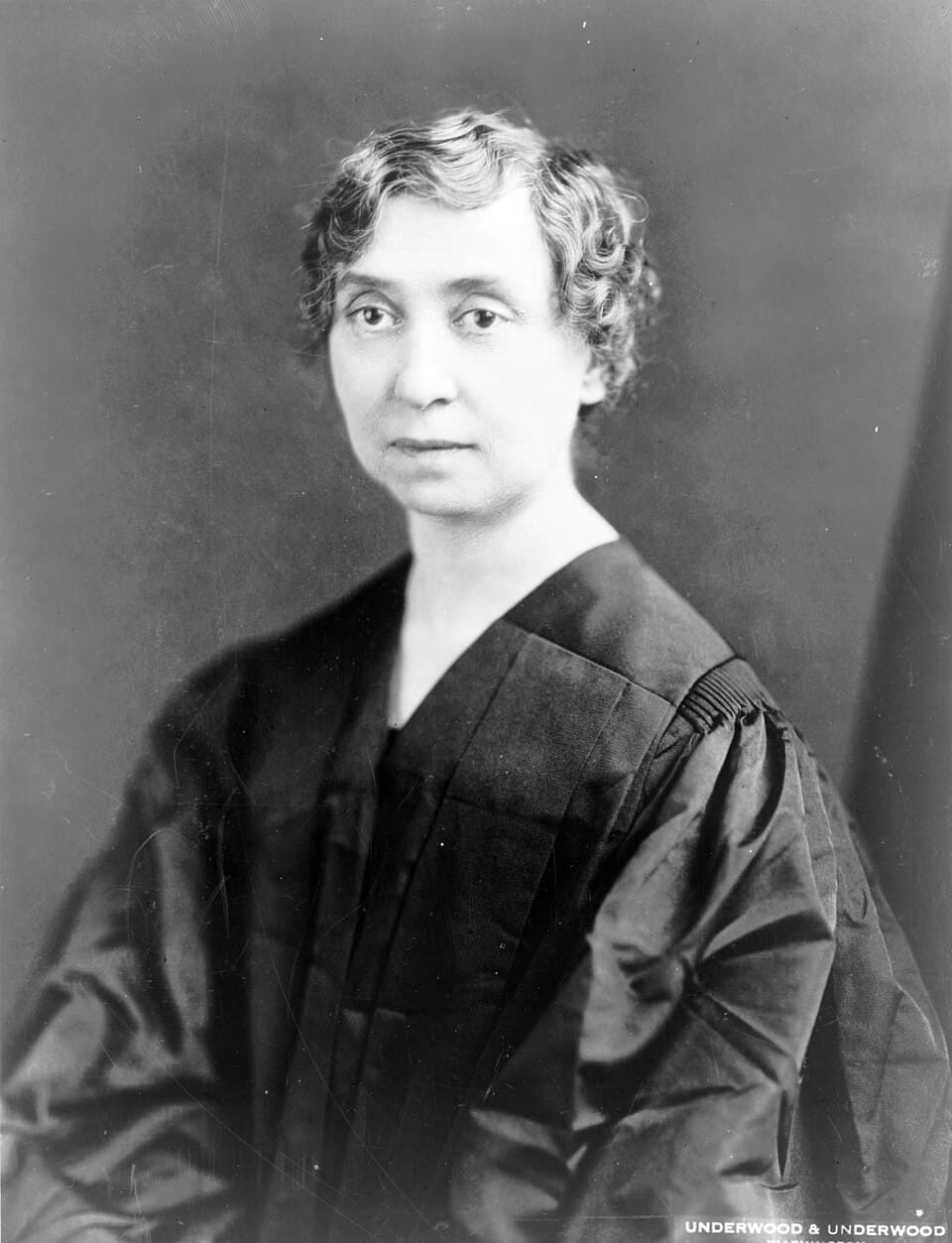
American · Law · Politics
Genevieve R Cline
July 27, 1879 – October 25, 1959
Early Life and Background
Genevieve Rose Cline was born in Warren, Ohio, on July 27, 1879, to Edward B. Cline and Mary A. (Fee) Cline.[1][2] Some biographical references, including later compendia and online databases, list her birth year as 1877, while others give 1878; however, detailed women’s‑history and legal encyclopedias consistently cite July 27 with a birth year of 1879, noting the discrepancy as a reflection of incomplete records for women of her era.[1] She grew up in a Midwestern environment shaped by industrial expansion and civic engagement, influences that would later inform her commitment to consumer protection and public service.
Cline attended Warren High School, receiving a standard secondary education at a time when many girls were steered toward domestic or clerical work rather than advanced study.[1][2] After high school she enrolled in Spencerian Business College in Cleveland, an institution that prepared students—especially women—for office and commercial work.[1][2] Business‑school training provided her with practical skills in bookkeeping, typing, and office administration, which proved valuable when she later worked in legal and civic organizations.
Seeking broader intellectual development, Cline went on to study at Oberlin College, a coeducational institution with a notable history of admitting women and African Americans.[1][2][3] Oberlin exposed her to liberal‑arts coursework and a culture of reform that aligned with her emerging interest in women’s rights and social policy. She did not complete a degree there but subsequently transferred to Baldwin‑Wallace College, where she pursued formal legal education through its affiliation with the Cleveland Law School.[2][3]
In 1913, before fully committing to law school, Cline gained hands‑on exposure to the legal profession by working as a clerk in her brother’s law office in Cleveland.[2] This experience acquainted her with case files, client interactions, and the daily practice of law. Cline later credited her brother with cultivating her interest in legal work, a common pathway for women of the time, who often relied on family connections to enter male‑dominated professions.[3]
Legal Education and Career Beginnings
Cline’s formal legal training culminated in 1921, when she graduated from Baldwin‑Wallace College, receiving an LL.B. (Bachelor of Laws) degree through its Cleveland Law School program.[1][2][3] The U.S. Courts’ historical profile of women judges emphasizes that she studied at Oberlin and then completed her LL.B. at Baldwin‑Wallace in 1921, a significant achievement given the limited number of women law students at the time.[3] This credential formally qualified her to practice law and signaled her entry into the professional legal community.
Following her graduation, Cline entered private practice in Cleveland, working with her brother.[1][3][5] Ballotpedia and judicial biographies note her service in private practice between 1921 and 1922, emphasizing that she used this period to deepen her expertise in commercial and customs‑related matters.[1][5] At the same time, she became increasingly active in women’s civic organizations, particularly the Ohio Federation of Women’s Clubs and the Cleveland Federation of Women’s Clubs.[2][3]
Through these organizations, Cline championed consumer protection, women’s rights, and support for the suffrage movement.[3] She advocated for honest labeling, fair pricing, and regulatory oversight of goods sold to households, viewing legal regulation as a tool to protect women and families in the marketplace. Her activism connected grassroots club work with formal law, foreshadowing her later role in customs enforcement and adjudication.
Cline’s political engagement extended to partisan activity; she was active in Republican politics and served at various times as vice president of the National Republican Women’s Association and president of the Cleveland Federation of Women’s Clubs.[2] These leadership roles placed her at the intersection of women’s civic action and party politics in the years immediately following the Nineteenth Amendment, giving her visibility and networks that would prove important when federal appointments were considered.
First Woman Merchandise Appraiser and Federal Service
Cline’s transition from private practice and civic activism to federal service occurred in 1922, when she was appointed by President Warren G. Harding to serve as appraiser of merchandise at the port of Cleveland for the U.S. Department of the Treasury.[1][3][4][5] The Encyclopedia of Baldwin Wallace University History and U.S. Courts profiles identify this appointment as a breakthrough: she became the first woman ever assigned by the Treasury Department as an appraiser of merchandise at a major U.S. port.[2][3][4]
The appraiser’s position required specialized knowledge of customs law, tariff schedules, and commercial practices. Appraisers assessed the value and classification of imported goods, determined applicable duties, and played a central role in enforcing tariff legislation.[3][4] Cline served in this capacity from 1922 to 1928, developing a reputation for meticulous attention to detail and integrity in dealing with importers and shipping firms.[2][3][5]
Her work as an appraiser unfolded against the backdrop of changing trade patterns and evolving tariff policies in the interwar period. As the United States navigated economic growth, protectionist pressures, and later the onset of the Great Depression, customs decisions helped shape industry competitiveness and consumer prices. Cline’s presence in this gatekeeping role demonstrated that women could manage technically complex, economically sensitive federal responsibilities.
During these years, she continued her involvement in women’s clubs and consumer advocacy. Her dual identity as a federal official and women’s‑rights activist made her a visible figure in regional and national conversations about the proper role of government in regulating business and protecting the public. The Richards Firm’s historical profile notes that her career in customs administration and her activism were recognized as part of a broader pattern of women expanding into legal and regulatory work in the 1920s.[4]
Nomination and Appointment to the U.S. Customs Court
Cline’s accumulated expertise in customs law and her public reputation led to her selection for the federal bench. On May 4, 1928, President Calvin Coolidge nominated her to an Associate Justice (judge) seat on the United States Customs Court, filling the vacancy created by the death of Judge William C. Adamson.[1] The Customs Court, based in New York but with nationwide jurisdiction, was an Article I court specializing in tariff and import valuation disputes.[1]
After consideration by the Senate, Cline’s nomination was confirmed on May 25, 1928.[1][3][4] Judicial histories and women’s‑history accounts uniformly describe this confirmation as a landmark: she became the first woman appointed to the federal judiciary and the first woman federal judge in the United States.[1][3][4][6] Although the Customs Court was not an Article III court, her appointment nevertheless placed a woman for the first time in a federal judicial position, an advancement that pre‑dated the appointment of women to Article III district and appellate courts.
Cline took her oath of office on June 5, 1928, in the Cleveland Federal Building.[1][2] This ceremony marked the beginning of her nearly quarter‑century tenure on the Customs Court. Baldwin‑Wallace University’s historical profile and U.S. Courts materials emphasize this date as the moment when the federal bench ceased to be exclusively male.[2][3] Her appointment came only eight years after national women’s suffrage, demonstrating the rapid, though still limited, expansion of women’s participation in formal legal authority.
Judicial Career and Major Decisions
As a judge on the Customs Court, Cline adjudicated cases that addressed the classification, valuation, and duty status of imported goods. These decisions often involved complex questions of statutory interpretation and the application of evolving tariff laws.[1] Her work contributed to the stability and predictability of customs jurisprudence during a period of economic volatility that included the late 1920s boom and the Great Depression.
One of the most celebrated cases associated with the Customs Court during Cline’s early tenure was Brancusi v. United States (1928), concerning the classification of modernist sculptor Constantin Brancusi’s work Bird in Flight.[10] Customs officials had treated the sculpture as an "industrial instrument" subject to duties, but the court ruled that it was a work of art eligible for duty‑free entry.[10] The National Archives Foundation, which has highlighted Cline as its "first lady of the week," notes that archival records preserve one of her early opinions related to this case.[10] The Brancusi decision has since become a touchstone in art and legal history for recognizing abstract modern sculpture as art.
Cline’s docket extended far beyond singular landmark cases. Press coverage from the period records her travel to major ports to hear large batches of customs disputes. On May 14, 1929, she arrived in Los Angeles to hear approximately 600 customs cases.[8] This assignment reflects both the heavy workload of the Customs Court and the trust placed in her to handle complex, high‑volume litigation at an early stage in her judicial career.
Later, in 1932, she returned to Los Angeles to preside over cases involving prominent figures such as film star Mary Pickford, media magnate William Randolph Hearst, and studio executive Winfield R. Sheehan, reportedly concerning customs disputes.[8] While precise dates for these proceedings are not consistently documented in accessible sources, they underscore the intersection of Cline’s work with the growing Hollywood and media industries, and the way customs law touched high‑profile cultural and economic actors.
Throughout her tenure, Cline became known for her meticulous attention to detail and fair application of customs regulations.[3][6] She approached cases with a balance of technical rigor and awareness of industry practices, qualities that won her respect in what had been a male‑dominated shipping and trade community.[6] Her decisions contributed to the standardization of customs practice and reinforced the rule of law in international trade.
Activism, Civic Leadership, and Recognition
Parallel to her judicial work, Cline remained connected to the civic organizations that had shaped her early career. She was active in the Ohio Federation of Women’s Clubs, the Cleveland Federation of Women’s Clubs, and national Republican women’s groups.[2][3] Through these roles she advocated for women’s civic engagement, legal literacy, and consumer protection, arguing that informed women could better navigate and influence the regulatory systems that affected their households.
As vice president of the National Republican Women’s Association, she promoted women’s participation in party politics and encouraged support for policies that addressed economic fairness and regulatory oversight.[2] Her presidency of the Cleveland Federation of Women’s Clubs further tied her to local reform initiatives, including campaigns for better public services and legal protections.
Cline’s pioneering status was recognized by contemporaries and later commemorated by legal and historical institutions. The United States Courts have profiled her in their "Women as 'Way Pavers'" series, identifying her as the first woman federal judge and emphasizing her role in consumer protection and women’s‑rights advocacy.[3] Modern law firms and legal organizations, such as the Richards Firm and others, have highlighted her contributions during Women’s History Month, framing her as a model for women lawyers entering regulatory and judicial careers.[4][6][9]
Her name appears in women’s‑history encyclopedias, judicial directories, and surname and given‑name compendia that catalog notable bearers of the Cline surname and the given name Genevieve.[1][12][16][14] These references reflect the enduring recognition of her historical significance.
Personal Life
Available biographical sources focus primarily on Cline’s professional and civic activities, offering limited detail about her private life. Standard references list her parents and note her close working relationship with her brother, whose law office provided her initial exposure to legal practice.[1][2][3] However, there is scant documentation of marriage, children, or domestic arrangements in the core judicial and historical records.
The emphasis on her public roles—student, clerk, activist, appraiser, judge—suggests that contemporaries and later historians viewed her life through the lens of professional pioneering rather than domestic narrative. This imbalance is itself historically revealing: women who entered public life in the early twentieth century often had their personal lives under‑recorded compared to their male counterparts, leaving gaps in the historical record.
What is clear is that Cline combined a demanding legal career with sustained involvement in women’s organizations and political activity, indicating a life oriented toward public service and institutional change. Her identity as a woman in law and politics in the interwar and postwar periods shaped how she was remembered and documented.
Legacy and Historical Impact
Cline’s most visible legacy is her status as the first woman federal judge in U.S. history, appointed to the U.S. Customs Court in 1928.[1][3][4][7][9][11] Judicial historians and modern commentators consistently highlight her as a "way paver" whose career made it easier for subsequent generations of women to enter the federal judiciary. Her service demonstrated that women could master highly specialized areas of law and exercise authoritative judgment over complex economic disputes.
The institutional impact of her appointment is reflected in the pattern of later women judges, including those on Article III district and appellate courts and eventually the Supreme Court. While Cline served on an Article I court, her presence on the federal bench broadened expectations about who could sit in judgment over federal legal questions, laying groundwork for later appointments.[1][3]
Cline also left a substantive legacy in the field of customs law. Over roughly twenty‑five years, she participated in thousands of decisions that helped shape tariff and import‑valuation jurisprudence in the mid‑twentieth century.[1][4] Cases like Brancusi v. United States, which recognized modern sculpture as art for customs purposes, linked her work to broader cultural and artistic developments.[10] The Customs Court’s role in such cases demonstrates that economic tribunals can have enduring influence on cultural definitions and artistic freedom.
Her activism in women’s clubs and consumer protection organizations contributed to the emergence of a legal‑reform agenda focused on household economics, product safety, and fair marketing. By bridging civic activism with federal regulatory work, Cline embodied a model of female legal leadership that connected everyday consumer concerns to high‑level legal structures.
Modern tributes—from the National Archives Foundation to law‑firm postings and social‑media campaigns during Women’s History Month—continue to honor her as a trailblazer.[7][10][11] These commemorations signal that her story remains relevant for contemporary discussions of gender, law, and representation in public institutions.
Later Life and Death
Cline’s active judicial service on the U.S. Customs Court ended on March 1, 1953, when she retired after approximately twenty‑five years on the bench.[1][4] Some institutional histories, such as Baldwin‑Wallace University’s, list May 1, 1953 as a retirement date, but federal judicial biographies and law‑firm histories generally identify March 1, 1953 as the official termination of her service.[1][2][4] Upon her retirement, she was succeeded by Judge Mary H. Donlon, another woman, underscoring that her pioneering role had helped normalize women’s presence on the Customs Court.[2][4]
After leaving the bench, Cline remained associated with Cleveland, the city where she had studied, practiced, and taken her oath. She lived there during her later years, though detailed accounts of her day‑to‑day activities in retirement are limited in the historical record.
On October 25, 1959, Genevieve R. Cline died in Cleveland, Ohio, at the age of 82.[1][2][4] Notices in alumni and institutional publications marked her passing and reiterated her status as the first woman appointed to a federal judgeship and a long‑serving member of the Customs Court.[2] Her death closed a life that spanned the period from the Gilded Age through the early Cold War, and that witnessed dramatic changes in women’s legal and political status.
In the decades since her death, Cline’s name has appeared in judicial histories, women’s‑history encyclopedias, and educational materials that highlight milestones in the diversification of the federal judiciary.[1][3][4][7] Her story continues to serve as an example of how individual women, leveraging education, family support, civic activism, and professional excellence, could break through entrenched gender barriers in American law.
Dated achievements
9 indexed.
- Jul271879Science
Birth in Warren, Ohio
Genevieve Rose Cline was born in Warren, Ohio, on July 27, 1879, though some sources cite 1878 as an alternate birth year.
View details Cline, Genevieve (1879–1959) - Encyclopedia.com - Jun011921Science
Completed LL.B. at Baldwin-Wallace Law School
Cline completed her LL.B. degree at Baldwin-Wallace Law School around 1921, laying the legal foundation for her federal career.