← All women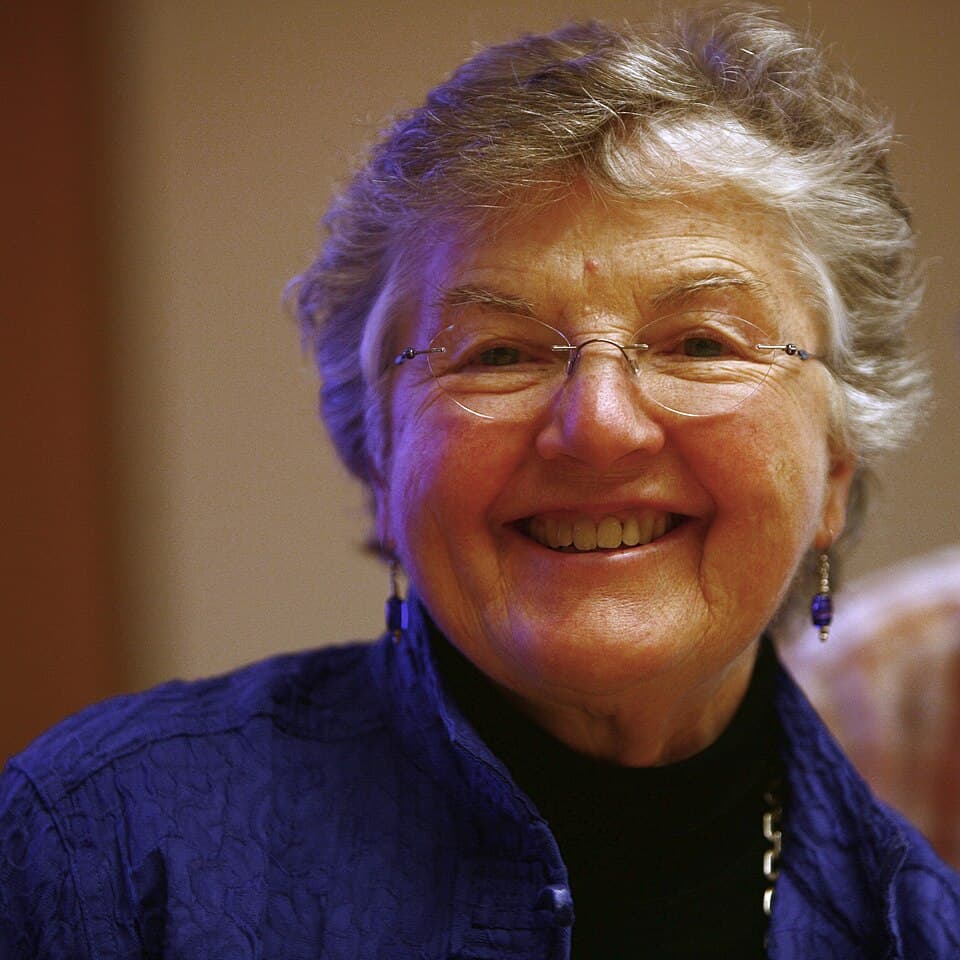
American · Science
Frances E. Allen
August 4, 1932 – August 4, 2020
Early Life and Background
Frances Elizabeth "Fran" Allen was born on August 4, 1932, in Peru, New York, a rural community near Lake Champlain in the northeastern part of the state.[1][14] She was the eldest of six children in a farming family, growing up during the Great Depression and World War II in an environment that combined economic hardship with a strong emphasis on education.[3][14] Her parents encouraged all their children, including daughters, to pursue schooling as a means of expanding opportunities beyond the farm.[3]
Allen’s early experiences of working on the farm and attending small local schools fostered both discipline and curiosity. According to biographical accounts, she developed a particular interest in mathematics and problem solving, subjects in which she excelled despite limited rural resources.[1][3] The expectation that she would become a teacher—one of the few professional paths widely open to women at the time—initially guided her educational choices, but her intellectual trajectory would ultimately carry her far beyond traditional roles.
Education and Formative Influences
Allen attended Albany State Teachers College (now the State University of New York at Albany), where she earned a bachelor’s degree in mathematics in 1954.[1][10] The program prepared her for a career in secondary education, and after graduation she taught high school mathematics, consistent with prevailing expectations for women with scientific training.[1]
Seeking to deepen her mathematical knowledge, Allen enrolled at the University of Michigan, a major center for both mathematics and early computing. There she completed a master’s degree in mathematics in 1957.[1][3] During her time at Michigan she was exposed to computing machinery and programming, at a moment when digital computers were transitioning from experimental devices to tools for research and industry. Biographical sources describe this period as formative: Allen discovered a passion for programming and the emerging discipline of computer science, which would soon reshape her professional ambitions.[3]
Her exposure to computing at Michigan coincided with a broader shift in the scientific community, as mathematicians, physicists, and engineers began to explore high-level programming languages and algorithmic methods. For Allen, the interplay between mathematical rigor and practical computation became a defining theme, one that would later underpin her contributions to compiler theory and program optimization.[10][13]
Career Beginnings at IBM
On July 15, 1957, shortly after completing her master’s degree, Allen joined IBM’s Thomas J. Watson Research Center as a programmer.[3][9] Her initial assignment was to teach FORTRAN, IBM’s newly introduced high-level programming language, to the center’s research staff.[3][9] FORTRAN had been announced only months earlier, and many scientists and engineers were unfamiliar with such languages. Allen’s teaching role required her to master both the language and the underlying computational models, placing her at the intersection of theory and practice from the outset of her career.
Working with researchers who needed to express complex scientific problems in code, Allen quickly confronted the limitations of existing compilers and the challenges of achieving efficient execution on early mainframes.[9][13] This experience ignited her long-term focus on how compilers translate high-level programs into optimized machine instructions, and how sophisticated analysis could bridge the gap between programmer intent and hardware performance.
Allen spent her entire professional career at IBM, from 1957 until her retirement in 2002, later holding the title of IBM Fellow Emerita.[8][10] Over those decades she participated in a sequence of ambitious projects that aimed to push the boundaries of high-performance computing and to make advanced architectures accessible through robust programming tools.
Major Technical Contributions
Allen became a central figure in the development of optimizing compilers, tools that analyze programs to produce machine code that runs efficiently on specific hardware architectures.[10][13] Her work combined theoretical insights about control flow and data flow with practical concerns about real-world systems.
Program Optimization and Foundational Papers
In the 1960s, Allen produced seminal work on program optimization, initially circulated within IBM and later published more broadly. A major manuscript titled "Program Optimization" was distributed internally in 1966, influencing compiler development across the company.[5] In 1969, this work was published in the Annual Review in Automatic Programming, bringing her ideas to the wider computing research community.[5]
Her research articulated systematic methods for analyzing and transforming programs to improve performance, laying out frameworks for what would become standard compiler optimizations. These techniques addressed issues such as eliminating redundant computations, reorganizing loops, and improving data locality, all critical for making efficient use of increasingly complex hardware.[10][13]
In 1970, Allen published an influential paper on control flow analysis in SIGPLAN Notices.[5] Control flow analysis studies the possible execution paths through a program, providing a foundation for many subsequent optimizations and correctness checks. Allen’s work formalized ways to represent and reason about these paths, making it possible to design compilers that could reliably transform code while preserving semantics.[10][13] This line of research became fundamental to modern compiler design and static analysis tools.
High-Performance Systems: Stretch/Harvest and ACS
Beyond theoretical contributions, Allen played key roles in the development of compilers for advanced IBM systems. She worked on the IBM 7030 "Stretch" project and its Harvest coprocessor, a system built for high-performance and intelligence applications.[13][9] Her compiler work for Stretch/Harvest required integrating sophisticated program optimization techniques with architectures designed for extreme throughput, including code-breaking and cryptanalytic tasks.
Allen later contributed to the IBM Advanced Computing System (ACS), another ambitious project targeting cutting-edge performance.[13] In these contexts she helped design compilers and programming environments that could exploit parallelism and specialized hardware features, while remaining usable for scientists and engineers not expert in low-level programming.
PTRAN and Automatic Parallelization
Beginning in the early 1970s, Allen played a major role in the PTRAN (Parallel Translation) project at IBM.[5][13] PTRAN focused on automatic program parallelization, the process of transforming sequential programs into versions that can run on multiple processors simultaneously. This work built on her earlier optimization research, extending it to identify independent computations and restructure code to exploit parallel architectures.
Automatic parallelization was essential for making multiprocessor systems accessible to mainstream programmers. Allen’s contributions helped demonstrate that parallel execution could be achieved without forcing developers to rewrite applications from scratch, thereby enabling broader use of high-performance computing in scientific and commercial settings.[3][13]
Intelligence and Security-Related Work
Biographical sources note that Allen contributed to national security and intelligence-related computing, including work on programming languages and security codes for the National Security Agency (NSA)
Alongside her research, Allen took on significant leadership roles. In 1989, she was named an IBM Fellow, becoming the first woman to hold this prestigious title.[8][10] IBM Fellows are selected for extraordinary technical achievements and are expected to provide strategic guidance for the company’s research and development efforts. In 1995, Allen became president of the IBM Academy of Technology, a global organization of senior technical leaders within the company.[14] In this role, she helped shape IBM’s technical direction and fostered collaboration across research, development, and product groups. Her leadership within the Academy also provided an institutional platform for mentoring and supporting emerging technologists, including women and underrepresented minorities. Allen received numerous honors recognizing both her technical achievements and her role as a pioneer for women in computing. The most prominent of these is the ACM A.M. Turing Award, which she received for 2006, becoming the first woman ever honored with the award.[1][10] The citation highlighted her "pioneering contributions to the theory and practice of optimizing compiler techniques" and noted that her work laid the foundation for modern optimizing compilers and automatic parallel execution.[1][14] The award was formally presented at the ACM Awards Banquet on March 17, 2007.[14] Allen was also recognized by other professional organizations. She became an IEEE Fellow, reflecting her impact on both computing and broader engineering fields.[9] The Institute of Electrical and Electronics Engineers (IEEE) later established the Allen Medal in her honor, awarded for "innovative work in computing leading to lasting impact on other fields of engineering, technology or science."[8] Notably, it was only the second IEEE medal named after a woman, underscoring both her stature and the historical underrepresentation of women in such honors.[8] In the policy sphere, the U.S. House of Representatives approved House Concurrent Resolution 95 on May 1, 2008, honoring Allen as a pioneer in computing and the first woman to receive the Turing Award.[8] The resolution explicitly acknowledged her contributions to optimizing compiler techniques and highlighted the significance of her achievements for women in science and technology. Allen also received additional awards, including recognition such as the Ada Lovelace Award, which further affirmed her role in advancing women’s visibility in computer science.[3] These honors collectively reflect the breadth of her impact, from core technical research to institutional change. Public biographical sources provide limited detail about Allen’s personal life beyond her family background and professional activities. They note her origins in a large farming family in Peru, New York, and her lifelong dedication to teaching, mentoring, and supporting colleagues.[1][3][14] There is no widely cited evidence of marriage or children in major reference biographies, and sources instead emphasize her professional identity and community engagement. Throughout her career, Allen was known for her commitment to education and mentorship, particularly for women entering computer science. She frequently participated in interviews, talks, and organizational initiatives aimed at broadening participation in computing, sharing both technical insights and reflections on her experiences navigating a male-dominated field.[13] Her reputation for intellectual rigor was matched by a noted willingness to support and encourage younger researchers. Frances E. Allen is widely regarded as one of the premier computer scientists of the 20th century, especially in the domain of compiler technology and high-performance computing.[8][10] Her work changed how programs are analyzed and transformed, making it possible for programmers to use high-level languages while still achieving efficient execution on complex architectures. Key elements of her legacy include: Allen’s influence extends beyond specific technical artifacts. The analytical frameworks she helped develop underpin many contemporary compiler infrastructures, static analyzers, and optimization tools used in both academia and industry. Her emphasis on systematic program analysis continues to guide research in programming languages and software verification. In women’s history, Allen’s career demonstrates that women have played central roles in shaping the deep infrastructure of computing—not only in applications or user-facing technologies, but in the fundamental mechanisms by which programs are translated and optimized. Her achievements challenged narrow narratives about who leads high-performance systems research and helped widen pathways for subsequent generations. Allen retired from IBM in 2002, after approximately 45 years with the company, but remained active as an IBM Fellow Emerita.[9][10] In this capacity she continued to engage with the computing community through talks, interviews, and advisory roles. Her 2006 Turing Award and subsequent honors brought renewed visibility to her earlier work, prompting historical reassessments of compiler research and its architects. During her later years, Allen also became a focal point for initiatives seeking to document and celebrate the contributions of women in computing. Professional societies and educational organizations highlighted her story in campaigns aimed at inspiring young women to pursue technical careers, often citing her journey from a rural farm to the pinnacle of computer science recognition.[8][11] Frances E. Allen died on August 4, 2020, in Schenectady, New York, on the day of her 88th birthday, from complications of Alzheimer’s disease.[10][11] Her death prompted tributes from IBM, ACM, IEEE, and many other organizations. IBM publicly remembered her as a pioneer in compiler organization and optimization algorithms, emphasizing her status as the first female IBM Fellow and first woman to win the Turing Award.[8][15] Obituaries and memorial articles highlighted both her technical contributions and her mentorship, noting that her work on interprocedural analysis and automatic parallelization remained at the leading edge of compiler research.[9][15] The establishment of the IEEE Allen Medal, along with continued recognition of her Turing Award, ensures that her name remains closely associated with innovation in computing and its impact on other fields.[8] Allen’s life story—from a rural New York farm to global recognition as a pioneer of optimizing compilers—embodies the profound ways in which women have shaped modern technology. Her technical achievements, leadership positions, and honors together compose a legacy that continues to influence computer science and the broader narrative of women in STEM.Leadership and Service at IBM
Awards, Honors, and Recognition
Personal Life
Legacy and Historical Impact
Later Life and Retirement
Death and Commemoration
Dated achievements
8 indexed.
- Aug041932Science
Birth of Frances Elizabeth Allen
Frances Allen was born on a farm near Peru, New York, the eldest of six children in a farming family near Lake Champlain.
View details Frances Allen - Wikipedia - Jul151957Science
Joins IBM Research and begins teaching FORTRAN
Allen joined IBM's T.J. Watson Research Center, with her first assignment being to teach the newly released FORTRAN language to research staff.