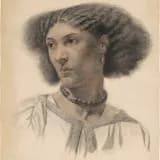
Fanny Eaton died on 4 March 1924 in London, sources differing on whether in Acton or Hammersmith, at the age of 88.
Fanny Eaton died on 4 March 1924 in London, at the advanced age of 88. Sources differ as to the precise location of her death, with some citing Acton and others Hammersmith, both west London districts where she had lived in her later years working as a seamstress, domestic cook, and needlework instructor after her modeling career ended.
By the time of her death, the Pre-Raphaelite movement that had once employed her as a model had long since faded from fashion, and Eaton herself had lived decades in relative obscurity, her contributions to some of the era's most celebrated paintings largely unrecognized by the wider public. She had outlived her husband, James Eaton, whom she married in the 1850s and who died in 1881, and had raised a large family of children in England.
Her death went largely unremarked at the time, a reflection of how thoroughly her role as a favored Pre-Raphaelite model had been erased from popular memory even within her own lifetime. It was only in recent decades, through the work of art historians and curators re-examining the racial politics of Victorian art, that Fanny Eaton's story and her significant contribution as one of the few identifiable Black models in major nineteenth-century British paintings has been rediscovered and celebrated. Institutions such as the Royal Academy, the Yale Center for British Art, and Amgueddfa Cymru (Museum Wales) have since staged research and exhibitions restoring her name and image to the historical record.