← All women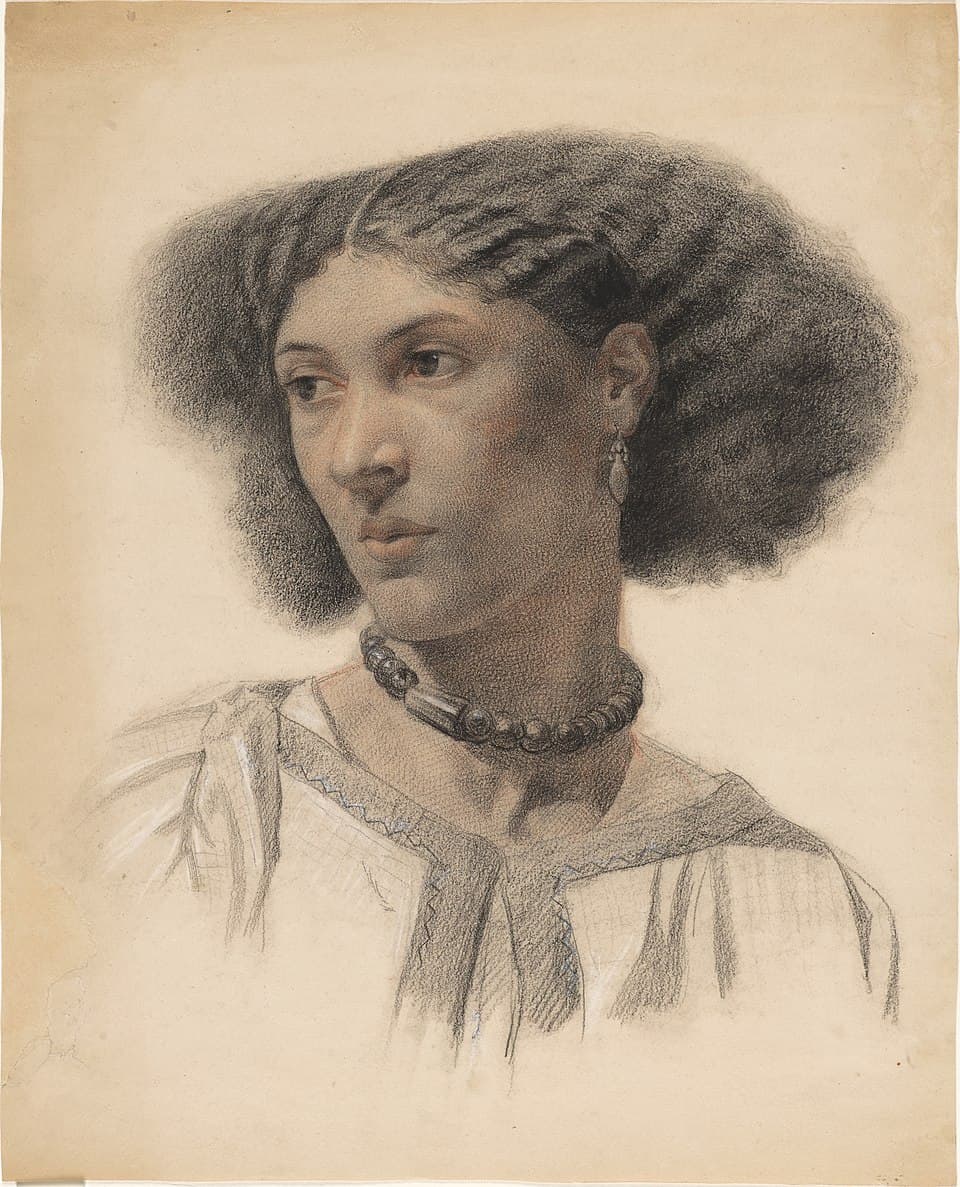
Jamaican · Arts · Activism
Fanny Eaton
June 23, 1835 – March 4, 1924
Early Life and Background
Fanny Matilda Eaton, born Fanny Matilda Antwistle/Entwhistle, entered the world on 23 June 1835 in Saint Andrew Parish, Jamaica, then part of the British Empire.[1][2][4][11] Her birth occurred less than a year after the formal abolition of slavery in the British colonies in 1834, placing her among the first generation born in nominal freedom after centuries of plantation bondage.[1][2] Her mother, Matilda Foster, is described in modern scholarship as a formerly enslaved woman who worked on British-owned plantations in Jamaica.[2][8][10] Several accounts suggest that her likely father was James Entwistle, a white British soldier stationed on the island, though documentary proof remains limited and contested.[10][13]
Eaton thus grew up at the intersection of Black Caribbean and British identities. Sources indicate that she and her mother migrated to London in the 1840s, when Fanny was still a child.[2][8][10][12] They joined the small but growing communities of people of African and Caribbean descent in the metropolis, shaped by the afterlives of slavery and imperial expansion. By the time of the 1851 census, Eaton was recorded as a servant
The London into which Eaton moved was marked by intense debates about race, empire, and morality. While abolition had formally ended slavery, racial hierarchies persisted in labor markets, social life, and visual culture. For a mixed-heritage Jamaican-born girl like Fanny, opportunities were limited and precarious, concentrated in domestic service and other forms of low-paid work. Yet this environment also placed her within reach of the city’s artistic circles, including the Pre-Raphaelite Brotherhood, whose members were beginning to challenge academic conventions in art. Eaton’s transition from domestic servant to artist’s model took place in the late 1850s. The earliest known drawing of her is dated to around 1859, and several commentators identify that year as the beginning of her documented modeling work for Pre-Raphaelite and Aesthetic artists.[2][12][14] This activity appears to have supplemented her income rather than replacing domestic service; like many working-class women, she combined multiple forms of labor to support herself and, later, her family. From roughly 1859 to 1867, Eaton became a sought-after model within the Pre-Raphaelite circle.[1][4][7][11][14] She posed for Simeon Solomon, Dante Gabriel Rossetti, John Everett Millais, Joanna Mary Boyce, Rebecca Solomon, Frederick Sandys, Albert Moore, Walter Fryer Stocks, and others.[1][4][7][12][14] Scholars have identified her features—sharp cheekbones, distinctive eyes, and curly hair—in more than twenty paintings and drawings, with additional works likely still to be recognized.[12][16][17] Although modeling was often poorly paid and socially ambiguous, it offered Eaton access to spaces of artistic creation usually closed to working-class and racialized women. Her mixed heritage made her an "exotic" figure within Victorian visual culture, and she was frequently cast in biblical, historical, or "Eastern" roles.[6][10][17] At the same time, several artists depicted her with dignity and strength, sometimes as central figures rather than merely as decorative or marginal presences. The clearest dated milestone in Eaton’s modeling career is her role in Simeon Solomon’s painting The Mother of Moses. Modern art-historical research identifies Eaton as the model for the title figure in this work.[4][6][17] The painting was exhibited at the Royal Academy of Arts on 28 April 1860, marking her public debut as a model within Britain’s foremost art institution.[4][17] In The Mother of Moses, Solomon drew on Eaton’s features to represent a biblical mother engaged in an act of protection and sacrifice. Her presence as a Black Jamaican-born woman in such a role challenged typical racialized casting in Victorian religious imagery, where women of colour were more often associated with servants, outsiders, or allegorical "types" rather than dignified maternal protagonists.[6][17] The Royal Academy exhibition anchored Eaton’s visibility within the Pre-Raphaelite milieu. From this point, she appeared in various guises across paintings, watercolours, and drawings, often transposed into different ethnic or geographic identities—"Eastern," "African," "Hebrew"—according to artistic and literary conventions of the time.[6][10][17] Although her name rarely appeared in catalogues, her face was repeatedly inscribed into the visual record of mid-Victorian art. While Eaton did not create artworks herself, her significance lies in the corpus of works in which she modeled. Scholars and curators have worked to re-identify her image in notable Pre-Raphaelite and Aesthetic compositions. Among the best-known of these are: In many of these paintings, Eaton’s image is used to embody biblical or historical characters situated within an imagined "Orient" or antiquity. Her presence thus intersected with Victorian fantasies about race and geography, while also bringing the reality of Black and mixed-heritage lives into canonical art—even if viewers did not know her name.[6][10][16][17] Recent scholarship, such as the study "Fanny Eaton: The 'Other' Pre-Raphaelite Model" and the 2024 article "Far Too Black? Fanny Eaton, Simeon Solomon, and The Mother of Moses," has emphasized how artists navigated Eaton’s perceived racial difference.[6][17] These analyses show that her features were sometimes softened or altered to align with dominant ideals of beauty, revealing both the constraints and possibilities of her representation in the Victorian art world. During her lifetime, Eaton does not appear to have received formal awards or honors for her work as a model. Like most artist’s models of the period, she remained largely invisible in official records and art criticism, with her contributions subsumed under the names of male painters.[1][6][12] Her posthumous recognition emerged gradually. In 1988, researchers identified Eaton as the model in several Pre-Raphaelite works, inaugurating a process of reattribution and biographical reconstruction.[12][16] Since then, museums and galleries—including the Royal Academy of Arts, the Fitzwilliam Museum, Art UK, and National Museum Wales—have highlighted her life and role through articles, podcasts, and exhibitions.[2][9][13][14][16] These institutions foreground Eaton as an important Black presence within nineteenth-century British art, situating her alongside well-known white models such as Jane Morris or Elizabeth Siddal while emphasizing the distinct racial and social dynamics that shaped her career.[6][9][16] Contemporary commentators sometimes refer to her as "the first British supermodel of mixed heritage," a characterization that reflects current efforts to acknowledge her visibility but is not firmly established in historical sources.[5] Scholars caution against overstating undocumented "firsts," instead focusing on the documented breadth of her appearances and the significance of her image in canonical artworks. Eaton’s personal life was closely intertwined with her economic realities. In the late 1850s, she began a relationship with James Eaton, a horse-cab driver.[8][12] They cohabited in London’s Coram Fields area and later married; surviving records show them as a couple raising a large family while living in crowded working-class housing.[8][12] Between 1858 and 1879, Eaton gave birth to ten children, whom she supported alongside her modeling and domestic work.[8][12] Balancing sittings for artists with childcare and household labor, she embodied the precarious nature of working-class womanhood in Victorian London. Her modeling income was likely intermittent and modest, supplementing the wages from domestic service and her husband’s work as a cab driver.[12][14] In 1881, Eaton was widowed, losing James Eaton and becoming a single mother responsible for her surviving children.[8][12] The exact date of his death is not documented, but sources agree on the year.[8][12] After this loss, she continued to work as a cook and housekeeper in various locations, including Hammersmith in West London and on the Isle of Wight.[12] Her life after the main modeling period thus exemplifies the long-term economic fragility faced by many Black and mixed-heritage women in Britain. By the late nineteenth and early twentieth centuries, Eaton’s direct involvement with the art world had ended, though her image persisted in paintings hanging in galleries and private collections. She remained part of the working-class population of London, moving between households and jobs as a domestic worker, cook, and housekeeper.[1][4][12] Eaton died on 4 March 1924 in London, at approximately 88–89 years of age.[1][2][4][7][11] Different sources place her death either in Acton or Hammersmith, both then within the metropolis.[4][7][11] A Spanish-language account, drawing on death records, notes that she died in Acton of senility and heart syncope.[11] A Portuguese-language biography describes her as having died in Acton after a long life as a working-class emigrant.[4] Regardless of the precise location, it is clear that Eaton ended her days in modest circumstances, likely in the home of one of her children.[2][8][10] At the time of her death, she was not widely remembered in public discourse, and no obituaries celebrating her contribution to art have been found. Her passing thus marked the quiet end of a life whose visual legacy far exceeded its written record. Eaton’s legacy lies in the gradual recognition of her role as a Black Jamaican-born muse within the Pre-Raphaelite and Aesthetic movements. As scholars, curators, and descendants have pieced together her biography, she has come to symbolize several intertwined histories: Institutions such as the Royal Academy of Arts, Art UK, and the Fitzwilliam Museum have produced essays, podcasts, and educational materials foregrounding Eaton as a "forgotten" or "overlooked" figure whose face "was hiding in plain sight" in well-known paintings.[2][5][9][12][13][14][16] These projects align with broader efforts in art history and museum practice to recover marginalized subjects, including Black British women. Eaton’s descendants have also contributed to her emerging legacy. Her great-grandson, Brian Eaton, has been involved in publicizing her story and ensuring she is acknowledged in relation to the works for which she modeled.[12] Through family memory and archival research, her life has been brought into dialogue with contemporary conversations about race, representation, and the visibility of Black women in British cultural history. In scholarly terms, Eaton features in analyses of the Pre-Raphaelite "stunner"—the idealized female model—and its racialized limits. Articles such as "Far Too Black? Fanny Eaton, Simeon Solomon, and The Mother of Moses" examine how artists navigated her perceived "otherness" and how those negotiations are evident in the paintings themselves.[6][17] By tracing her image across canvases and catalogues, researchers highlight the complexity of racial representation in Victorian art, challenging earlier assumptions about homogeneously white aesthetic ideals. Today, Eaton is increasingly cited in studies of Black British women pioneers and in public history projects aimed at diversifying the canon.[8][16] Her story offers a compelling example of how working-class, racialized women participated in and shaped cultural production, even when their names were omitted from the historical record. From her birth in post-emancipation Jamaica to her modeling work in mid-Victorian London, Fanny Eaton’s life illuminates the intersections of race, gender, class, and empire. As an artist’s model, she did not leave behind writings or artworks of her own; her legacy is embedded in the paintings and drawings that bear her likeness. These images, once anonymous, are now recognized as traces of a Black woman whose body and face helped define the visual language of the Pre-Raphaelite movement. Her biography also underscores the limits of recognition in nineteenth-century art. Despite her presence in numerous canvases, Eaton spent most of her life in domestic service, raising a large family and facing the economic vulnerabilities common to widowed working-class women. The belated nature of her commemoration—through twenty-first-century scholarship, museum interpretation, and family advocacy—illustrates both the erasure experienced by Black women in historical records and the possibilities of recovery through careful research. For women’s history, Eaton stands as a vital figure: a Jamaican-born, mixed-heritage woman whose image was central to many celebrated works yet whose name was long forgotten. Her rediscovery enriches our understanding of Victorian art and foregrounds the indispensable, often unsung contributions of Black women to cultural heritage.Career Beginnings and Development as an Artist’s Model
Public Debut: The Mother of Moses (1860)
Major Works and Artistic Appearances
Recognition, Erasure, and Rediscovery
Personal Life: Marriage, Children, and Work
Later Life and Death
Legacy and Historical Impact
Assessment
Dated achievements
3 indexed.
- Jun231835Arts
Birth of Fanny Eaton in Jamaica
Fanny Matilda Antwistle (later Eaton) was born in St. Andrew Parish, Jamaica, on 23 June 1835, to a formerly enslaved mother and a father of European or mixed descent.
View details BBC — Fanny Eaton programme - Apr281860Arts
Public debut as a model: Simeon Solomon's The Mother of Moses exhibited at the Royal Academy
Simeon Solomon's painting The Mother of Moses, believed to feature Fanny Eaton, was exhibited at the Royal Academy on 28 April 1860 — her clearest documented public debut.