← All women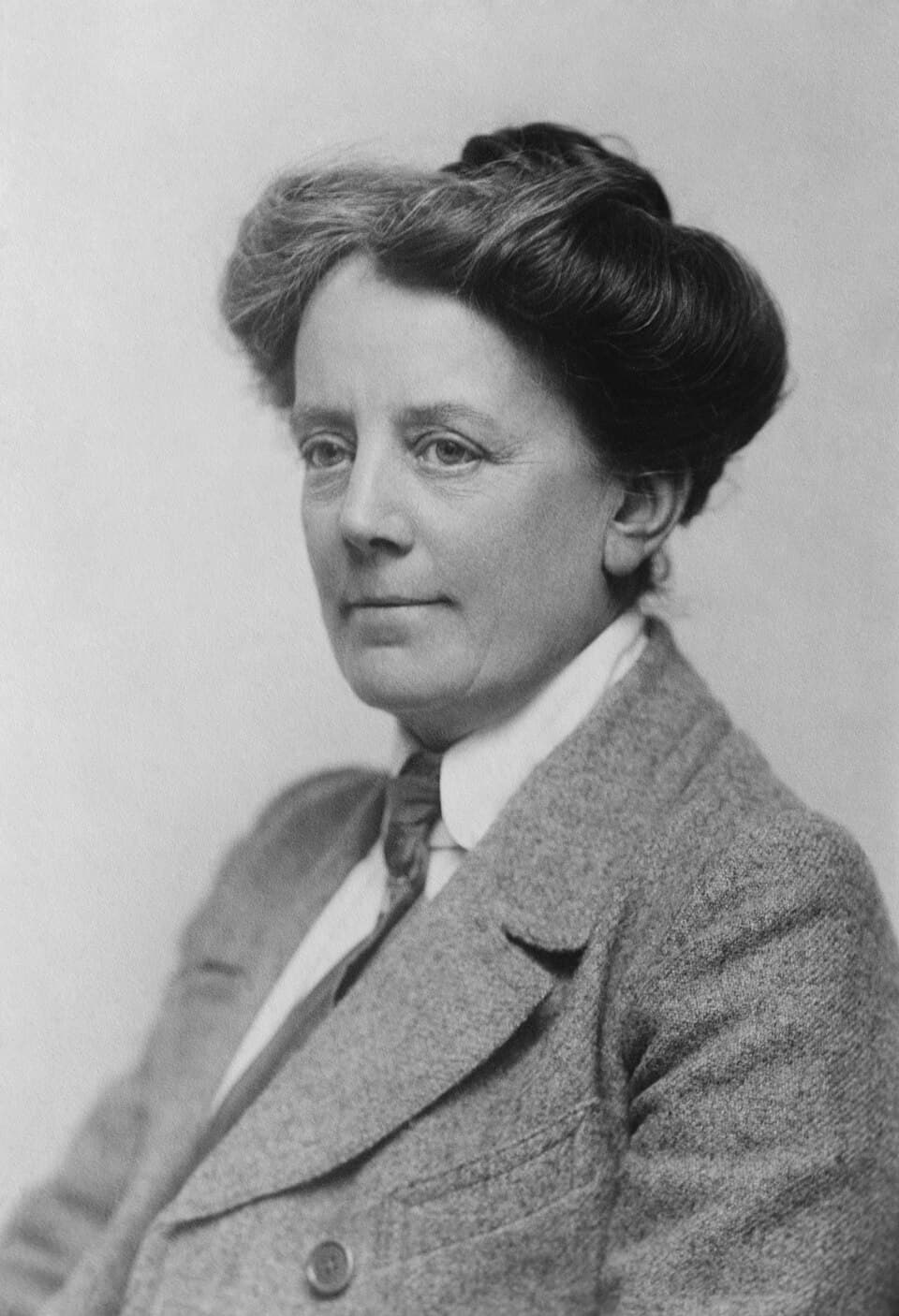
British · Arts · Activism
Ethel Smyth
April 22, 1858 – May 8, 1944
Early Life and Background
Ethel Mary Smyth was born on 22 April 1858Major‑General John Hall Smyth of the Royal Artillery and his wife Emma, and spent much of her childhood in the suburban and semi‑rural outskirts of London, later associated with Sidcup in Kent.[1][8][13] Raised during the high Victorian era, she was educated by governesses at home and briefly at a girls’ school in Putney, receiving the conventional training expected of a well‑born daughter: languages, drawing, and music as an accomplishment rather than a vocation.[1][11]
From an early age Smyth developed a passionate interest in music. She studied piano and absorbed the repertoire available in domestic settings, but she quickly became convinced that she wanted to be a professional composer — an ambition that clashed with her father’s expectations for a respectable female life focused on marriage and family.[1][8] Her determination led to prolonged conflict within the household. As she later recounted in her memoirs, she staged a kind of domestic strike, refusing to participate in daily routines until her father agreed to support serious musical study.[1][17]
In 1877, at age nineteen, Smyth prevailed. She left England, against considerable familial resistance, to study at the Leipzig Conservatory, one of the leading institutions for German musical training.[1][2][8] At Leipzig she studied composition with Carl Reinecke and later took private lessons with Heinrich von Herzogenberg, whose circle included Johannes Brahms and other prominent musicians.[1][8][14] This move was highly unusual for an Englishwoman of her class and signalled Smyth’s refusal to accept the gendered limits of Victorian society.
Career Beginnings and Development
Smyth’s Leipzig years (late 1870s to early 1880s) were formative. Immersed in German musical culture, she encountered the works of Brahms, Wagner, and other key figures, and forged networks with performers and patrons.[1][8] She also began to compose seriously, writing chamber music and lieder, including sets of songs that would later be published, and experimenting with larger forms.[1][19]
Returning to England in the 1880s, Smyth confronted a cultural environment often hostile to new music and especially sceptical of women composers.[3][11] Nevertheless, she continued composing and seeking performances. Between 1880 and 1930 she produced an extensive body of work: two sets of lieder and numerous songs, chamber pieces, orchestral scores, choral works, and eventually six operas, a mass, and a choral symphony.[1][19] Her early major success came with the Mass in D, completed in the early 1890s and first performed in 1893. The Mass attracted attention for its scale and ambition, and it demonstrated that Smyth could handle complex choral‑orchestral forces at a level comparable to male contemporaries.[3][11]
During the 1890s and early 1900s she increasingly focused on opera, a genre that offered rich opportunities for dramatic expression but was notoriously difficult for women to penetrate. Her first opera, Fantasio, appeared in 1894, followed by Der Wald in 1901.[2][3] Smyth worked across languages and national contexts, often writing or co‑writing her own libretti and negotiating directly with theaters and conductors, thereby asserting unusual control for a woman composer.
Major Works and Artistic Achievements
Smyth’s reputation rests largely on her operas and large‑scale vocal works, though she also wrote notable chamber and orchestral music. Her operatic output comprises six works: Fantasio (1894), Der Wald (1901), The Wreckers (completed 1904, premiered 1906), The Boatswain’s Mate (1914), Fête galante (1922), and Entente cordiale (1924).[1][2][3] These operas span late Romantic idioms to more experimental, sometimes satirical styles, and they place her among the significant early‑20th‑century composers of dramatic music.
Der Wald, a one‑act opera in German, achieved historic prominence when it was staged at the Metropolitan Opera House in New York on 11 March 1903, conducted by Walter Damrosch.[2][3][16] This performance was the first time an opera by a woman composer was presented at the Met, and Smyth remains, for more than a century, the sole woman represented there with an opera.[3][13][16] A second performance followed on 20 March 1903.[3] The work, grounded in late‑Romantic harmonic language and forest imagery, showcased Smyth’s ability to write effectively for large forces and to compete artistically on a major international stage.
Her third opera, "The Wreckers", is widely considered her masterpiece. Set in a remote Cornish community where wreckers deliberately lure ships to destruction and loot their cargo, the opera explores themes of fanaticism, morality, and love.[2][3] It premiered at the Neues Theater in Leipzig in November 1906, under the German title Strandrecht, after difficulties securing an English staging.[2][3][8] Smyth insisted contractually that no revisions be made to the score without her approval, a striking assertion of authority for a woman composer at the time.[3][8] The opera later received performances in Britain and France and has been hailed by modern critics as one of the most important English operas of its era.[3][4]
Among her later operas, "The Boatswain’s Mate" (1914) stands out for its wit and its portrayal of an independent female protagonist who outsmarts male characters, reflecting Smyth’s feminist sensibilities.[2][3] Fête galante and Entente cordiale, produced in the 1920s, show her engagement with neo‑classical and topical themes.[1][3] Outside opera, her Mass in D, choral works, and chamber music broadened the repertoire available from women composers in the early 20th century.[1][3][19]
Smyth was also a prolific writer. She published ten volumes of autobiographical and polemical works over several decades, including Impressions That Remained, Streaks of Life, and other books that mix anecdote, musical criticism, and reflections on gender.[1][17] These texts offer invaluable primary material for understanding women’s experiences in professional music and suffrage activism at the time.
Activism and "The March of the Women"
In addition to her musical career, Smyth played a significant role in the women’s suffrage movement in Britain. Around 1910 she joined the Women’s Social and Political Union (WSPU), the militant organisation led by Emmeline Pankhurst.[2][9][10] Smyth became close friends with Pankhurst and devoted roughly two years almost entirely to suffrage work, temporarily suspending her compositional activity.[1][9][11]
Her most famous contribution to the movement is "The March of the Women", composed in 1910–1911 and dedicated to Pankhurst.[2][10][20] The song quickly became the official anthem of the WSPU and was sung at rallies, prison protests, and meetings. Its stirring melody and march rhythm provided a sonic identity for the British suffrage campaign; performances of the song helped forge solidarity among activists and projected their demands into public space.[2][10]
Smyth’s activism went beyond composition. On 4 March 1912, she was arrested during a mass window‑smashing campaign in London and sentenced to two months in Holloway Prison for her participation.[2][9][11] In a famous episode recounted by conductor Thomas Beecham, Smyth was seen in the prison yard conducting a chorus of incarcerated suffragettes singing The March of the Women, using a toothbrush as an impromptu baton.[2][11] This image has come to symbolise the fusion of music and militant protest in the suffrage movement.
Smyth’s activism reflected both her feminist convictions and her sense of solidarity across class lines. As a well‑known composer from a privileged background, she risked social standing and personal freedom to participate in disruptive direct action. Her involvement helped draw attention to the suffrage cause and demonstrated that artistic women were willing to engage in political struggle, not merely to comment from the sidelines.[9][10]
Awards, Honours, and Recognition
Smyth’s achievements eventually received high‑level recognition in Britain’s honours and academic systems. On 2 January 1922, she was appointed Dame Commander of the Order of the British Empire (DBE), becoming the first woman composer and the first woman to be granted a damehood specifically for services to music and literature.[2][3][13] The honour reflected both her artistic output and her public prominence, including her role in suffrage activism.
Her popularity and critical esteem in the 1920s contributed to further recognition. On 9 June 1926, the University of Oxford awarded her an honorary Doctor of Music (DMus), making her the first woman to receive an honorary music doctorate from Oxford on the basis of artistic achievement rather than royal status.[19] This honour signalled a growing acceptance of women’s contributions to high culture within academic institutions.
During her lifetime, Smyth was also noted for various trailblazing "firsts" that are frequently cited in secondary literature. She is described as the first woman to have an opera performed at both the Metropolitan Opera in New York and at London’s Covent Garden, and as the first woman to conduct her own orchestral works at the Proms, though specific performance dates are less clearly documented.[1][13][19] These claims underscore her role in breaking institutional barriers in British and international musical life.
Posthumously, her work has continued to receive recognition. A modern recording of her choral symphony The Prison, conducted by James Blachly, won the Grammy Award for Best Classical Solo Vocal Album in 2021, bringing renewed attention to Smyth as a historic woman composer whose work can still command contemporary acclaim.[19] This retrospective honour illustrates the ongoing process of rediscovering and reassessing women’s contributions to classical music.
Personal Life and Relationships
Smyth never married and had no children, a personal choice that deviated from Victorian norms and enabled her to pursue her career with relative independence.[11] She was widely understood in her own time, and is now frequently described, as queer or bisexual.[10][12][19] Her emotional life included intense attachments to both men and women, often with an unrequited or complicated character.
Among her significant relationships were deep friendships and romantic infatuations with women such as the suffrage leader Emmeline Pankhurst, for whom she wrote The March of the Women, and the writer Virginia Woolf.[10][12] Smyth and Woolf corresponded and spent time together; Smyth developed strong feelings for Woolf, who responded with affection and interest but did not reciprocate on the same romantic terms. Their relationship is documented in letters and memoirs that reveal much about gender, sexuality, and artistic life in early‑20th‑century Britain.[10][12]
Smyth’s personal style was outspoken, often abrasive, and deliberately unconventional. She dressed in ways that challenged feminine norms, embraced outdoor activities such as golf and hunting, and enjoyed the company of intellectual and artistic elites.[1][17] Her memoirs record numerous anecdotes of her clashes with critics, conductors, and family members, illustrating a personality that refused deference and demanded to be taken seriously.
Later Life
From the 1920s onward, Smyth’s hearing increasingly deteriorated, making it difficult for her to continue composing and participating fully in musical life.[1][2] As deafness advanced, she shifted much of her energy toward writing, producing further volumes of autobiography and essays that discussed not only her own career but broader issues of women in music and society.[1][17]
She lived for many years in Surrey, first in Frimley Green and Frimley, then in Hook Heath near Woking, where she remained until her death.[17] During the 1930s, she enjoyed a period of renewed attention and celebration in Britain and abroad as a pioneering woman composer and suffrage activist, even as some of her works slipped from regular performance.[1][4] Contemporary and later commentators have noted that her forthright public persona may have contributed both to her fame and to the subsequent neglect of her music, as institutions were unsure how to handle a woman who challenged their authority.
Smyth died at her home in Woking on 8 May 1944, aged 86.[2][13][15] Britannica notes the date as 9 May, but a range of biographical and institutional sources, including medici.tv and Wikipedia, concur on 8 May.[2][13] The cause of death has been described as heart failure, following a period of declining health.[14] She was buried locally, leaving behind manuscripts, published scores, and extensive literary works that would form the basis for later reassessment of her career.
Legacy and Historical Impact
Ethel Smyth’s legacy is multi‑layered, encompassing music, feminist activism, and the politics of cultural memory. As a composer, she expanded the early‑20th‑century repertoire with works that ranged from conventional Romantic idioms to more experimental and satirical styles. Her operas, particularly The Wreckers and The Boatswain’s Mate, have been increasingly recognised as significant contributions to British and European music history.[3][4] Her Mass, chamber pieces, and songs continue to be performed and recorded, often within programmes that highlight women composers.[1][19]
In the realm of activism, Smyth stands out as a rare example of a major composer who engaged directly in militant political action. The March of the Women and her imprisonment in 1912 immortalised the role of music in the suffrage struggle. Her insistence that women should be free to take artistic and political risks anticipated later feminist arguments about the intersection of creative work and social justice.[2][9][10]
Institutionally, Smyth broke important ground. She was the first woman composer to have an opera performed at the Metropolitan Opera, the first woman to receive a damehood for services to music and literature, and the first woman to be awarded an honorary Doctor of Music by Oxford for artistic achievement.[2][3][13][19] These milestones have made her a central figure in studies of women’s access to cultural and academic recognition.
Yet her legacy also illustrates how women’s achievements can be "erased" or marginalised. After her death, Smyth’s music fell into relative obscurity, and for decades she was remembered more for colourful anecdotes than for her compositions. Recent scholarship, performances, and recordings — including the Grammy‑winning release of The Prison — have fuelled a revival of interest, positioning her as a major, if belatedly acknowledged, figure.[4][16][19]
For women’s‑history research, Smyth offers a case study in the ways gender, class, sexuality, and national culture intersect in the careers of creative women. Her life shows how a determined individual could challenge Victorian domestic ideals, navigate transnational networks, participate in radical politics, and carve out a professional identity as a composer despite pervasive structural barriers. Her story also underscores the importance of ongoing re‑evaluation to ensure that women’s contributions are not lost to historical amnesia.
Today, institutions such as the Royal College of Music, museums, and feminist music initiatives feature Smyth in exhibitions and educational resources, while new productions of The Wreckers and other works continue to reshape her place in the canon.[1][4][16][19] As these efforts gain momentum, Ethel Smyth is increasingly recognised not only as a "woman composer" but as a major artist whose work and activism changed the landscape for women in music and public life.
Dated achievements
8 indexed.
- Apr221858Arts
Birth of Ethel Smyth
Ethel Mary Smyth was born in Sidcup, Kent, England.
View details Wikipedia: Ethel Smyth - Mar111903Arts
Der Wald performed at the Metropolitan Opera
Smyth's opera Der Wald performed at the Met, first female composer there.
View details