← All women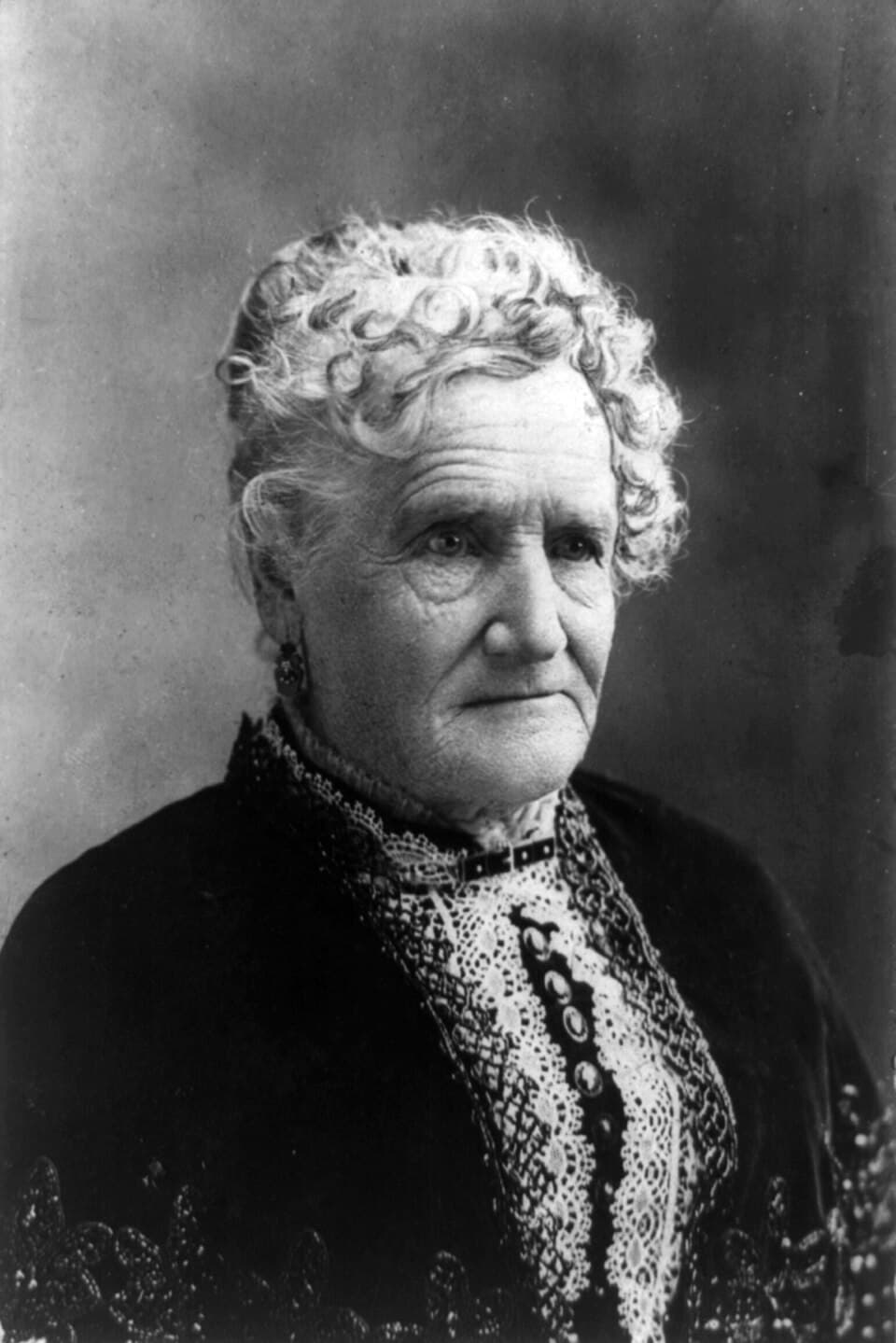
American · Politics · Activism · Law
Esther Hobart Morris
August 8, 1814 – April 2, 1902
Early life and background
Esther Hobart Morris was born Esther Hobart McQuigg on August 8, 1814, in Spencer, New York, in Tioga County. She came of age in a rural environment where women’s legal and economic options were narrow and heavily shaped by family circumstance. Later historical accounts describe her as orphaned at a young age and apprenticed to a seamstress, a path that pushed her early into paid labor and self-reliance. Those formative experiences would remain important to her later public life, since she was repeatedly depicted by contemporaries and later historians as practical, independent, and unwilling to defer automatically to male authority.
As a young woman, Morris worked as a milliner and businesswoman. That detail matters because it shows that she was not only a symbolic reformer but also someone with direct experience in trade and household economics. In the first half of the nineteenth century, women who ran businesses still did so under legal and social constraints that often limited their ability to control earnings or property. Morris’s later sensitivity to women’s legal disabilities was shaped by that world. Sources also note that she was active in anti-slavery circles, suggesting that her reform interests developed before her move west and before she became famous for suffrage. Her early life thus combined labor, family disruption, and reform-mindedness in ways that prepared her for the public role she would later play.
Marriage, widowhood, and move west
Morris married Artemus Slack and had at least one son. After Slack’s death in 1845, she moved with her child to Peru, Illinois, to settle the estate. That experience proved consequential, because it confronted her directly with the legal vulnerabilities of widows and married women. In nineteenth-century America, property law often placed women at a disadvantage, especially after marriage or widowhood. Morris’s later advocacy for women’s property rights was rooted in these lived realities, not abstract theory.
She later remarried John Morris, a prosperous merchant, and eventually moved farther west. By 1869, she and her family were in Wyoming Territory, where the rapid growth of a mining society and the relative openness of frontier politics created unusual opportunities for reform. Wyoming is central to Morris’s historical significance because it became the first territory to grant women the vote and one of the earliest places in the world to recognize women’s political equality in law. Morris did not act alone, and modern historians are careful not to overstate any single individual’s authorship of Wyoming suffrage. Still, she became the person most strongly associated with the movement in public memory.
Wyoming suffrage and public reform
The first territorial legislative session in Wyoming in 1869 passed a women’s suffrage bill that Governor John A. Campbell signed into law. The same reform climate also produced measures affecting married women’s property rights and equal pay for women teachers. Contemporary and later accounts credit Morris with helping build support for these changes, including by hosting a tea party for electors and candidates to encourage favorable discussion of women’s rights. Whether or not she was the sole architect of the legislation, she was unquestionably one of its most visible advocates and later its best-known symbol.
Her significance should be understood in the context of national suffrage strategy. During the late nineteenth century, reformers were searching for examples that might prove women’s political participation would not disrupt public life. Wyoming Territory provided exactly that kind of example, and Morris’s prominence made the experiment vivid to the broader public. For suffragists, the fact that a woman could be associated with successful governance in a rough frontier environment weakened arguments that women were too fragile, too dependent, or too socially constrained for citizenship.
Justice of the peace in South Pass City
On February 14, 1870, Morris was appointed justice of the peace in South Pass City, Wyoming Territory. She became the first woman in the United States to hold judicial office, a distinction often described as the first female justice of the peace or first woman judge. In the context of a mining town, the office required more than symbolic stature. Morris handled local disputes with speed and firmness, and contemporary accounts describe her as effective and respected.
Her tenure lasted about eight and a half months in 1870. Later summaries report that she handled dozens of cases and that her decisions were not reversed, a striking outcome in an era when women’s competence in public office was frequently doubted. The fact that she served at all was itself a profound challenge to nineteenth-century norms. Women were still excluded from most professions, and the legal profession in particular remained overwhelmingly male. Morris’s appointment therefore represented both a local practical solution and a national precedent. It demonstrated that women could preside over legal matters, exercise judgment, and command public authority in a formal state-recognized role.
Her service was also remarkable because it occurred in a frontier environment where formal institutions were still developing. In such places, a justice of the peace often functioned as a crucial civic officer. Morris’s appointment showed that women could be entrusted with the maintenance of order, not merely with reform rhetoric. That made her a durable icon for historians of women in law and public administration.
Later public life and recognition
After her short judicial tenure, Morris continued to be involved in political and legal affairs. She left her husband and moved to Laramie in 1871. In 1873, she was briefly on the ballot for state representative in Wyoming, underscoring that her role in public life did not end with her judicial appointment. She remained a visible figure in the story of Wyoming women’s rights as the territory moved toward statehood.
In 1890, during Wyoming’s statehood celebrations, Morris was honored for her suffrage activities. That same year, Wyoming entered the Union as a state while retaining women’s suffrage in its constitution, making it the first state to do so. Morris’s reputation therefore survived the territorial period and was incorporated into the state’s self-image. By the mid-1890s, she was being publicly celebrated as an elder stateswoman of the suffrage movement. In 1895, at about age 80, she was elected a delegate to the national suffrage convention in Cleveland, a sign that her historical importance was recognized not only in Wyoming but in the national movement as well.
Legacy, memorialization, and historical interpretation
Morris’s legacy rests on several overlapping achievements. She is remembered as the first woman to hold judicial office in the United States, as a symbolic beneficiary of Wyoming’s early suffrage laws, and as a person whose name became attached to the broader success of women’s rights on the frontier. Historians have also noted that later memory sometimes simplified her role, crediting her with more direct authorship of suffrage legislation than the documentary record can fully support. Even so, the historical core remains clear: she was one of the most visible early women officeholders in American history.
Her commemoration in statuary further fixed her place in public memory. A life-size statue of Morris stands in front of the Wyoming State Capitol in Cheyenne, and a copy was installed in the National Statuary Hall collection in the U.S. Capitol after she was chosen to represent Wyoming there. Such honors indicate that her image was used to symbolize both the state’s identity and the national significance of women’s enfranchisement. Morris’s story continues to appear in scholarship, museum interpretation, educational media, and public history because it captures a pivotal transition: the move from women as legally dependent subjects to women as recognized civic actors.
Personal life and death
Morris’s personal life included widowhood, remarriage, motherhood, and repeated relocation across the growing United States. Those experiences were typical of many nineteenth-century women, but in her case they became politically meaningful because they exposed the legal inequities that suffragists later challenged. Her family life is therefore not separate from her public role; it helped shape the political insights that made her such a potent symbol.
She died in Cheyenne, Wyoming, on April 2, 1902. By then, she had become a lasting emblem of women’s rights in the American West. Her life bridged the era before organized female suffrage was nationally visible and the period when women’s political claims were gaining durable ground. Though her actual time in office was brief, her place in the history of American law and activism was permanent. Morris remains significant because she embodied a turning point: the moment when a woman in the United States was not only allowed to vote, but entrusted to judge the conduct of others under the law.
Dated achievements
4 indexed.
- Aug081814Activism
Birth in Spencer, New York
Esther McQuigg (later Hobart Morris) was born in Spencer, New York, on August 8, 1814.
View details Esther Hobart Morris — WNCRI - Dec101869Politics
Wyoming Territory passes women's suffrage law
Wyoming Territory's legislature passed and Governor John A. Campbell signed the first law in U.S. history granting women full voting rights.