← All women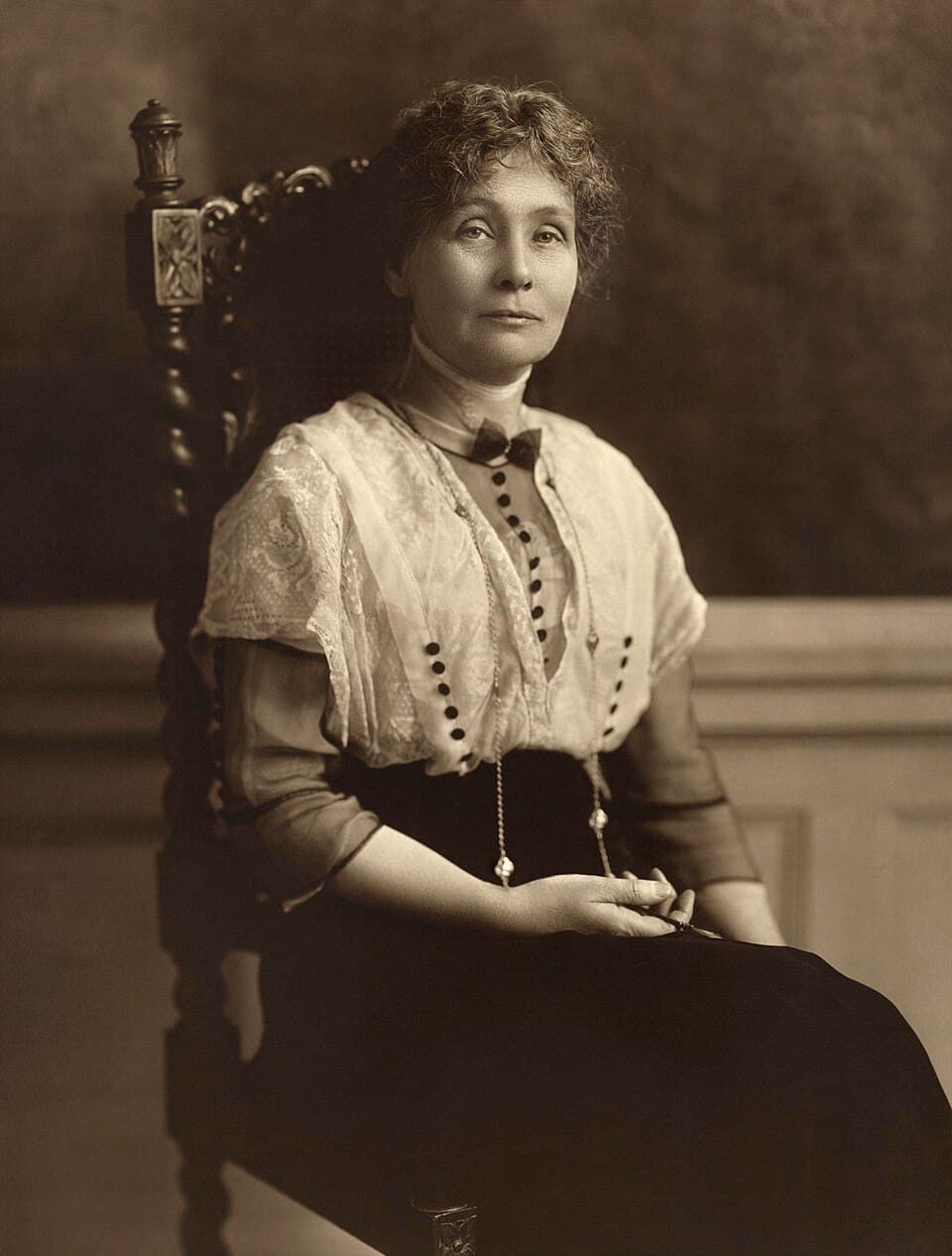
British · Activism · Politics · Law
Emmeline Pankhurst
July 14, 1858 – June 14, 1928
Early Life and Background
Emmeline Goulden Pankhurst was born in Manchester, England, in July 1858, most commonly given as 14 July, though some sources note a possible birth on the 15th.[2][5][6] She was the daughter of Robert Goulden, a manufacturer with radical political sympathies, and Sophia Crane Goulden, who had been involved in anti‑slavery activism.[2][3] The family belonged to the reform‑minded, nonconformist middle class and discussed issues such as parliamentary reform, abolitionism, and women’s rights at home.[2][10]
Emmeline was introduced to political ideas at a young age. One oft‑recounted formative experience was attending a women’s suffrage meeting with her mother in the early 1870s, which impressed upon her the injustice of women’s exclusion from the vote.[3][9] Although her parents supported many radical causes, they also accepted prevailing norms about women’s domestic roles. As a girl she was expected to help in the household and was not encouraged toward higher education, a limitation that sharpened her awareness of gender inequality.[2][10]
The Gouldens later moved to Manchester’s Moss Side, and Emmeline briefly attended École Normale, a finishing school in Paris, which exposed her to European ideas and broadened her cultural horizons.[1][2] Her early reading and conversations at home familiarised her with figures such as John Stuart Mill, whose arguments for women’s suffrage would shape the emerging movement.[2][10]
Marriage, Family, and Political Awakening
In 1879 Emmeline met Richard Marsden Pankhurst, a barrister and committed radical who supported causes including women’s suffrage, free education, and freedom of speech.[1][2] They married later that year, forming a partnership grounded in political activism as well as personal affection. Richard, already known for drafting a women’s suffrage bill and contributing to the Married Women’s Property Act, strongly encouraged Emmeline’s public involvement.[2][3]
The couple settled in Manchester and had five children: Christabel (born 1880), Estelle Sylvia (known as Sylvia, born 1882), Francis Henry (Frank, born 1884, who died in childhood), Adela (born 1885), and Henry (born 1889).[1][2] Their home became a gathering place for socialists, suffragists, and other reformers. Emmeline’s responsibilities as a mother ran alongside her growing political work, giving her direct experience of the constraints faced by women who lacked legal and political power.[2][10]
By around 1880, Pankhurst was actively involved in the women’s suffrage movement, working with groups that sought to secure voting rights through petitions, lobbying, and public meetings.[2][13] She and Richard joined the newly formed Independent Labour Party (ILP), seeing it as a vehicle for radical social change, including expanded rights for women.[2][13] Her participation in local politics exposed her to poverty, unemployment, and the harsh realities of industrial society, deepening her conviction that political representation was essential for reform.[2][10]
Early Activism and the Women’s Franchise League
Pankhurst’s first major organisational initiative came in 1889, when she helped found the Women’s Franchise League.[2][3] This group campaigned not only for women’s votes but also for equal rights in divorce and property matters, reflecting Emmeline’s belief that political enfranchisement must be linked to broader social and legal equality.[2][3] The League supported extending the municipal vote to married women, an incremental but important step in challenging the idea that wives were legally subsumed under their husbands.
In 1894, Pankhurst was elected as a Poor Law guardian for the Chorlton Board of Guardians, giving her direct responsibility for oversight of workhouses and relief for the destitute.[2] The experience shocked her: she witnessed overcrowding, harsh discipline, and inadequate care for poor women and children. These encounters reinforced her view that charitable efforts alone could not remedy structural injustice; women needed political power to change laws and institutions.[2][10]
Emmeline’s work with the Women’s Franchise League and the Poor Law guardianship honed organisational skills she would later deploy on a national scale. She became an experienced public speaker and committee member, adept at mobilising supporters and confronting hostile authorities. At the same time, she grew increasingly frustrated with what she saw as the slow pace and narrow ambitions of constitutional suffrage campaigns.[2][3]
Founding the Women’s Social and Political Union
By the early 1900s, Pankhurst had concluded that conventional lobbying and petitioning were insufficient. When her local ILP branch refused to admit women as full members, she decided to create a new organisation devoted entirely to women’s suffrage.[13] On 10 October 1903, at her home in Manchester, she founded the Women’s Social and Political Union (WSPU).[1][2] The WSPU’s declared aim was simple but radical: to secure women’s parliamentary vote by whatever means proved necessary.
Under Emmeline’s leadership, the WSPU adopted the motto "deeds, not words" and placed emphasis on direct, confrontational tactics. Initially, this meant organised heckling of political meetings, petitions, and tightly coordinated demonstrations. Pankhurst and her daughters, especially Christabel, quickly became the organisation’s driving forces, with Emmeline serving as figurehead and chief strategist.[1][9][11]
In 1905, the WSPU’s militant phase crystallised when Christabel Pankhurst and textile worker Annie Kenney interrupted a Liberal Party meeting to demand that ministers state their position on votes for women.[3] Their arrest and imprisonment drew national attention and demonstrated the Union’s willingness to defy social norms and legal boundaries. Pankhurst supported these actions and increasingly argued that constitutional methods had failed.[1][2]
Militant Suffragette Campaigns
From 1906, after moving WSPU headquarters to London, Pankhurst orchestrated a sustained campaign in the capital, targeting Parliament and the government directly.[2] The suffragettes organised marches, deputations to ministers, and attempts to enter the House of Commons, often resulting in violent clashes with police. Emmeline herself was arrested multiple times, beginning a cycle of imprisonment and hunger strikes that would define suffragette militancy.[1][3][7]
In 1908, Pankhurst became a national figure through large‑scale demonstrations, including mass rallies in Hyde Park and other venues, which drew tens of thousands of supporters.[2][7] These events showcased her gifts as an orator: she spoke in uncompromising terms about the injustice of women’s exclusion and framed the struggle as one for basic human rights rather than mere political reform. The press simultaneously vilified and sensationalised the suffragettes, ensuring constant coverage.
As the Liberal government continued to delay suffrage legislation, WSPU tactics escalated. Windows were smashed, letter boxes burned, and symbolic acts of arson carried out against empty buildings associated with the government. Pankhurst defended these tactics as necessary to break through official indifference, though she also sought to maintain central control and set limits on the extent of violence.[1][2][7] Her insistence on discipline and loyalty contributed to internal tensions, particularly with her daughter Sylvia, who favoured socialist organising among working‑class women and opposed the WSPU’s increasing centralisation.[1][2]
A critical episode in this militant phase was the confrontation known as "Black Friday" in 1910, when suffragettes protesting the shelving of a suffrage bill were met with heavy police violence outside Parliament.[2] Pankhurst was present, and the brutality convinced her that the government would only respond to intense pressure. Over the next years she continued to authorise militant actions, even as the toll on activists’ health grew due to repeated imprisonment and force‑feeding.[1][2][7]
International Influence and the 1913 American Tour
Pankhurst’s fame spread beyond Britain, and by the early 1910s she was widely recognised as the world’s most prominent suffrage campaigner. In 1913 she embarked on a major lecture tour in the United States, designed both to raise funds for the WSPU and to influence American suffrage strategy.[5][6]
On 13 September 1913, she arrived in New York City, greeted by intense media interest and controversy.[5] Newspapers debated whether to bar her from entry because of her arrests in Britain, and a New York Times article famously asked, "What will New York do with Mrs. Pankhurst?"[5] Her lectures attracted large audiences and generated discussion about the merits of militant tactics.
During this tour, on 13 November 1913 in Hartford, Connecticut, Pankhurst delivered her celebrated "Freedom or Death" speech.[4] In it she offered a powerful defence of suffragette militancy, arguing that women were engaged in a struggle comparable to historical revolutions and that they had the right to resist laws that denied their humanity. The speech remains one of the most important documents in feminist political rhetoric of the early twentieth century.[4]
Her American visits strengthened transatlantic networks, influencing some U.S. activists to experiment with more confrontational protests while also provoking debate over how far women’s movements should go in challenging the law.[5][6]
World War I and Strategic Shift
The outbreak of World War I in 1914 marked a turning point in Pankhurst’s career. As Britain entered the conflict, she and Christabel decided to suspend militant suffrage actions and support the war effort.[1][2][7][13] Pankhurst urged women to contribute to national defence, take up war work, and pressure men to enlist. She believed that demonstrating women’s patriotism and indispensability would strengthen their claim to citizenship.[2][7]
This stance created deep divisions within the movement. Sylvia Pankhurst opposed the war and focused on relief work among poor women in London’s East End, criticising her mother’s alignment with the government.[13] Emmeline, however, saw the war as a fight against militarist autocracy and felt that suffrage demands could not be pursued in the same way during national emergency.[2][7]
Throughout the war, Emmeline travelled, spoke, and organised initiatives to mobilise women workers, particularly in munitions factories and other industries newly opened to female labour.[7][10] Her efforts contributed to changing perceptions of women’s capabilities and helped create political pressure for post‑war reforms recognising their contributions.
Partial Enfranchisement: The Representation of the People Act 1918
In the war’s final years, support grew within Parliament for some extension of the franchise to women. Committees such as the Speaker’s Conference considered the issue, and Pankhurst participated in delegations urging reform.[13] On 6 February 1918, the Representation of the People Act 1918 received Royal Assent.[7] The Act granted the parliamentary vote to women over 30 who met property qualifications, while greatly expanding the male electorate by abolishing many restrictions.[2][7]
Although the new rights applied to only about 40 percent of women and excluded many younger and working‑class women, the Act represented a historic breakthrough: for the first time, British women were recognised as national voters. Pankhurst, who had campaigned for this outcome for nearly four decades, saw the reform as vindication of both militant and constitutional efforts, even while insisting that full equality remained the ultimate goal.[2][7][10]
After 1918, Emmeline continued political work. She stood as a parliamentary candidate in the newly enfranchised climate, though she did not win a seat.[2][8] Her experiences of party politics led her eventually to join the Conservative Party in 1926, a decision that surprised some former allies but reflected her belief that the Conservatives were best placed to safeguard and extend women’s gains.[2]
Personal Life and Later Years
Pankhurst’s personal relationships were deeply intertwined with her political activities. Her marriage to Richard Pankhurst ended with his death in 1898, an event that left her both emotionally bereft and financially strained.[2] As a widowed mother, she had to support her children while continuing activism, which intensified her awareness of the economic vulnerabilities faced by women.
Her relationships with her daughters, particularly Christabel and Sylvia, were complex. Emmeline and Christabel worked closely as leaders of the WSPU and shared a commitment to militant tactics and a centralized organisation.[1][2] By contrast, Sylvia’s socialism and focus on working‑class women brought her into conflict with her mother over strategy, class politics, and the extent of militancy. These tensions culminated in Sylvia’s effective exclusion from the WSPU and lasting estrangement from Emmeline.[1][2]
In her later years, Emmeline travelled extensively, including further trips to North America.[5][6] She published "My Own Story", an autobiographical account of her life and suffrage work, which helped shape public understanding of the movement.[1][2] Health problems, exacerbated by the physical toll of imprisonment and hunger strikes, increasingly limited her activity, but she remained a respected and sometimes controversial figure in British politics.
Full Enfranchisement: Equal Franchise Act 1928
The final legislative goal of the suffrage movement was full equality in the franchise: the same voting age for women and men and the removal of property requirements. Through the 1920s, campaigners continued to press for reform, building on the partial victory of 1918.[2][7]
On 2 July 1928, the Representation of the People (Equal Franchise) Act 1928 received Royal Assent.[2][5][7] The Act lowered the voting age for women from 30 to 21 and removed most remaining restrictions, thereby granting women equal electoral rights with men. This reform instantly added several million women to the British electorate and is widely regarded as the culmination of the suffrage struggle.[2]
Biographers and historians consistently link this achievement to Pankhurst’s decades of activism. Though she did not live to witness Royal Assent, she had long insisted that anything less than equal franchise would perpetuate women’s second‑class status. The 1928 Act thus stands as the legislative realisation of demands she had articulated since the nineteenth century.[2][7][10]
Death and Memorialisation
Emmeline Pankhurst died in London on 14 June 1928, aged 69, reportedly from septicaemia.[1][2][3][6][9] Her death came just weeks before the Equal Franchise Act became law, a timing that lent a poignant note to contemporary reflections on her life. Obituaries acknowledged both the controversy of her militant tactics and the central role she had played in advancing women’s rights.
In recognition of her contribution, a statue of Pankhurst was commissioned and placed in Victoria Tower Gardens, near the Houses of Parliament. The statue was formally unveiled on 14 March 1929
During her lifetime, Pankhurst received limited formal honours, reflecting both the establishment’s discomfort with militancy and the broader marginalisation of women in public recognition. However, her impact was acknowledged in various ways. She was widely profiled in newspapers and journals across Europe and North America, invited to address large audiences, and consulted by politicians seeking to understand or manage the suffrage issue.[5][6][10] Posthumously, Emmeline Pankhurst’s status as a key figure in British political history has been firmly established. She has been regularly featured in museum exhibitions, educational curricula, and media presentations about the suffrage movement.[3][7][9] Institutions such as the National Archives, the UK Parliament, and national museums present her as a central protagonist in the story of how British women won the vote.[7][9][13] Her name has also been given to streets, buildings, and organisations commemorating women’s activism. Biographies, scholarly studies, and popular accounts continue to reassess her tactics and their consequences, ensuring her enduring presence in debates over political protest and feminist strategy.[1][2][10][11] Emmeline Pankhurst’s legacy is multifaceted and contested, but her historical importance is undisputed. As founder and leader of the WSPU, she helped transform the British suffrage movement from a largely constitutional campaign into a mass, militant struggle that captured public attention and forced political leaders to confront women’s demands.[1][2][7] Her advocacy of direct action—ranging from public heckling to property damage and hunger strikes—challenged conventional boundaries of acceptable protest. Critics argued that militancy alienated supporters and delayed reform, while defenders contended that it was precisely the suffragettes’ disruptive tactics that made women’s disenfranchisement impossible to ignore.[1][2][10] Modern scholarship generally recognises that both constitutional and militant strategies contributed to eventual success, with Pankhurst’s leadership playing a crucial role in raising the political stakes.[2][7][10] Beyond suffrage itself, Pankhurst helped redefine women’s political identity. She insisted that women were not merely petitioners seeking favour but citizens demanding rights. Her speeches articulated a vision of women as agents of social change, entitled to participate fully in political life and capable of sacrifice equal to that of men. This framing has influenced later feminist movements, which draw on her insistence that gender equality requires structural transformation rather than minor concessions.[1][2][4] Her legacy is also visible in the transnational character of women’s activism. Through tours in North America and contacts with European campaigners, Pankhurst contributed to international networks of suffrage and feminist organising. Her visits to the United States influenced certain aspects of American suffrage tactics and highlighted the global nature of debates over women’s rights.[5][6] At the same time, historians have scrutinised the limitations of her approach, including the WSPU’s focus on middle‑class women, its sporadic alliances with conservative forces, and its sometimes dismissive stance toward working‑class concerns.[1][2][11] These critiques form part of a broader reassessment of early feminist movements and their relationship to class, empire, and race. Nevertheless, Emmeline Pankhurst remains one of the most recognisable figures in women’s history. Her name and image—especially in the iconic statue near Parliament—serve as symbols of the long struggle for women’s political rights. The enfranchisement of British women in 1918 and their attainment of equal franchise in 1928 are widely presented in public memory as milestones to which she significantly contributed, even if the reforms resulted from the combined efforts of many organisations and individuals.[2][7][9] Emmeline Pankhurst’s life illustrates the complexities of social movements and the individuals who lead them. She combined visionary commitment with organisational discipline, personal courage with sometimes authoritarian leadership. Her willingness to endure imprisonment and physical danger inspired many, while her strategic choices generated internal dissent and ongoing historical debate.[1][2][11] From her Manchester upbringing in a radical household to her final years witnessing the near‑completion of the suffrage programme she had championed, Pankhurst’s story encapsulates key dynamics of late nineteenth‑ and early twentieth‑century British politics: the rise of mass movements, the expansion of democracy, and the growing insistence that gender could no longer serve as a barrier to citizenship. Her biography remains essential reading for understanding not only the history of women’s rights but also the broader evolution of modern political protest.Awards, Honours, and Recognition
Legacy and Historical Impact
Assessment
Dated achievements
8 indexed.
- Jul141858Science
Birth of Emmeline Pankhurst
Emmeline Goulden was born in Manchester, England, on 14 July 1858, though some sources note ambiguity between the 14th and 15th.
View details Emmeline Pankhurst - Britannica - Oct101903Science
Founding of the Women's Social and Political Union
Pankhurst founded the WSPU in Manchester on 10 October 1903, launching the militant suffragette movement in Britain.