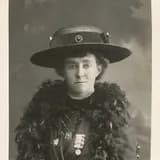
Thousands marched in Davison's London funeral procession on 13 June 1913, honouring her as the suffrage movement's first martyr.
On 13 June 1913, a large and carefully choreographed funeral procession moved through the streets of London for Emily Davison, organised by the Women's Social and Political Union. Thousands of suffragettes, dressed in the WSPU's purple, white, and green colours, marched behind her coffin, accompanied by bands, banners, and honour guards, in a deliberate act of public mourning and political theatre.
The procession was one of the largest public demonstrations the suffrage movement had staged, drawing enormous crowds of onlookers along the route from Victoria station to King's Cross, from where her coffin was taken by train to her family's home in Morpeth, Northumberland for burial. The scale and solemnity of the event marked Davison as the movement's first widely acknowledged martyr, a status deliberately cultivated by Emmeline Pankhurst and the WSPU leadership to galvanise public sympathy and reinforce the moral seriousness of the suffrage cause.
This was a genuine milestone: no previous suffrage campaigner's death had been marked with such a coordinated, nationally visible display of collective mourning and political messaging. The funeral cemented Davison's legacy in the public imagination and became a powerful symbol invoked by later generations of activists commemorating the sacrifices made in the struggle for women's votes.