← All women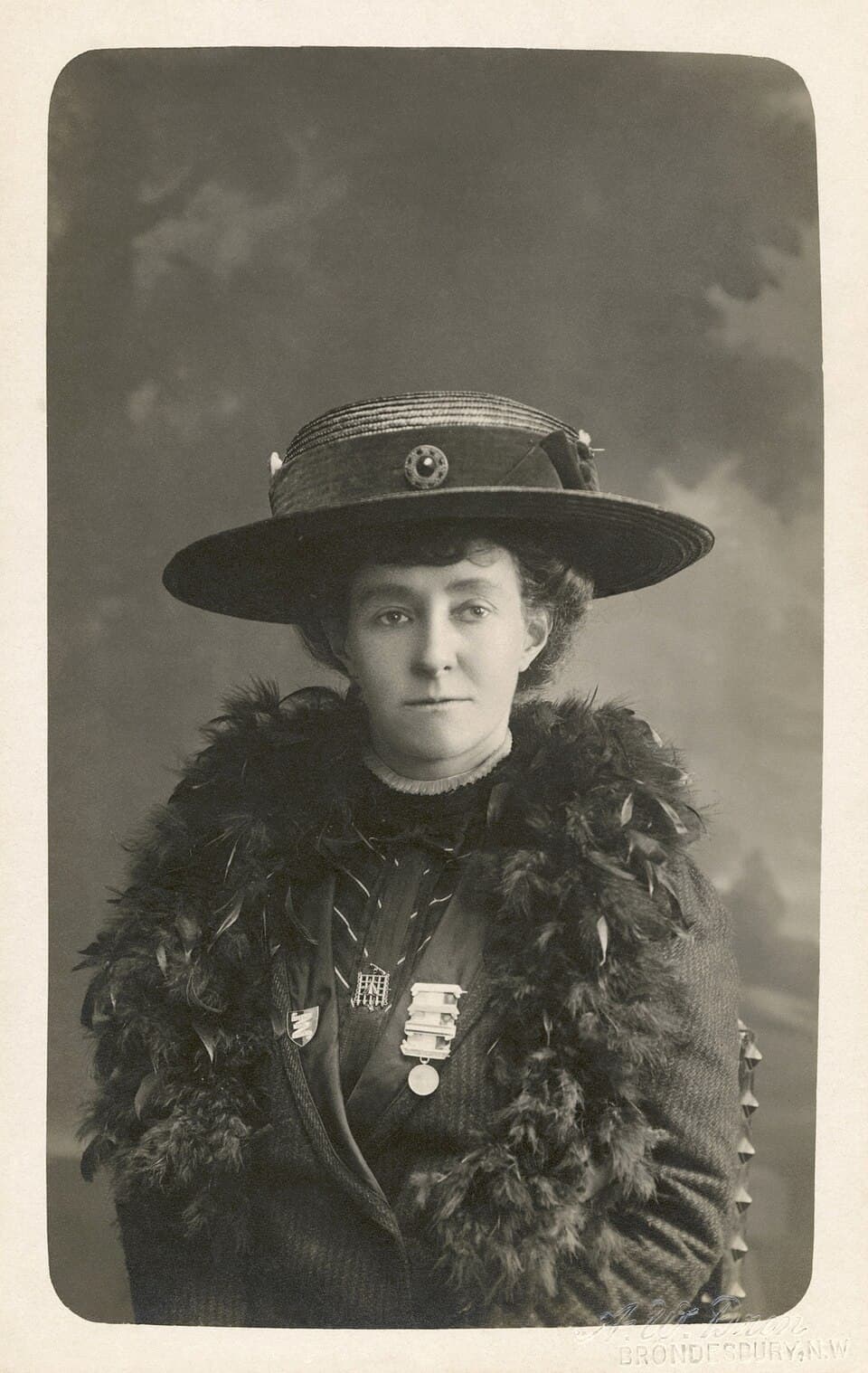
British, English · Activism · Politics
Emily Davison
October 11, 1872 – June 8, 1913
Early Life and Background
Emily Wilding Davison was born on 11 October 1872 at Roxburgh House in Greenwich, then part of Kent and now in Greater London.[1][2][3][13] Her parents were Charles Davison, a commercial traveller, and Margaret Davison (née Caisley). The family had recently moved south from Morpeth in Northumberland, and these dual connections—to London and to the North East—would be reflected later in how her life was commemorated.[13][15] She grew up in a comfortable middle‑class household, though the family’s finances declined after her father’s death when she was still young.[3][13][15]
Davison was educated first at local schools and then at Royal Holloway College, one of the few higher‑education institutions open to women in late Victorian Britain.[1][3] She later studied at St Hugh’s Hall, Oxford, reading English.[1][3][9] In 1895 she achieved first‑class honours in English, an exceptional academic performance.[9] However, women were not permitted to graduate or receive degrees from Oxford at that time, so her achievement was formally unrecognised, a grievance that deeply affected her and shaped her understanding of gender injustice.[1][3][9] The combination of intellectual success and institutional discrimination became a formative influence on her political radicalisation.
After leaving Oxford, Davison worked as a governess and teacher, earning her living in a profession considered respectable for women but offering limited prospects for advancement.[3][8][15] Her experience of economic insecurity following her father’s death, together with her awareness of professional and educational barriers, contributed to her growing conviction that incremental reform was insufficient and that more direct action was needed to challenge women’s exclusion from political power.[3][8]
Career Beginnings and Development as a Suffragette
By the early 1900s, the campaign for women’s suffrage in Britain was intensifying. Constitutional suffragists, organised in groups such as the National Union of Women’s Suffrage Societies (NUWSS), pursued lobbying and petitions, but a newer organisation, the Women’s Social and Political Union (WSPU), founded by Emmeline Pankhurst in 1903, advocated militant tactics under the slogan "deeds not words."[2][3][5] In 1906, Emily Davison joined the WSPU.[2][3][8][9] Although the exact date of her membership is not documented, this year marks the beginning of her full engagement with militant suffrage activism.
At the time she joined the WSPU, Davison was employed as a teacher, but she quickly became one of the organisation’s most committed members.[3][8] The WSPU’s readiness to break laws, disrupt political meetings and engage in civil disobedience resonated strongly with her belief that traditional methods had failed to secure women’s political rights. She took part in demonstrations and protests across the country, often travelling at her own expense.[3][8][15] In 1909, she left teaching to work effectively full‑time for the suffrage movement, a decision that entailed significant personal risk and financial sacrifice.[3][9][15]
Davison rapidly gained a reputation for her willingness to undertake high‑risk actions. She was first imprisoned in 1909, initiating a pattern of repeated arrests and short prison terms for offences including obstruction, stone‑throwing, and setting fire to pillar boxes.[3][5][9] Over the following years she was arrested on nine occasions, went on hunger strike seven times, and was force‑fed on forty‑nine occasions, according to later accounts.[2][5][6] These experiences hardened her resolve and pushed her toward ever more dramatic forms of protest.
Major Actions, Militant Protests and Imprisonments
Davison’s activism encompassed a spectrum of tactics, ranging from public demonstration to clandestine acts designed to embarrass the authorities. In 1909, she was sentenced to a month’s hard labour in Strangeways Prison, Manchester, for throwing stones at the carriage of Chancellor of the Exchequer David Lloyd George
During one of her terms in Strangeways, Davison barricaded herself in her cell to avoid forcible feeding. A warder, enraged by her resistance, reportedly turned a hose into the cell and nearly flooded it, placing her in grave danger.[3] The incident illustrated both her determination and the punitive lengths to which prison authorities would go. Davison later sued Strangeways’ wardens and was awarded 40 shillings in compensation, a rare legal victory for a suffragette prisoner.[3] Her protests grew more radical over time. She was involved in arson attacks on pillar boxes, intended to disrupt communications and symbolically "burn" the government’s refusal to recognise women’s political rights.[3][9][15] In 1912, she received a six‑month sentence in Holloway Prison for setting fire to a postal pillar box.[9] While incarcerated, she went on hunger strike and was force‑fed, enduring severe physical and psychological suffering.[3][9][15] One of her most famous non‑violent protests occurred on census night in 1911. Davison hid in a cupboard in the crypt of the House of Commons, so that when the census was taken her address would be recorded as "House of Commons," symbolically asserting women’s right to be present in the legislature that excluded them.[3][9] This act, later confirmed by census records, has often been cited as one of the most imaginative pieces of suffrage protest, cleverly exposing the contradiction between women’s political exclusion and their presence in the national household. By 1911–1912, Davison had become increasingly militant. Some contemporaries within the WSPU considered her methods too extreme, and she did not always act under direct orders from the leadership.[3][13] Nonetheless, she remained within the movement’s orbit and continued to conceive dramatic interventions designed to capture public attention. Davison’s most famous—and final—protest took place at the Epsom Derby on 4 June 1913, one of the premier events in the British sporting and social calendar.[2][3][4][9] The Derby was attended by royalty, aristocracy, and large crowds, and extensively covered by the press. Davison travelled to Epsom with suffragette flags, including one in the movement’s colours of purple, white and green.[3][9][13] Film footage and photographs show Davison stepping or running onto the track at Tattenham Corner as the horses rounded the bend.[3][4][9][13] She reached toward the bridle of Anmer, the King’s horse, and was struck at speed, thrown violently to the ground, and trampled.[3][9][13] The exact nature of her intended act remains contested. Some historians argue she sought to attach a suffragette banner to the royal horse to create a dramatic but non‑fatal symbolic gesture.[3][9][13] Others interpret the event as an act of self‑sacrifice, pointing to her previous willingness to risk injury and the WSPU’s rhetoric of martyrdom.[3][13] Whatever her precise intention, the result was catastrophic. Davison sustained severe head injuries and internal trauma and was taken to Epsom Cottage Hospital, where she never regained consciousness.[1][3][9][13] Newsreel footage of her collision, shown in cinemas, shocked audiences and was rapidly disseminated. Newspapers worldwide reported the incident, often with sensational headlines that emphasised the drama of a suffragette falling under the King’s horse.[1][3][9] The Derby protest crystallised the public debate over militant suffrage tactics. Supporters viewed Davison’s action as courageous and exemplary of women’s willingness to risk everything for political rights. Critics condemned it as reckless and proof that the WSPU had gone too far.[1][3][9][13] The episode became one of the most iconic scenes of the suffrage movement, frequently replayed in later documentaries and commemorative events. Despite medical efforts, Emily Davison never recovered from her injuries. On 8 June 1913, four days after the Derby, she died at Epsom Cottage Hospital at the age of 40.[1][2][3][9] The inquest recorded a verdict of "misadventure," and there was no criminal prosecution. Her death certificate and hospital records confirm the severity of the trauma she suffered.[1][3][13] Her passing prompted an immediate response from the Women’s Social and Political Union. Emmeline and Christabel Pankhurst and other leaders framed Davison as a martyr who had "died for women’s freedom," emphasising her years of sacrifice—multiple imprisonments, hunger strikes, and force‑feeding—as part of a narrative of heroic struggle.[2][3][9][13] WSPU publications and speeches following her death positioned her as the movement’s most visible symbol of martyrdom. Davison’s body was transported to London, and on 13 June 1913 the WSPU organised a spectacular funeral procession through the city, in which thousands of suffragettes and sympathisers marched behind her coffin.[13] Later, her remains were interred in St Mary’s Churchyard, Morpeth, Northumberland, where her grave bears the inscription "Deeds not words," echoing the WSPU motto.[13][15] Little is recorded about Davison’s romantic relationships, and there is no evidence that she married or had children.[2][3][5][15] Her life was largely organised around her work as a teacher, her studies, and her activism. Contemporaries and later biographers describe her as intensely committed, serious‑minded, and often solitary, though she formed close friendships with other suffragettes.[3][13][15] She wrote articles, letters and occasional pamphlets on suffrage issues, demonstrating a reflective, literate style shaped by her academic training.[3][8][15] Her religious views were influenced by Anglicanism and a broadly Christian ethical framework, which she interpreted as compatible with radical political action in defence of justice.[13][15] The absence of a conventional domestic life has often been highlighted in feminist histories as enabling her to devote herself wholly to the cause, while also illustrating the personal sacrifices demanded of some activists. During her lifetime, Davison did not receive official honours from the state; indeed, she was more frequently the target of legal punishment than recognition. Her "honours" were instead the internal esteem she held within the WSPU and among fellow suffragettes, who admired her courage and readiness to endure suffering.[3][13][15] Posthumously, however, she has been commemorated in multiple ways. In Morpeth, her grave became a site of remembrance for local and national feminists.[13][15] In London, the English Heritage blue plaque scheme later recognised the house in which she lived, marking her as a significant historical figure.[11] Schools, feminist organisations and museums frequently feature her in exhibitions and educational materials as an exemplar of suffragette militancy.[4][8][12] On 11 September 2018, a statue of Davison was unveiled in Morpeth, reflecting renewed interest in her life amid broader centenary commemorations of women’s suffrage.[9] This monument, along with other local memorials, demonstrates how she has moved from the margins of official history into the canon of publicly recognised figures whose actions changed British society. Emily Wilding Davison’s legacy has been shaped by both contemporary reactions and later historiography. Immediately after her death, the WSPU elevated her to the status of martyr, using her story to rally support and emphasise the moral seriousness of the suffrage campaign.[2][3][9][13] The dramatic nature of her Derby protest and the spectacle of her London funeral procession created powerful images that entered the public imagination. Over time, historians have debated the meaning of her actions. Earlier accounts often portrayed her as a tragic heroine and emphasised the narrative of willing self‑sacrifice. More recent scholarship, drawing on film analysis and archival materials, has questioned whether she intended to die or instead sought a dramatic but survivable protest, such as attaching a banner to the King’s horse.[3][9][13] This debate reflects wider concerns about how political movements construct martyrdom and how individual motives can be reinterpreted for collective ends. Regardless of her precise intention, Davison’s life illuminates key aspects of women’s history in Edwardian Britain: the structural exclusion of women from higher education and professional advancement; the evolution of militant political tactics; the use of hunger strikes and force‑feeding as tools of both protest and repression; and the ways in which gendered expectations shaped the reception of political violence and self‑harm.[1][2][3][9][13] Her repeated imprisonments and hunger strikes exemplify the bodily risks suffragettes accepted in their struggle. Davison also plays a central role in public education about the suffragette movement. Institutional resources such as BBC Bitesize, museum exhibits, and school curricula frequently highlight her story as a concise, vivid illustration of the campaign for votes for women.[4][8][10][12] In popular memory, she is often the first suffragette whose name children encounter, making her an entry point into broader discussions of feminism and democratic rights. Her life and death have influenced later feminist activism by providing a historical example of uncompromising protest. While contemporary movements usually reject physical self‑harm as a tactic, Davison’s readiness to push the boundaries of acceptable behaviour challenges later generations to consider the ethical dimensions of resistance and the costs of social change. Her story underscores how political rights now taken for granted were secured through both moderate and radical means. In the decades since her death, Emily Davison has appeared in films, television dramas, and documentaries about the suffragette movement. Newsreel footage of the 1913 Derby is regularly reused in visual histories of feminism, making the moment of her fall one of the most recognisable images of early twentieth‑century protest.[3][9][13] Writers and artists have drawn on her life to explore themes of martyrdom, gender, and political commitment. Public history projects, including museum displays and digital archives, have placed renewed emphasis on her intellectual life and regional connections, seeking to move beyond a purely martyrdom‑centred narrative.[4][8][15] Exhibitions at institutions such as the Museum of London and regional heritage organisations highlight her education, teaching work, and strategic thinking about protest, broadening the understanding of her contributions beyond the Derby incident alone.[4][15] Her memory is also sustained through local commemorations in Morpeth and London, including plaques, guided walks and educational events. The erection of her statue in 2018, along with continuing scholarship, suggests that her significance within women’s history is secure and likely to remain prominent as historians and activists revisit the suffragette movement’s complex legacy.[9][11][13] Emily Wilding Davison occupies a distinctive place in the history of women’s suffrage. She was neither a national leader nor a major strategist like the Pankhursts, yet her individual actions had an outsized symbolic impact. Her life illustrates how committed, often anonymous activists can shape historical narratives through dramatic gestures that capture the public imagination. Her trajectory—from exceptional student denied a degree, to teacher, to militant suffragette repeatedly imprisoned and ultimately fatally injured in protest—embodies the tensions of Edwardian Britain, where expanding opportunities for women coexisted with rigid political exclusion.[1][3][9][13] The injustices she experienced in education and employment helped propel her into radical activism, while her death exposed both the risks of militant tactics and the state’s harsh treatment of political dissent. Today, Davison is remembered as a courageous, if controversial, figure whose life prompts reflection on the nature of political sacrifice and the contested boundary between protest and self‑harm. Her story continues to serve as a powerful reminder that democratic rights have often been won through struggle, persistence and, in some cases, profound personal cost.The 1913 Epsom Derby Protest
Later Life and Death
Personal Life
Awards, Honours and Contemporary Recognition
Legacy and Historical Impact
Commemoration and Cultural Representations
Assessment
Dated achievements
6 indexed.
- Oct111872Science
Birth of Emily Wilding Davison
Emily Wilding Davison was born at Roxburgh House, Greenwich, England.
View details Emily Davison - BBC History - Jan011906Science
Joins the Women's Social and Political Union (WSPU)
Davison joined Emmeline Pankhurst's WSPU in 1906, beginning her militant suffrage career (exact day unverified).