← All women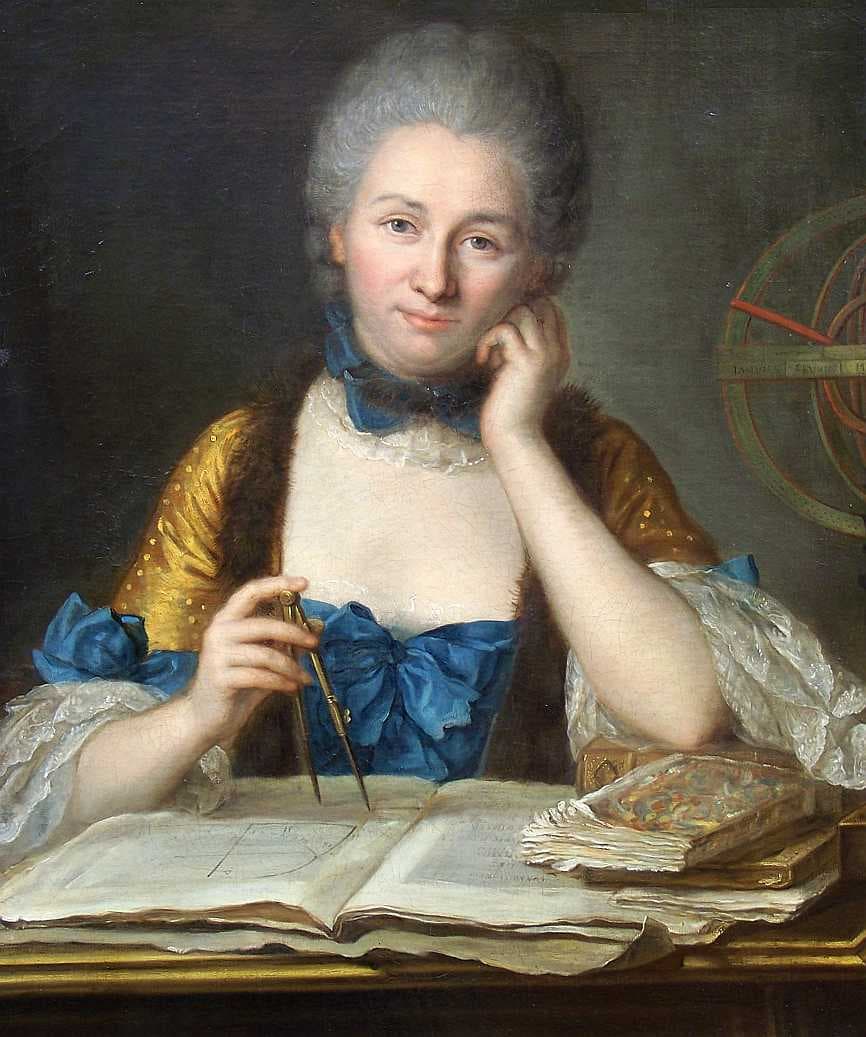
French · Science · Literature
Émilie du Châtelet
December 17, 1706 – September 10, 1749
Early Life and Background
Gabrielle Émilie Le Tonnelier de Breteuil, later known as the Marquise du Châtelet, was born on 17 December 1706 in Paris, in the Kingdom of France.[4][3][10] She was the daughter of Louis Nicolas le Tonnelier de Breteuil, Baron de Breteuil, an aristocrat who served as introducer of ambassadors at the court of Louis XIV, and Gabrielle Anne de Froullay, Baronne de Breteuil.[3][7][9] This position placed her family at the heart of diplomatic and courtly life and ensured access to cosmopolitan intellectual circles.
Born into this privileged environment, Émilie benefited from an education that was highly unusual for girls in early eighteenth‑century France. Contemporary accounts and later biographers note that her father encouraged her studies and allowed her to learn alongside boys, arranging tutors for subjects such as mathematics, physics, languages, and music.[10][13][9] She learned Latin and Italian, acquired facility in German, and read widely in literature and philosophy. The Stanford Encyclopedia of Philosophy emphasizes that by her adolescence she had already developed a strong appetite for mathematics and natural philosophy, aided by access to advanced texts and discussions with learned visitors.[3]
Despite this intellectual freedom, Émilie grew up in a society that limited women’s formal participation in scholarship. Universities and academies barred women, and learned careers were generally unavailable. Her early life thus combined exceptional education with structural constraints that would shape her later strategies: she cultivated salon culture, correspondence, and print as alternative avenues for scholarly work.
Marriage, Social Position, and Early Intellectual Development
In 1725, at around age eighteen or nineteen, Émilie married Florent‑Claude, Marquis du Châtelet‑Lomont, a nobleman with a military and administrative career.[3][4][15] The marriage gave her the title Marquise du Châtelet. The couple had at least three children together.[4][13] Her husband’s duties often kept him away from Paris, and after some years they agreed informally to lead largely separate lives, a not uncommon arrangement among high aristocracy.[13][15]
Émilie divided her time between Paris and the family estates, notably the château of Cirey‑sur‑Blaise in Champagne, which would later become a crucial site of scientific and philosophical work. Within aristocratic society she was known for her wit, love of theater, music, and dance, and for her skill in equitation.[9][14] These social accomplishments supported her participation in salons, where she encountered leading figures of the Enlightenment.
Her deeper intellectual formation continued through private study. She took mathematics lessons from Pierre‑Louis Moreau de Maupertuis, a prominent mathematician and physicist.[13][4] She also read works by René Descartes, Gottfried Wilhelm Leibniz, and Isaac Newton, absorbing the major currents in seventeenth‑century philosophy and science. These studies laid the foundation for her later original contributions to debates over motion, force, and the nature of physical laws.
Relationship with Voltaire and the Cirey Laboratory
Émilie du Châtelet is closely associated with the philosopher and writer Voltaire (François‑Marie Arouet).[4][3] Around the early 1730s, they began what would become a 15‑year partnership, both romantic and intellectual.[6][13] When Voltaire faced persecution for his writings, Émilie invited him to stay at Cirey‑sur‑Blaise, where they established a household oriented around study, writing, and experimentation.
At Cirey, Émilie organized space for scientific work, including a small laboratory and library. She and Voltaire conducted experiments on optics and fire, discussed mathematics and metaphysics, and critiqued each other’s drafts.[4][9] Voltaire’s Éléments de la philosophie de Newton—a major popularizing work on Newtonian physics—was deeply shaped by du Châtelet’s expertise; she corrected his mathematics and guided his understanding of Newton’s theories.[4][3][11] The Science Museum and UNESCO accounts describe her as essential to Voltaire’s Newtonian turn, emphasizing that he relied on her to grasp the technicalities of mechanics.[11]
In this period she also cultivated networks beyond Cirey, corresponding with scholars in France and abroad. Her role at Cirey illustrates how an aristocratic woman could carve out an alternative to university life: she turned a country estate into a semi‑private research center, using her social and financial resources to support advanced work in physics and philosophy.
Paris Academy Prize Essay on Fire (1738)
In the late 1730s, the Paris Academy of Sciences announced a prize competition on the nature of fire, a central question in contemporary physics and chemistry.[2][18] Both Émilie du Châtelet and Voltaire prepared essays for this competition. Although Voltaire’s paper was submitted under his own name, some sources suggest that Émilie’s scientific insight strongly influenced his work.[18]
Du Châtelet, however, wrote and submitted her own essay. The Academy did not award her the prize, but in 1738 her paper received an honorable mention and was published in the Academy’s volume of prize essays.[2] Historians treat this as the first time a woman’s scientific paper was published by the Paris Academy of Sciences, a major institutional breakthrough.[2][14] Given that the Academy barred women from membership and seldom printed women’s work, this publication signaled her recognition as a serious contributor to experimental and theoretical physics.
The essay addressed the properties of fire and heat, combining experimental reflections with theoretical analysis. While not revolutionary in itself, it demonstrated her ability to engage with cutting‑edge scientific debates under her own name and helped consolidate her reputation among the learned elite. It also highlighted the strategies open to women: competitions and print could provide pathways into scientific discourse even when institutional doors remained closed.
Institutions de Physique (1740, 1742)
Émilie du Châtelet’s magnum opus is the treatise Institutions de Physique, first published in Paris in 1740 and reissued in a second edition in 1742.[4][11] Initially conceived as a textbook to instruct her teenage son in natural philosophy, the work expanded into a comprehensive synthesis of contemporary physics and metaphysics.
In Institutions de Physique, she set out to explain the principles of Newtonian mechanics while critically examining the ideas of Descartes and Leibniz. She discussed space, time, matter, motion, and force, engaging especially with the controversy over vis viva (living force). Following Leibniz, she argued that the measure of force is proportional to the square of velocity, rather than simply to velocity, aligning herself with those who saw energy‑like quantities as fundamental.[4][3]
The treatise also included a sophisticated treatment of probability, drawing on the work of Jacob Bernoulli and Pierre Rémond de Montmort. She explored the philosophical significance of probabilistic reasoning for decision‑making and the evaluation of evidence.[3] This engagement with probability shows that her interests extended beyond mechanics to the epistemological foundations of science.
Contemporary and modern scholars emphasize that Institutions de Physique helped disseminate Newtonian ideas in France, where Cartesian physics still dominated.[4][11] The book reached readers across Europe, and the second edition in 1742 confirms its success and continuing influence.[4] By authoring a substantial, technically informed work of natural philosophy, du Châtelet moved beyond the stereotypical role of salon hostess to become a public intellectual shaping scientific education.
Translation and Commentary on Newton’s Principia
Du Châtelet’s most enduring scientific achievement is her French translation and commentary on Isaac Newton’s Philosophiæ naturalis principia mathematica (Principia). She worked intensively on this project in the 1740s, and completed the manuscript in 1749, shortly before her death.[4][11][9]
The translation was ambitious in scope. Newton’s original Latin text is mathematically and conceptually demanding; du Châtelet rendered it into elegant French while adding extensive annotations. Her commentary clarified proofs, corrected errors, and integrated developments in continental mathematics. She provided algebraic reformulations of Newtonian propositions, making the work more accessible to readers familiar with analytic methods.[9]
Of particular importance is her treatment of dynamics and conservation. In the commentary, she argued strongly for the conservation of quantities proportional to the square of velocity, anticipating later concepts of kinetic energy.[3][4] This placed her at the heart of eighteenth‑century debates about the nature of force and helped bridge Newtonian mechanics with Leibnizian metaphysical concerns.
The translation was published posthumously: an initial edition appeared in 1756, and a more complete, definitive version was released in 1759 under the auspices of the Academy and other editors.[4][9] Her version became the standard French edition of the Principia and remained authoritative for many decades. Through this work, generations of French scientists encountered Newton through du Châtelet’s interpretive lens, making her a crucial mediator of modern physics.
Other Writings and Intellectual Contributions
Beyond her prize essay and major Newtonian works, Émilie du Châtelet wrote in several genres. She composed essays on ethics and the nature of happiness, reflecting on the relationship between pleasure, virtue, and rational self‑interest.[4][3] She also drafted a treatise on the nature of light and engaged with controversies in optics, although some of these writings remain less well documented or unpublished.
Her interest in metaphysics and philosophy of language appears in discussions of causation, necessity, and the meaning of scientific concepts. The French‑language scholarship highlights her as a philosophe who interrogated the status of laws of nature and the interplay between mathematics and physical reality.[1][17] She contributed to debates on whether space and time are absolute or relational and how to understand the status of hypothetical entities invoked in physics.
Du Châtelet was also a translator and commentator of other works. She translated parts of Christian Wolff’s German writings and drew heavily on his systematic approach in Institutions de Physique.[3] Her translations and adaptations helped integrate German rationalist philosophy into French discourse.
Awards, Honors, and Recognition
Formal institutional honors for women in the eighteenth century were rare, and Émilie du Châtelet never became a member of the Academy of Sciences or other learned bodies. Nonetheless, her honorable mention in the Academy’s 1738 prize competition and the publication of her paper on fire constituted a significant form of recognition.[2]
Contemporaries such as Voltaire praised her extensively. Voltaire referred to her as "a great man whose only fault was being a woman," a phrase that has been widely quoted in modern biographies.[9][15] He acknowledged her as his intellectual equal in physics and mathematics, and dedicated works to her. Foreign scholars corresponded with her, treating her as a serious thinker.
Modern recognition has expanded substantially. UNESCO includes her in its "Women in Science" virtual museum, highlighting her role in the history of physics and the translation of Newton.[11] Scientific and historical organizations, including the American Physical Society and the St Andrews history of mathematics project, have published detailed profiles of her work.[10][9] She is frequently invoked in discussions of women’s exclusion from and contributions to early modern science.
Personal Life and Relationships
Émilie du Châtelet’s personal life was intertwined with her intellectual career. Her marriage to Florent‑Claude du Châtelet provided social status and financial resources, but the couple led largely separate lives after some years.[3][13] She managed her estates and used her wealth to fund her library, laboratory, and the renovations at Cirey that allowed for comfortable scholarly residence.
Her long‑term relationship with Voltaire was unconventional but important. They lived together at Cirey for extended periods, pursuing joint and separate projects. Their partnership challenged norms of gender and propriety, but within the aristocratic and literary world it became famous as a union of two brilliant minds.[4][6]
In the later 1740s, Émilie entered into a romantic relationship with the younger officer Jean François de Saint‑Lambert, while maintaining ties with Voltaire.[4] She became pregnant by Saint‑Lambert in 1749. Accounts emphasize that she continued her scholarly work while pregnant, driven by a strong sense of urgency about completing her Newton translation.[11][13]
She had several children by her husband, and family responsibilities coexisted with her scientific ambitions. Managing these roles required flexibility and the support of servants and relatives, illustrating how aristocratic resources could mitigate—but not erase—the constraints facing learned women.
Later Life and Death
In her early forties, du Châtelet remained intellectually active but increasingly aware of the risks associated with late pregnancy. In 1749, while staying at the court of Lunéville under Stanisław Leszczyński, former king of Poland and duke of Lorraine, she focused intensely on finishing her Principia translation.[4][11] She is reported to have worked long hours, revising and polishing the commentary.
She gave birth to a daughter in 1749 and, as multiple sources summarize, died from an infection or complications about six days after the birth.[13][4] Her death occurred on 10 September 1749 in Lunéville.[4][2][16] Voltaire, devastated, later wrote about her brilliance and the loss to science and philosophy.
After her death, friends and colleagues arranged for the Principia manuscript to be edited and published. The first edition in 1756 and definitive edition in 1759 ensured that her final work would reach readers, even though she did not live to see its impact.[4][9]
Legacy and Historical Impact
Émilie du Châtelet occupies a central place in the history of women in science and in the broader history of Enlightenment physics and philosophy. Her Institutions de Physique and her translation and commentary on Newton’s Principia were among the most advanced treatments of mechanics available in French in the mid‑eighteenth century.[4][11] They helped shift French intellectual culture from Cartesian to Newtonian frameworks and stimulated debates over force, energy, and the nature of laws.
As a woman, du Châtelet faced structural barriers: exclusion from universities and academies, skepticism about female intellectual capacity, and the pressures of marriage and motherhood. Her strategy was to use aristocratic resources—salons, private tutors, estates, and print—to carve out a space for scholarship. The 1738 Academy publication of her prize essay stands as an institutional milestone, marking the first scientific paper by a woman in the Academy’s publications.[2][14]
Her legacy also lies in the interpretive lens she provided for Newton. French‑speaking generations encountered Newton’s mechanics through her translation, commentary, and algebraic reformulations.[9][10] This mediation influenced how concepts such as force, inertia, and conservation were understood and taught.
In modern historiography, du Châtelet is increasingly recognized not merely as Voltaire’s companion but as a scientist and philosopher in her own right.[10][11][18] Scholarly studies in the Stanford Encyclopedia of Philosophy and specialized articles analyze her metaphysics, epistemology, and philosophy of science, showing that she developed original positions on the status of laws, the relation between mathematics and reality, and the grounding of probability.[3][18]
Public institutions have contributed to her remembrance. UNESCO includes her among notable women in science; science museums and historical blogs profile her as a trailblazer who "turned heads" at Versailles and in learned circles.[11] Academic and popular discussions of gender in science often cite her as an early example of a woman who achieved recognition despite institutional exclusion.
Overall, Émilie du Châtelet’s life illustrates both the limitations and possibilities of women’s scholarly work in the eighteenth century. Through determination, intellectual courage, and strategic use of social position, she produced works that remain part of the canonical history of physics and philosophy. Her story continues to inspire efforts to recover and acknowledge women’s contributions to science across eras.
Dated achievements
6 indexed.
- Dec171706Science
Birth in Paris
Born Gabrielle Émilie Le Tonnelier de Breteuil in Paris on 17 December 1706, into an aristocratic family at the heart of Louis XIV’s court.
View details Émilie du Châtelet – Biography - Jan011738Science
First scientific paper by a woman published by the Paris Academy of Sciences
Paris Academy of Sciences publishes du Châtelet’s prize essay on fire with honorable mention, the first scientific paper by a woman in its publications.