← All women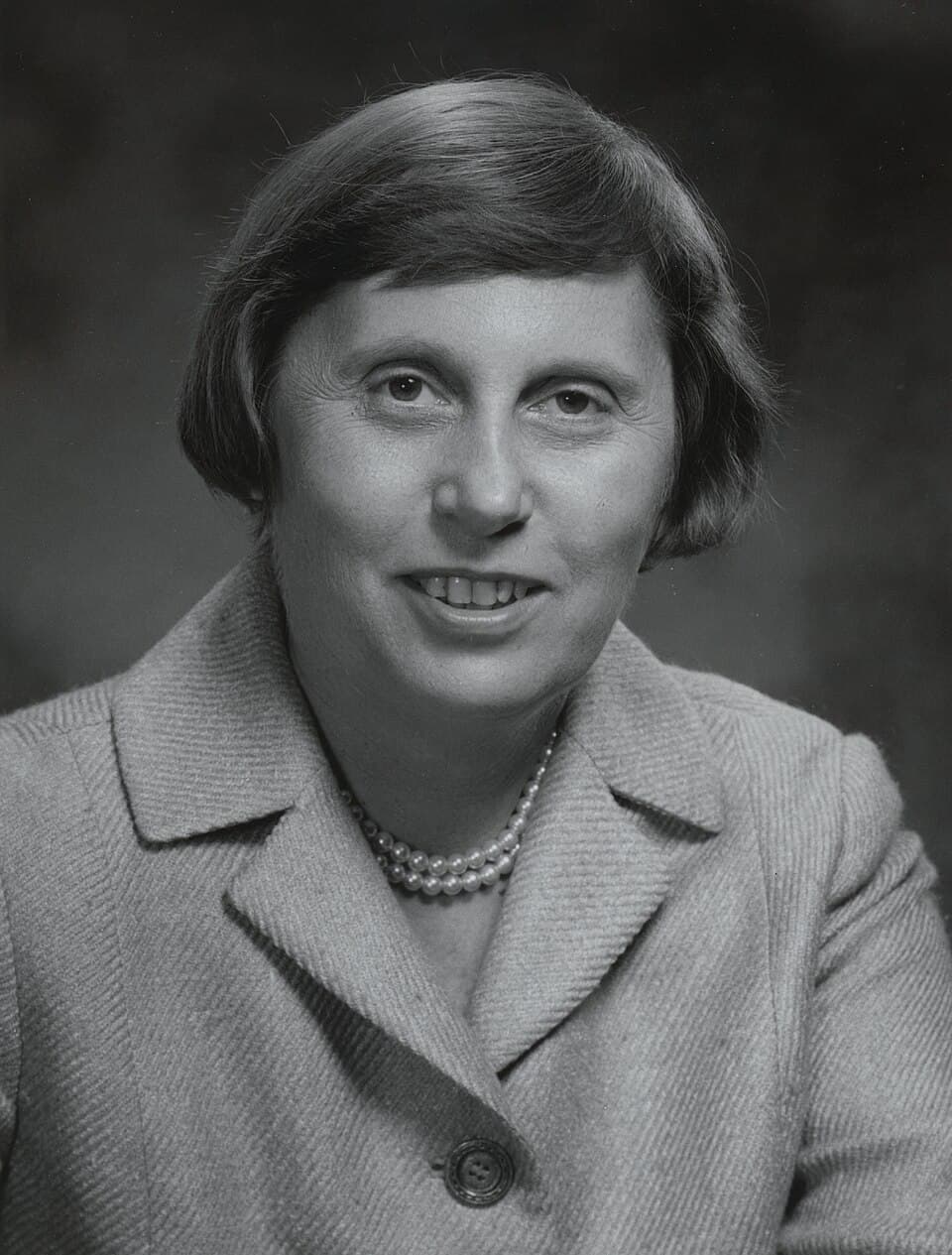
American · Politics
Ella T. Grasso
May 10, 1919 – February 5, 1981
Early Life and Background
Ella Rosa Giovianna Oliva Tambussi, later known as Ella T. Grasso, was born on May 10, 1919, in Windsor Locks, Connecticut.[7][8] She was the only child of Italian immigrants Giacomo (James) Tambussi, a mill worker, and Maria Olivia Tambussi, a homemaker.[3][7][13] Growing up in a small mill town, she was immersed in a working‑class environment shaped by the rhythms of factory labor and the aspirations of immigrant families seeking stability and respect in the United States.
Grasso attended St. Mary’s School in Windsor Locks and later the Chaffee School in Windsor, a girls’ preparatory school where her academic promise and leadership qualities were encouraged.[17] Her upbringing in a Catholic and ethnically Italian community instilled a strong sense of duty, frugality, and compassion for the disadvantaged—values that would later inform her public service. She grew up witnessing the vulnerability of workers to economic downturns and the importance of community solidarity, experiences that helped shape her political commitments.
In 1936, Grasso enrolled at Mount Holyoke College in South Hadley, Massachusetts, one of the leading women’s colleges in the United States.[1][2] She excelled academically, earning a B.A. in economics and sociology in 1940 and an M.A. in economics and sociology in 1942.[1][2] Her studies exposed her to social science methods and public policy analysis, reinforcing her interest in the structures that governed economic life and social welfare. Mount Holyoke’s environment, dedicated to women’s intellectual and civic development, provided an important foundation for her future political leadership.
Career Beginnings and Development
After graduate school, Grasso returned to Connecticut during World War II, serving as assistant director of research for the War Manpower Commission of Connecticut.[17] In this role she helped analyze labor needs and allocation, gaining practical experience in government operations and workforce policy. Her wartime work demonstrated her ability to handle technical administrative tasks and introduced her to state officials and political networks.
On June 8, 1942, she married Thomas (Tom) Grasso, forming a partnership that would endure throughout her political career.[8] The couple settled in Windsor Locks and later raised two children. While Tom Grasso largely stayed out of the spotlight, his support was widely credited with enabling Ella to pursue demanding public roles while maintaining a family life.[12]
Grasso’s sustained involvement in the Democratic Party began in the 1940s and 1950s. She worked on local campaigns and served on party committees, including becoming first woman chair of the Democratic State Platform Committee, a position she held from 1956 to 1968.[17] She also participated in national politics, serving on the Platform Drafting Committee for the 1960 Democratic National Convention and co‑chairing the Resolutions Committee at the 1964 and 1968 conventions.[17] These roles gave her experience in high‑level negotiation and policy framing, and increased her visibility within the party.
Her formal legislative career began with the 1952 election, when she won a seat in the Connecticut House of Representativesfirst woman to be elected floor leader of the Connecticut House, a position that required directing legislative strategy and managing party unity.[1][17] This role demonstrated her mastery of parliamentary procedure and her ability to command respect in a male‑dominated institution.
State Executive Leadership and Constitutional Reform
In 1958, Grasso sought statewide office and was elected Secretary of the State of Connecticut; she took office in 1959 and served until 1971, winning re‑election in 1962 and 1966.[1][12][17] As secretary of the state, she oversaw elections, corporate registrations, and archival records. She became known for her meticulous attention to detail and administrative competence.
During this period she played a significant role in shaping Connecticut’s 1960 state constitution. As one of the architects of the new document, she helped modernize the state’s governmental framework, addressing issues such as apportionment, executive powers, and judicial organization.[12] Her involvement in constitutional reform showed that women could influence foundational legal structures, a domain historically dominated by men.
Grasso’s work as secretary of the state was widely admired. She built a reputation as an honest, hardworking official who took pride in efficient administration. Her success in a technical, executive role made her a natural candidate for higher office and demonstrated that women could handle complex statewide responsibilities.
Service in the U.S. House of Representatives
On November 3, 1970, Grasso was elected to the U.S. House of Representatives from Connecticut’s 6th District.[12][17] She took office on January 3, 1971, joining a small group of women serving in the House.[8][18] She served two consecutive terms, from 1971 to 1975, choosing not to seek re‑election in 1974 so that she could run for governor.[17]
In Congress, Grasso focused on issues such as federal spending, social programs, and transportation. She developed a reputation for close attention to constituent needs, pragmatic liberalism, and willingness to work across the aisle. Her congressional experience broadened her understanding of federal‑state relations and gave her insight into national policy debates, particularly in the post‑Vietnam and post‑Watergate era.
Her time in the House was important for women’s history because it contributed to the gradual increase in female representation in national legislative bodies. Grasso demonstrated that a woman from a small, working‑class town could successfully participate in complex federal policymaking and earn respect from colleagues.
Gubernatorial Campaign and Historic Election
In 1974, Grasso decided to seek the governorship of Connecticut. On July 20, 1974, the Connecticut Democratic state convention unanimously nominated her for governor by acclamation, reflecting strong party unity behind her candidacy.[14] The decision to rally behind a woman candidate for the state’s top executive post was itself a notable milestone.
The general election took place amid national disillusionment following the Watergate scandal and impending resignation of President Richard Nixon. Voters were receptive to messages of honesty and reform. Grasso campaigned on themes of fiscal responsibility, compassionate social policy, and open government, drawing on her long record of public service.[13][15] She ran against Republican Congressman Robert Steele.
On November 5, 1974, Grasso won the gubernatorial election, becoming Governor of Connecticut.[8] In doing so, she became the first woman in the United States to be elected governor in her own right, not as the spouse or widow of a former governor, and the first woman governor of Connecticut.[12][16][18][19] Earlier women governors, such as Miriam “Ma” Ferguson of Texas and Nellie Tayloe Ross of Wyoming, had followed husbands in office; Grasso’s victory was based solely on her individual political career.
This breakthrough drew national attention. Media outlets highlighted her modest style, practical experience, and the significance of her election for the women’s movement, which was gaining strength in the 1970s.[13] Her success demonstrated that a woman could win a competitive statewide executive race on merit and programmatic appeal.
Governor of Connecticut: Policies and Crisis Leadership
Grasso was inaugurated as the 83rd governor of Connecticut on January 8, 1975.[2][8][9] Her governorship lasted until her resignation on December 31, 1980.[8][17] She framed her leadership as hands‑on and fiscally responsible, focusing on balancing budgets while maintaining essential services.
Among her notable initiatives was support for open government. In 1975 she signed the Connecticut Freedom of Information Act (FOIA), a landmark measure that expanded public access to state and local government records and meetings.[15] The FOIA established a presumption of transparency and has remained a cornerstone of accountability in Connecticut’s governance. Its adoption aligned the state with broader national trends toward openness in the wake of Watergate.
Grasso also emphasized prudent fiscal management, working to control spending and address deficits at a time of economic turbulence. She advocated for programs benefiting the elderly, working families, and vulnerable populations, striving to balance social concern with budgetary discipline.[13]
Her most celebrated moment of crisis leadership came during the Blizzard of 1978. In February 1978, a massive winter storm struck Connecticut and the broader New England region, paralyzing transportation and endangering lives. Grasso famously ordered the closure of highways and took a direct, visible role in coordinating emergency responses.[13][19] Her decisive actions were widely credited with preventing casualties and minimizing chaos. The episode significantly boosted her popularity and became a defining image of a capable woman governor in action.
Throughout her tenure, Grasso maintained a reputation for accessibility and plain speech. She often visited communities around the state, reinforcing her image as a governor closely attuned to ordinary citizens rather than elite political circles.
Awards, Honors, and National Recognition
Grasso’s achievements brought a range of honors. On May 25, 1975, her alma mater Mount Holyoke College awarded her an honorary Doctor of Laws degree, recognizing her public service and barrier‑breaking political career.[12] The honor symbolized the college’s pride in a graduate who had reached one of the highest offices in state government and embodied its mission of educating women for leadership.
Her national stature continued to grow through the late 1970s. She was often cited in media profiles as a model of honest, pragmatic governance. A Time magazine feature, “Connecticut’s Favorite Daughter: Ella T. Grasso 1919–1981,” emphasized her significance as the first woman governor elected in her own right and discussed her impact within the context of emerging feminism in politics.[13]
After her death, formal recognition of her legacy intensified. On June 9, 1981, President Ronald Reagan posthumously awarded Grasso the Presidential Medal of Freedom, the nation’s highest civilian honor.[8][12] The award acknowledged her trailblazing role in American politics and her distinguished service to Connecticut. It also reflected bipartisan respect, as a Republican president honored a Democratic governor.
In 1993, Grasso was inducted into the Connecticut Women’s Hall of Fame, placing her among the state’s most influential women in fields such as politics, science, and the arts.[12][16] This institutional recognition further cemented her status as a central figure in Connecticut’s history and in the national story of women’s political advancement.
Personal Life
Ella and Thomas Grasso married in 1942 and remained together until her death in 1981.[8] They had two children and maintained their family home in Windsor Locks, underscoring her identity as a local resident even as her responsibilities expanded to the state and national level.[12][17]
Accounts from colleagues and journalists depict Grasso as deeply attached to her family and community. Despite a demanding schedule, she tried to protect time for family life and frequently drew on domestic metaphors when speaking about budgeting and stewardship, framing public resources as something to be managed with the care of a household.[13] Her marriage is often described as supportive and stable, providing emotional grounding during intense political campaigns and legislative battles.
Grasso’s personal style was modest. She avoided ostentation, preferred straightforward communication, and cultivated an image of approachability. These traits contributed to her popularity and helped bridge the gap between political elites and ordinary citizens.
Later Life, Illness, and Death
In 1980 Grasso was diagnosed with ovarian cancer.[1][12] As her health deteriorated, she confronted the difficult decision of whether she could continue to serve effectively as governor. Ultimately, she concluded that the state required a fully functioning executive and chose to resign.
On December 31, 1980, Grasso resigned as governor of Connecticut, ending her term early.[8][12][17] Lieutenant Governor William A. O’Neill succeeded her. Grasso’s resignation was widely seen as an act of responsibility and integrity, consistent with her lifelong emphasis on duty.
On February 5, 1981, Ella T. Grasso died in Hartford, Connecticut, at the age of 61.[1][8][12][18] She had suffered complications from ovarian cancer, including heart failure and multiple organ failure.[18] Her death prompted extensive tributes. A New York Times profile titled “To Ella Grasso, Life Was a Challenge” reflected on her journey from mill town daughter to barrier‑breaking governor and emphasized her resilience and dedication.[11]
Grasso was buried in St. Mary Cemetery in Windsor Locks, returning to the town where her life had begun.[17] Her funeral drew public officials and ordinary citizens alike, many of whom remembered her as a governor who spoke plainly, worked hard, and embodied the possibility of women’s full participation in public leadership.
Legacy and Historical Impact
Ella T. Grasso’s legacy occupies a central place in the history of women’s political leadership in the United States. As the first woman elected governor in her own right, she demonstrated that women could win and hold high executive office on the basis of experience and competence rather than familial ties.[12][16][18] Her success helped erode long‑standing assumptions that the governorship was inherently male.
Within Connecticut, Grasso reshaped political expectations. Her leadership during the Blizzard of 1978 and her championing of open government left enduring marks on the state’s institutional and civic culture.[13][15][19] The Freedom of Information Act she signed remains a key tool for transparency, and her crisis management is still cited as exemplary.
Her career also had symbolic power for Italian Americans and other immigrant communities. As the daughter of mill workers from Italy, she showed that ethnic minority women could ascend to the highest levels of state government. This narrative has been important for understanding the diversification of American political elites in the 20th century.[7][13]
Grasso’s recognition—including the Presidential Medal of Freedom and her induction into the Connecticut Women’s Hall of Fame—ensures that her story continues to be taught in schools, commemorated in museums, and referenced in scholarship on women in politics.[8][12][16] She is often invoked as an example of how persistence, competence, and integrity can gradually overcome structural barriers.
In a broader sense, Grasso’s life highlights the connection between women’s higher education and political participation. Her trajectory from Mount Holyoke student to governor underscores the role of women’s colleges in cultivating leaders who would challenge gender norms and transform public life.[1][2][12]
Today, Ella T. Grasso is remembered not only for being “first” but for governing effectively once the barrier had been broken. Her combination of humility, pragmatism, and firm ethical standards continues to serve as a model for public officials, and her pioneering career remains a touchstone in the ongoing expansion of women’s roles in democratic governance.
Dated achievements
16 indexed.
- May101919Politics
Birth of Ella Rosa Giovianna Oliva Tambussi in Windsor Locks, Connecticut
Ella Rosa Giovianna Oliva Tambussi (later Ella Grasso) is born in Windsor Locks, Connecticut, to Italian immigrant parents.
View details Ella Grasso - Wikipedia - Jun081942Politics
Marriage of Ella Tambussi and Thomas Grasso
Ella Tambussi marries Thomas Grasso, beginning a lifelong partnership that supports her ascent in public office.