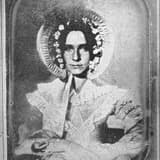
Draper's portrait became recognized as the earliest surviving photographic portrait of a woman and the first woman ever to sit for a photograph.
By 1840, the daguerreotype portrait of Dorothy Catherine Draper, taken by her brother John William Draper, had become recognized in contemporary scientific circles and later historical accounts as the first woman ever to sit for a photograph and the earliest surviving photographic portrait of a woman.
John William Draper himself described the image as the "earliest sunlight picture of a human face," emphasizing both the scientific achievement of capturing a legible human likeness and the significance of his sister's willingness to participate in an unproven and physically demanding experiment. At the time, photographic exposures required sitters to remain rigidly still for extended periods, often in direct, harsh sunlight, making the process uncomfortable and the outcome uncertain.
Historians and institutions such as the Bowery Boys history project and the University of Houston's Engines of Our Ingenuity have highlighted this portrait as a landmark in the history of photography precisely because it depicts a woman at a moment when photographic subjects were overwhelmingly experimental apparatus, landscapes, or male scientists themselves. Draper's portrait therefore holds a dual significance: as an early triumph of the daguerreotype process, and as the first documented instance of a woman being memorialized through photographic technology, opening the door to photography's eventual role in shaping visual representations of women in history.