← All women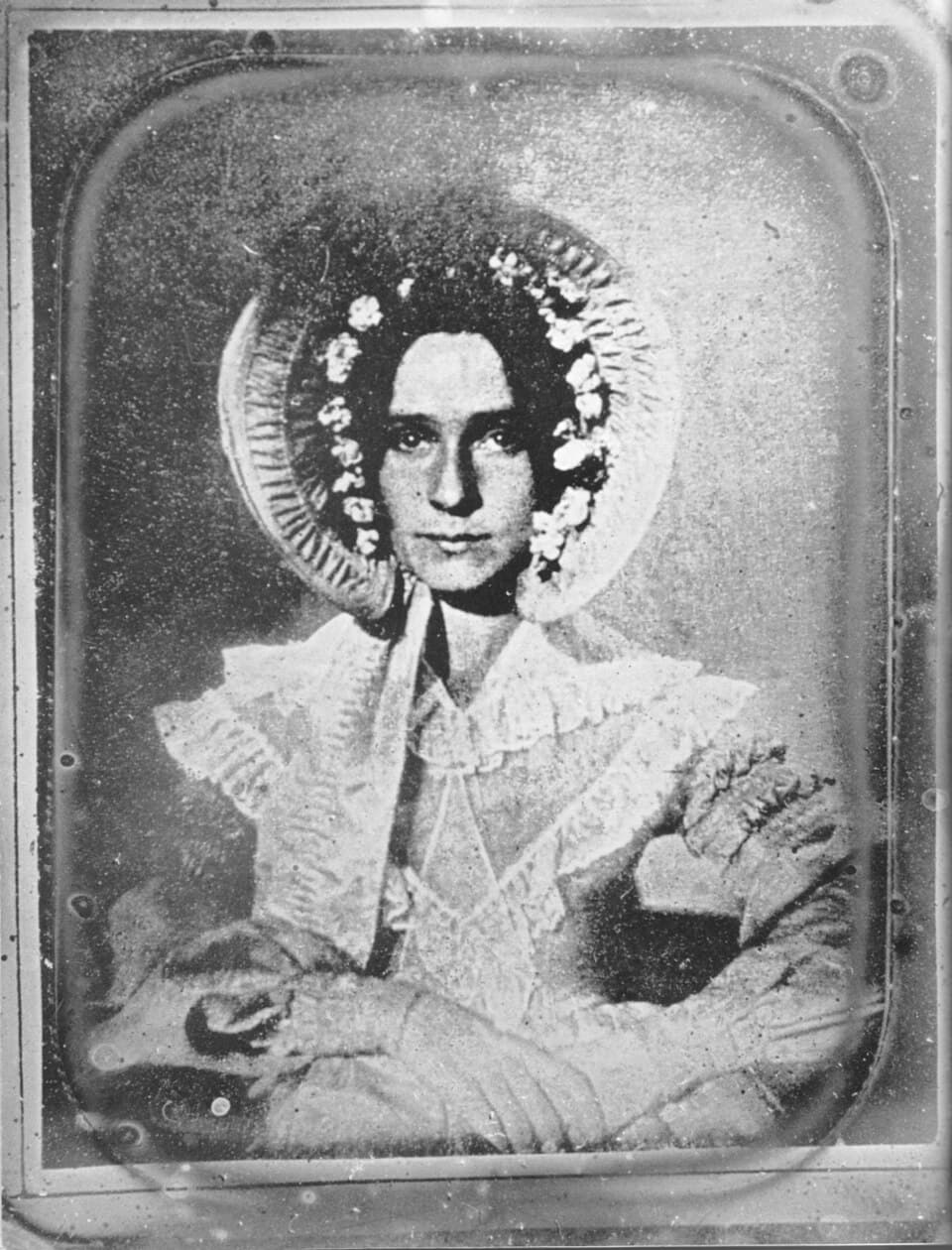
American, British · Science
Dorothy Catherine Draper
August 6, 1807 – December 10, 1901
Early Life and Background
Dorothy Catherine Draper (6 August 1807–10 December 1901) was an American artist, educator, and chemist best known today as the sitter for what is widely regarded as the earliest surviving photographic portrait made in the United States and the earliest surviving photographic portrait of a woman.[1][9] She was born in 1807, most likely in England, to the family of John Christopher Draper and Sarah (née Grubb), a family that would later play a major role in American scientific life.[1]
Dorothy was the elder sister of John William Draper (1811–1882), who became a prominent chemist, physician, and pioneer of photography, and of Henry Draper, known for his contributions to astronomical spectroscopy.[1] Biographical summaries describe Dorothy herself as an artist, educator, and chemist, indicating that she was unusually well educated for a woman of her era and engaged with scientific and artistic practice.[1] This educational background, combined with her proximity to her brother’s laboratory work, placed her in a unique position to participate in early photographic experiments.
While detailed records of her childhood are scarce, the Draper family’s intellectual orientation is clear from the later careers of her siblings. Growing up in such an environment, Dorothy likely encountered scientific discussions, experiments in chemistry and optics, and artistic culture, experiences that would later make her a trusted collaborator in her brother’s technical work. Her eventual move to the United States, and her presence in New York in the late 1830s, tied her life story to the burgeoning world of American higher education and research.
Education and Intellectual Milieu
Evidence from later accounts suggests that Dorothy attended classes at New York University (the University of the City of New York) around 1839, an unusual opportunity for a woman at that time.[5][7] A narrative associated with her famous portrait notes that she "attended NY University in 1839 (some say 1840)," and that she was remembered as her brother’s "life long assistant," implying both formal and informal participation in academic life.[5][3]
The University Building at Washington Square, completed in the 1830s, housed laboratories and studios where faculty members like John William Draper conducted research in chemistry and physics. Dorothy’s presence there—culminating in her rooftop portrait session—situated her literally and figuratively at the center of early American scientific innovation. Her education and intellectual engagement were not fully documented in contemporary publications, but the recurring description of her as an educator and chemist points to a woman who worked within scientific networks even without holding an official professorial title.[1]
Career Beginnings and Development
The surviving record focuses more on Dorothy Draper’s roles and activities than on formal job titles. She is described as an artist, suggesting skill in drawing or painting, and as an educator, indicating that she may have taught, possibly in association with her brother’s work or in other settings.[1] The label chemist attached to her in modern summaries reflects her involvement in laboratory practice and chemical processes, most notably in relation to early photographic experimentation.[1]
John William Draper, who immigrated to the United States and became a professor of chemistry and natural philosophy, used the rooftop of the New York University Building as an improvised photographic studio.[7][9] In this context, Dorothy’s career development is best understood as that of a scientific collaborator and experimental subject. She assisted her brother and agreed to sit for technically demanding exposures, at a time when the daguerreotype process was new, hazardous, and difficult to master.
Sources emphasizing her role as "life long assistant" note that her support contributed to her brother’s success and fame, often without corresponding recognition of her own contributions.[2][3] This pattern—women serving as essential collaborators in scientific work yet remaining largely invisible in formal credit—was typical of the nineteenth century. Dorothy’s life exemplifies this dynamic, making her an important figure in women’s history as well as in the history of photography.
Major Works, Discoveries, and Accomplishments
Dorothy Catherine Draper’s historically significant accomplishment centers on her role as the sitter for one of the earliest successful daguerreotype portraits in the United States and the first known portrait of a woman.
The 1839 Rooftop Daguerreotype
In 1839, within a year of Louis Jacques Mandé Daguerre’s announcement of the daguerreotype process in Paris, John William Draper undertook experiments in portrait photography in New York.[9] According to the Smithsonian Institution, the portrait of Dorothy was "originally taken by her brother Dr. John W. Draper in his Washington Square studio at the New York University in 1839 or 1840, within the first year" of Daguerre’s announcement.[9]
Tradition and later commentary situate the session on or near the roof of the University Building, chosen to provide intense sunlight necessary for the long exposure times of early daguerreotypes.[7][2] One popular description notes that Dorothy’s face was dusted with flour to reduce shininess and increase contrast on the sensitized metal plate, and that she sat motionless in direct sunlight for several minutes while the image was exposed.[14]
This daguerreotype is described by multiple sources as likely the first photographic portrait made in the United States.[5][9] It is also identified as one of the first clear daguerreotypes of a human face, demonstrating that the process could capture detailed facial features rather than blurred or indistinct forms.[5][7][10] Although experimental or undocumented portraits may have been made earlier, no surviving examples clearly predate Dorothy’s image, and major institutions treat her portrait as the earliest extant American photographic portrait.
First Woman Ever Photographed
By 1840, contemporary and later accounts recognized the portrait of Dorothy Catherine Draper as the first woman ever to sit for a photograph and the earliest surviving photographic portrait of a woman.[2][4][6] The Bowery Boys History project describes her as "the first woman to ever sit for a photograph—a daguerreotype, actually, in the year 1840, upon the rooftop of the school which would become New York University."[2] Other narratives echo this, naming the image "the first portrait photograph ever taken" and "the first photograph of a female face."[2][6]
The plate shows Dorothy in a poke bonnet, a characteristic 1830s fashion item. A widely shared commentary emphasizes that her portrait is "the only surviving contemporary photograph of someone wearing the 1830s poke bonnet, a pre-Victorian hat," highlighting its value as a document of dress history as well as technological innovation.[10] The photograph, therefore, serves as both a milestone in the history of photography and a rare visual record of women’s fashion on the cusp of the Victorian era.
Inscriptions associated with the daguerreotype state that Dorothy "was his life long assistant" and "was the first person to have her daguerreotype likeness taken in 1840 by her brother," reinforcing the claim that she was the first sitter for a successful daguerreotype portrait by John William Draper and the first woman photographed in the United States.[3]
Preservation and Alteration of the Plate
The original daguerreotype plate survived into the twentieth century but suffered from later restoration efforts. Accounts note that in 1933 a restoration attempt significantly altered the image, effectively removing most visible details of Dorothy’s face.[5] Despite this damage, the plate continued to be cited and displayed as the earliest known photographic portrait, with reproductions based on earlier copies or descriptions used to illustrate her likeness.
Today, one version of the portrait is held by the Spencer Museum of Art
Formal awards or honors given directly to Dorothy Catherine Draper during her lifetime are not well documented. The recognition she received was largely informal and retrospective, linked to renewed interest in the origins of photography. The Bowery Boys History narrative notes that "a renewed interest in the image in the 1890s brought the now elderly matron a bit of late-in-life recognition."[2] As photographic historians and enthusiasts looked back at early daguerreotypes, Dorothy’s portrait was rediscovered and celebrated as a landmark. This attention, coming decades after the original experiment, acknowledged her central role as sitter and collaborator in a foundational moment for photography. In modern times, museums, historians, and popular media continue to honor her legacy. The Smithsonian Institution describes her portrait as "believed to be the first photographic portrait made in the United States," thereby anchoring her in national technological history.[9] Research projects on Greenwich Village and New York University’s University Building frequently mention Dorothy as the first woman named in accounts of the building, due to her famous rooftop portrait session.[7] Public history initiatives and online communities have further amplified her story. Articles, podcasts, and social media posts now present her as "a largely forgotten figure in American history" whose image marks a turning point in the representation of women and the development of photography.[2][6][17] While these are not formal honors in the traditional sense, they constitute an ongoing cultural recognition of her significance. Detailed information about Dorothy Catherine Draper’s personal life—such as marriage, children, or daily activities—is limited in surviving sources. Genealogical records and memorial pages, including a Find A Grave entry, confirm her birth and death dates but do not provide extensive biographical narrative.[1] The emphasis in most accounts is on her role in her brother’s scientific work rather than on her private life. The inscription associated with her portrait, noting that she "was his life long assistant," suggests a close and enduring relationship with her brother John William Draper and prolonged involvement in his work.[3] This phrasing implies that she remained unmarried or prioritized familial and intellectual collaboration, though definitive conclusions about her marital status or children cannot be drawn from the available evidence. Later descriptions portray her in old age as a "matron" who witnessed the rise of photography from experimental novelty to everyday practice.[2] The renewed interest in her portrait in the 1890s indicates that she was still living and able to appreciate, at least indirectly, the historical importance of the image taken of her decades earlier. Dorothy Catherine Draper’s legacy lies largely in the intersection of women’s history, history of technology, and visual culture. As the sitter for the earliest surviving American photographic portrait, she occupies a unique place in the story of how photography emerged as a practical and cultural force. Her portrait challenges assumptions that early scientific and technological milestones were exclusively male domains. While her brother John received formal credit for the technical achievement of making a successful daguerreotype portrait, Dorothy’s willingness to participate in demanding experiments and to have her likeness used as a test subject was crucial to the success of his work. Recognizing her role foregrounds the often-overlooked contributions of women as collaborators, assistants, and subjects in the development of new technologies. The image of Dorothy in her poke bonnet has also become an important artifact in fashion and cultural history. It is frequently cited as the only surviving photograph of a woman wearing a 1830s poke bonnet, providing rare visual evidence of pre-Victorian female dress.[10] As such, the portrait serves as a visual time capsule, capturing not only the technical possibilities of early photography but also the aesthetics and social identities of the era. Moreover, her story illustrates the fragility of historical memory. For much of the twentieth century, Dorothy remained a "forgotten figure" in American history, even as her image was reproduced in textbooks and exhibitions.[2] Recent scholarship, blogs, and podcasts have worked to restore her name and context, emphasizing that the famous early daguerreotype was not simply a technical demonstration but a collaboration between a scientist and his sister, an educated woman engaged in art and chemistry.[2][7] Her legacy is further clarified by contrast with a later, unrelated figure: Dorothy Draper (1889–1969), the American interior decorator famous for founding one of the first formal interior design firms in the United States.[11][12][16] Confusion between the two Dorothys has sometimes obscured Dorothy Catherine Draper’s distinct historical role. Careful historical work now differentiates them, ensuring that Dorothy Catherine is remembered specifically for her place at the dawn of photography. In the decades following her rooftop portrait, Dorothy Catherine Draper lived through a period of rapid technological change. She witnessed photography evolve from experimental daguerreotype plates to more accessible processes, and the medium’s integration into science, art, and everyday life. While detailed accounts of her activities during these years are scarce, the mention of renewed interest in her portrait in the 1890s suggests that she saw her youthful image become an object of historical curiosity.[2] On 10 December 1901, Dorothy died at the age of ninety-four.[1] Her passing marked the end of a life that spanned from the era before photography to the threshold of the twentieth century, by which time photographs were ubiquitous in newspapers, family albums, and scientific publications. She was buried under the name Dorothy Catherine Draper, and her birth and death dates are confirmed in modern biographical and genealogical records.[1] After her death, the physical condition of the original daguerreotype deteriorated, and restoration attempts altered its appearance. Nonetheless, museums and historians continued to cite her image as the earliest known American photographic portrait, ensuring that her contribution remained part of the narrative of photography’s origins.[5][9] Today, Dorothy Catherine Draper is recognized not only as an early photographic subject but as an artist, educator, and chemist whose collaboration and presence at a pivotal technological moment merit a place in any almanac of women’s history. Her life story underscores how women’s faces, labor, and expertise have been embedded in scientific and artistic innovation, even when their names were long overlooked.Awards, Honors, and Recognition
Personal Life
Legacy and Historical Impact
Later Life and Death
Dated achievements
4 indexed.
- Aug061807Science
Birth of Dorothy Catherine Draper
Dorothy Catherine Draper was born on August 6, 1807, later to become the subject of the earliest surviving photographic portrait made in the United States.
View details Dorothy Catherine Draper - Wikipedia - Dec311839