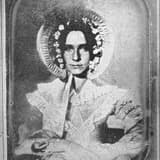
Dorothy Catherine Draper posed for a daguerreotype made by her brother John William Draper, believed to be the first photographic portrait taken in the U.S.
By late 1839, only months after Louis Daguerre's process was announced in France, Dorothy Catherine Draper sat for a daguerreotype portrait taken by her brother, John William Draper, a professor at New York University. The sitting took place on or near the rooftop of the University Building in Manhattan, where Draper had set up rudimentary photographic apparatus to experiment with the new technology under natural sunlight, since exposure times required for a clear image were still extremely long — often several minutes.
The Smithsonian Institution and other authoritative collections describe this daguerreotype as believed to be the first photographic portrait made in the United States and one of the earliest clear daguerreotypes of a human face anywhere in the world. Because sitters at the time had to remain motionless for long stretches, often with their eyes closed or faces powdered white to reflect enough light, the achievement was as much a feat of physical endurance and trust as it was of technical experimentation.
This sitting represents a foundational moment in the history of American photography, situating Dorothy Catherine Draper — an otherwise private woman — at the very origin point of a medium that would go on to transform visual culture, journalism, science, and personal memory across the modern world.